Showing posts with label William Roulette Farm. Show all posts

Thursday, March 14, 2024

Podcast: Irish historian Damian Shiels on famed Irish Brigade


In Episode 10 of "The Antietam And Beyond Podcast," Irish historian Damian Shiels joins co-hosts John Banks and Tom McMillan for a fascinating discussion about the famous Irish Brigade that fought on the William Roulette farm and at Bloody Lane during the Battle of Antietam. 

Learn more about Irish Brigade commander Thomas Meagher, common soldiers in the unit, the "procession of death" for the Irish in 1864 and much more. Plus, no podcast with an Irish Civil War historian can go without mentioning Major General Patrick Cleburne, the famous Confederate commander who died at the Battle of Franklin. 

Shiels, an historian and archaeologist, has lectured and published widely on both social military history and conflict archaeology. He established and runs the excellent Irish American Civil War web site and is author of The Irish In The American Civil War. Purchase your copy on Amazon.com. Shiels lives in Finland.

Friday, September 07, 2018

10 red-hot tips: An insider's guide to Antietam and beyond

Sunset image of the 124th Pennsylvania monument at Antietam.
(CLICK ON ALL IMAGES TO ENLARGE.)
Like this blog on Facebook

Here are 10 tips to maximize your Antietam battlefield visit from someone who has ventured to Sharpsburg, Md., 3,404 times ... and counting. He shall remain nameless. (Click on links for much deeper info.)

WALK THE GROUND AT THE CRACK OF DAWN -- Few battlefield experiences are better than Bloody Lane at sunrise. You may be the only one there. If so, that's even better. As you walk the lane where scores of Confederate dead once lay, listen to the crunch, crunch, crunch of gravel in the old roadbed, marvel at a lingering mist and then close your eyes and imagine the scene here on Sept. 17, 1862. Check out the seldom-visited William Roulette farm nearby and re-trace the route of the Irish Brigade over to Bloody Lane. For the more adventurous, walk the Final Attack Trail to the 16th Connecticut monument in the 40-Acre Cornfield. Wounded Nutmeggers lay there in no-man's land the night following the battle. Years later, one of those warriors wondered, "Why did I not die?" (Thinking I was alone here years ago near the 16th Connecticut monument, I looked over my shoulder to see a St. Bernard, apparently quite hungry. Thoughts of the movie Cujo danced evilly in my head. Thankfully, nearby was the massive mutt's master, who corralled the beast.)

Rub Thomas Meagher's schnoz for good luck.
RUB A UNION GENERAL'S NOSE -- Thomas Meagher -- the fiery Irishman who was one of the great characters of the Civil War -- is memorialized in bas-relief on the Irish Brigade monument next to the old War Department tower. Tap his schnoz for good luck and then ...

... CLIMB THE WAR DEPARTMENT TOWER ... for one of the greatest battlefield views of all time. You're in luck if no one else is there. Unbelievable vibe.

PICTURE THIS ... For best photography, sunrise and sunset are the "beauty" hours. At sunrise, my favorite shooting spots are in Bloody Lane and at Rodman Avenue, near the 40-Acre Cornfield. You also can't go wrong shooting the monument nearby for the 100th Pennsylvania -- the "Roundheads!" -- with the Joseph Sherrick farmhouse in the background. At sunset. park yourself on Cornfield or Mansfield avenues or at Hagerstown Pike for monument shooting. It can be spectacular. Aim for odd-angle images, and don't forget to try out the portrait function of your iPhone camera.

Here's how to contribute to the
Save Historic Antietam Foundation:
Donate | Mission | More
"ADOPT" A SOLDIER ... and walk in his footsteps. If you don't have an ancestor who fought at Antietam, pick a soldier from a regimental history on this page or try another source of information, research his background and then trace his route over the battlefield. NPS rangers in the Visitor's Center can aid your effort. Two years ago, I followed in the footsteps of  Samuel Gould, a 19-year-old private in the 13th Massachusetts, who was killed near the East Woods. “Samuel S. Gould stood within five feet of me when he was mortally wounded," Warren H. Freeman of Gould's Company A wrote to his father. "He had been in the company but four or five days. He was fresh from Harvard College, and I got quite well acquainted with him." Trust me: It will breathe life into your battlefield experience.

A sunrise image shot with my iPhone from Rodman Avenue.
16th Connecticut monument on the Final Attack Trail. Go see it. Trust me.
Let this image of the Susan Hoffman farmhouse be a substitute for a visit to the property, which is 
not open to the public. The farm, a Union hospital site, may be viewed from Keedysville Road.
Sunlight streams through the William Roulette barn, a makeshift hospital during and after the battle.
EMBRACE OFF-THE-BEATEN PATH SITES: Go where few battlefield tourists go. Walk the Tidball Trail, behind the Joshua Newcomer house, and enjoy an awesome view from the ridge. Visit the seldom-seen Mary Locher cabin and barn foundation -- fighting raged in this area on the morning of Sept. 17. When you get across busy Maryland Route 65, check out the 15th Massachusetts monument on the knoll on the other side of the road. Better yet, make the "Wounded Lion" monument your next stop. Best one on the field. Although it's not open to the public, the Susan Hoffman farm, site of a major Union hospital, can be viewed from Keedysville Road.  A beloved nurse named Helen Gilson sang The Star-Spangled Banner to scores of Union wounded there. "The effect on these wounded soldiers was almost inspiring," an admiring reporter who was there wrote about the singing scene. Go behind the John Otto house, on the hill astride Old Burnside Bridge Road, to view ruins of the farmer's Pennsylvania-style bank barn, used as a makeshift hospital during and after the battle. Perhaps sneak a peek inside the William Roulette barn, too. (Shhh! I didn't tell you.) It also was a hospital site.

The 15th Massachusetts monument -- featuring the "Wounded Lion" -- in the West Woods. It's my favorite.
CHAT UP A LOCAL -- You never know what great stories you may hear. Some families have been in the area for generations. Just as I was about to leave Sharpsburg five years ago, I was told this story about a Union soldier who served in a Maryland regiment. Private Barney Houser lived on Main Street, next to a church used as a makeshift hospital by the Union army, which "appropriated" items from his premises for use in care of wounded.

Ambrotype of Confederate officer Henry Kyd Douglas
 in the Boonsborough (Md.) Museum of History.
BEYOND THE BATTLEFIELD ... in Boonsboro, Md. The Boonsborough Museum of History at 113 N. Main Street is open at odd hours -- sometimes on Sundays and sometimes only by appointment. Few Civil War museums are in its league. Lifelong area resident Doug Bast has a spectacular collection, including some really weird items. (SEE THE MUMMIFIED HUMAN ARM WITH THE EMBEDDED BULLET!) My favorite museum piece is an ambrotype of Henry Kyd Douglas, who served under Stonewall Jackson.

AND IN SHEPHERDSTOWN ... there's another battlefield. The Maryland Campaign didn't end at Sharpsburg, Md. On Sept. 19-20, 1862, Union troops ventured across the Potomac, into what was then Virginia (now West Virginia), to keep pressure on Bobby Lee. Instead, the Yankees were whipped. The battlefield is mostly in private hands, but from River Road, you can view the craggy cliffs from which some frenzied 118th Pennsylvania soldiers leaped to their deaths as well as lime kiln ruins that date to the battle. Somewhere up on that bluff, an insider told me, a Union artillery shell remains embedded, in view but safely out of reach of prying hands. When you tire of Civil War battlefield tramping, grab a donut and coffee at the Shepherdstown Sweet Shoppe Bakery, housed in a 200-year-old building that was used as a Confederate hospital. Or head back over to Sharpsburg and stop at ...

... NUTTER'S ICE CREAM -- Yum. And cheap, too.

BONUS TIP: Oh, man, go visit South Mountain!

As always, enjoy the journey.

North Carolina soldiers were overwhelmed here at Fox's Gap at South Mountain on Sept. 14, 1862.

-- Have something to add (or correct) in this post? E-mail me here.

Wednesday, May 04, 2016

4 seldom-seen Antietam sites (Little Mac's battle view, too?)

Armed with an iPhone6 and fueled by desire,  I roamed the Antietam battlefield recently during my annual Civil War Power Tour with the aim to visit and document off-the-beaten path sites. (Actually, I made it up as I went along.) Here's what I found:
William Roulette's barn, where hundreds of wounded soldiers were treated.


SECOND IMAGE ABOVE: Click at upper right for interactive panorama of Roulette barn interior.
ABOVE: Roulette farmhouse seen through a knothole in the nearby barn.

INSIDE WILLIAM ROULETTE'S BARN-TURNED-HOSPITAL


In dozens of visits to the Roulette farm over the years, I have poked my head into the spring house where grievously wounded 14th Connecticut lieutenant George Crosby had surgery, inspected the fabulous, thick-walled ice house, peered through the old farmhouse windows and mulled the story of those dang bees. Until last weekend, I had never been inside the Roulette barn, which was used as a field hospital during and after the battle.

Save for the foundation and perhaps some of the flooring, much of the 1862 barn is long gone. Nevertheless, the experience was quite eerie after we slipped through a narrow opening into the large, open space. Birds fluttered through slits, and sunlight on the beautiful morning cast unusual shadows inside. Perhaps this early 20th-century account by a Pennsylvania veteran who witnessed what happened there more than 152 years ago explained my uneasiness:
The tables on the Roulette barn floor presented a scene of  the schambles. Piles of amputated legs and arms were in evidence, inviting even from stolid hearts, commiseration, pity, tears. In the stables below. and under temporary straw sheds along the adjacent fences and out buildings, were to be found hundreds of wounded and dying men.
Wounded in the East Woods, General Mansfield died at the George Line farm on Sept. 18, 1862.
Another view of  Line's farmhouse as well as the summer kitchen, which may date to the Civil War.
The sign on historic Smoketown Road near the George Line farm.
Joseph Mansfield

FARM WHERE GENERAL MANSFIELD DIED

The old, black-and-white metal sign along historic Smoketown Road -- the route XII Corps took to the battlefield -- points to the site where Union General Joseph Mansfield died. Wounded in the chest in the East Woods just after dawn, the 58-year-old officer from Middletown, Conn., was transported about a quarter-mile by soldiers using muskets to form a stretcher and then another quarter-mile by ambulance to George Line's farm.

The sign, however, is inaccurate: Mansfield died of his wounds on Sept. 18, 1862, a day after the battle. The loghouse in which the general expired was sold by Line to another man, dismantled, moved to another area location and "brickcased," according to an account in the 124th Pennsylvania regimental history, sometime in the 19th century. The current brick house, shown above, may be post-war, although the summer kitchen shown in the second photo may date to the Civil War. (Please note this is private property; do not trespass.)

Israel Richardson died in the second-floor room at upper right in the Philip Pry house.
ABOVE: President Lincoln visited the ailing Richardson here in early October 1862. 
BELOW: In the video, Jake Wynn of the National Museum of Civil War Medicine
 explains one of  the room's little secrets.

Israel Richardson

WHERE 'FIGHTING DICK' DIED

Leading an attack at Bloody Lane, Union General Israel Richardson was struck in the chest by a piece of artillery shell. Initially taken to another field hospital, the 46-year-old officer eventually was transported for treatment to the Pry House -- the same site where General Joseph Hooker, who was shot in the inner side of  his right foot during the I Corps' assault earlier that morning, was hospitalized.

After she received news of her husband's wounding, Fannie Richardson traveled from Michigan with her sister-in-law to the Pry house near Keedysville, Md., to help care for her husband, and President Lincoln himself visited the general there in early October. (Supposedly, Mrs. Pry cooked breakfast for the president, who left an appreciation note signed "A. Lincoln.")

Unfortunately, "Fighting Dick" suffered complications, and he died in the second-floor Pry room on Nov. 3, 1862. Keep in mind the room is really not all original. The inside of the Pry House was gutted by a fire of unknown origin in 1976, and the beautiful brick house was painstakingly restored by the National Park Service.

In the video above, Jake Wynn of the excellent National Museum of Civil War Medicine explains why Mrs. Pry hid candy in the room after the general's death.


SECOND IMAGE ABOVE: Click at upper right for interactive panoramic view from Pry house attic. 
ABOVE: Present-day view of Antietam battlefield from attic trapdoor is obscured by trees.

George McClellan
LITTLE MAC'S VIEW FROM PRY HOUSE?

Last Sunday, I had the rare opportunity to view the Antietam battlefield from the trapdoor in the attic of the Pry house -- perhaps the same view diminutive Army of the Potomac commander George McClellan had.  As the story goes, "Little Mac" is believed to have stood on a barrel for unobstructed views of fighting at Bloody Lane, the West Woods and more. I  haven't read any first-hand account that corroborates that story, so it could just be -- ahem -- a tall tale. The present-day view from atop the Pry House is impressive, although the battlefield is now obscured by trees. The trapdoor attic is inaccessible to the public.

Like this blog on Facebook.


Thursday, October 24, 2013

Antietam: A rare piece of history from Roulette farm?

Did Union surgeons operate on wounded soldiers on this table?
The interior of the Roulette farmhouse has
 changed little since 1862.
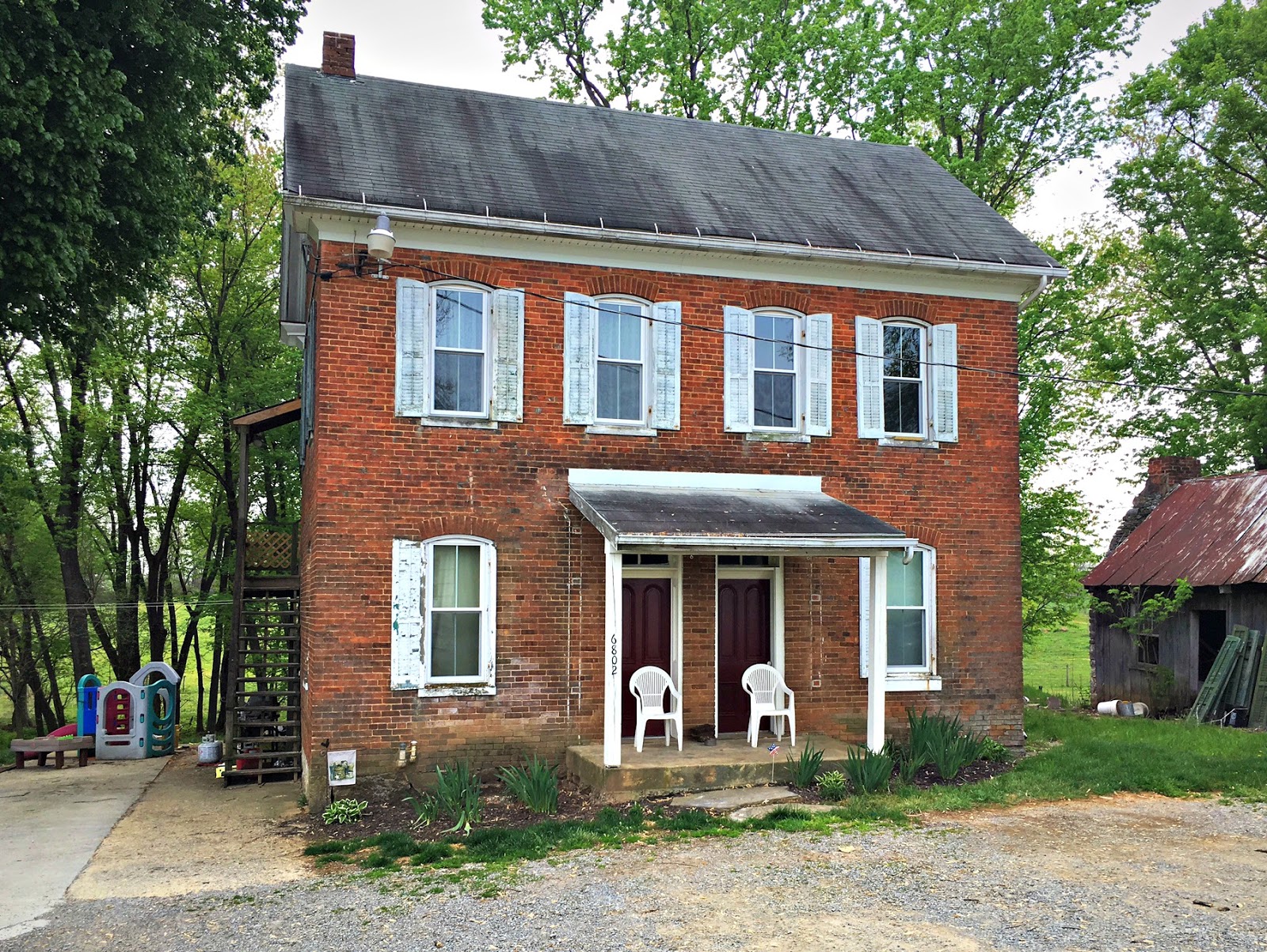
Friend of the blog Penny was kind enough to share a photo of the gate-leg table above that may have a tie to the Battle of Antietam. Penny is a descendant of William Roulette, the farmer whose fields were the scene of terrible fighting during the battle on Sept. 17, 1862. Roulette's barn, spring house and farmhouse were used as field hospitals during and after the battle. According to Penny's mother, who died in 1997, this table belonged to the Roulettes and was used for surgery at Antietam. Perhaps the table once was used in the Roulette room shown at right, photographed through a window during my visit to the battlefield in September. If only that table could talk, eh? Here's a terrific tour of the interior of the Roulette farmhouse over at Harry Smeltzer's fine Bull Runnings blog.

William Roulette's farmhouse today.

Saturday, May 18, 2013

Antietam panorama: Bloody Lane, William Roulette farm

Click on image for full-screen panorama.

Mortally wounded on the William Roulette farm, 
14th Connecticut Pvt. George Corbit is buried 
in Center Cemetery in Coventry. The Talcott brothers,
also mortally wounded on Roulette's farm, are buried nearby.
Shot recently at Bloody Lane at Antietam, this interactive panorama provides a ton of information, especially when viewed on a large screen. It's pretty stunning actually. (Thank you, iPhone, picmonkey.com and especially dermandar.com.)

Sunlight obscures detail to the far right, but the stone Observation Tower, probably the best place to take in the battlefield, juts out. In the middle is the farm lane leading to William Roulette's barn (in the far distance), which was used as a field hospital during and after the battle, and farm house. (The house, which retains its 1862 appearance, is not shown in this image, but you can check out my interactive panorama of it here.

All 16 of my interactive Antietam panoramas are here.) The 14th Connecticut monument peeks over the ridge to the left (white monument), marking the regiment's farthest advance during the battle.  In its first battle of the Civil War, the 14th Connecticut swept across Roulette's property, capturing Rebels in the farmer's house and spring house, where Lt. George Crosby later had surgery for a bullet wound. Roulette's property was ruined, of course, but he lost something much more important: His 20-month-old daughter, Carrie May, died shortly after the battle of typhoid fever, perhaps caused by an influx of thousands of soldiers in the area.

As I walk the fields on the Roulette farm, I often think of the three men from Coventry, Conn., who were mortally wounded near the farm lane. Privates George Corbit and Samuel Talcott were buried Oct. 23 in Center Cemetery in the small town about 20 miles east of Hartford. "Never before have the citizens of Coventry been called upon to perform a more painful duty,” the Hartford Courant reported four days after their funeral. On Nov. 12, a funeral was held in the same cemetery for Samuel’s brother, Henry, who died from his Antietam wounds in his father’s house in Coventry. "Yet hardly had the sun set behind the western horizon, or the dread echoes of the rumbling hearse died away in the distance," the Courant reported after Henry's funeral, "than they were again called upon to perform a similar duty."

Of course, it was at Bloody Lane that Alexander Gardner took some of the most famous photographs of the Civil War. I've walked the lane many times, often by myself,  and almost every time the hair raises on the back of my neck knowing that heaps of Confederate dead were stacked here Sept. 17, 1862. It's an eerie, mystifying, awe-inspiring and sad place. 

Alexander Gardner's image of Rebel dead in Bloody Lane. (Library of Congress collection)

Wednesday, October 19, 2011

Antietam visit: Roulette Farm video/photo journal


One of my favorite spots at Antietam is the William Roulette Farm, scene of terrible fighting during the late morning and afternoon of Sept. 17, 1862. The farm is not only rich in battlefield history, it's a photographer's dream -- especially in the early morning light on a fall day. And even when all you have is a Blackberry Bold to take photos (and video).

Until a couple walking their large dog arrived, I had the farm to myself last Saturday morning. I was especially keen on visiting the springhouse behind the Roulette farmhouse. That's where soldiers from Company B of the 14th Connecticut Infantry captured Rebel skirmishers by using good old-fashioned Yankee ingenuity. (Check out my video above for further explanation.)

Roulette Farm springhouse, where 14th Connecticut soldiers captured Rebel skirmishers.
William Roulette, known as "Billy" locally, was pro-Union. He encouraged Union soldiers to drive
the Rebels from his property during the battle. The house is on National Park Service property.
After the battle, William Roulette's prosperous farm was ruined. Like many houses in the Sharpsburg area, his was used as a field hospital. I have read accounts that the carpets in his parlor were so drenched with blood that they had to be soaked for hours in nearby Antietam Creek. Roulette's barn, a stone's throw from his farmhouse, also was used as a Union field hospital.

I had the good fortune to know lifelong Sharpsburg resident Earl Roulette, William's great-grandson. Earl, who died at 88 in 2008, enjoyed telling stories about his great-grandfather during my visits at his house on Main Street. Earl had quite a collection of Antietam battlefield relics and other interesting items handed down by his ancestors, including this ammunition chest and this wedding ring pulled from the finger of a dead soldier. Expect part of Earl's collection that was acquired by the National Park Service to eventually be displayed at the Antietam Visitors Center.

Entrance to springhouse (left), which dates to the late 18th century, and the spring.
William Roulette's barn was used as a field hospital during the battle. The Roulette
farmhouse is up the hill in the left background.
14th Connecticut monument on the Roulette Farm, near the infamous Bloody Lane. The
regiment lost  38 killed and mortally wounded and  88 wounded.