Showing posts with label Franklin. Show all posts
Showing posts with label Franklin. Show all posts
Tuesday, November 04, 2025
Video: Explore Fort Granger in Franklin, Tennessee

Tuesday, December 03, 2024
Tales from the road: Jimmy Gentry and the horrors of Dachau
 |
| Jimmy Gentry statue near a church in Franklin, Tennessee. |
Like this blog on Facebook | My YouTube videos
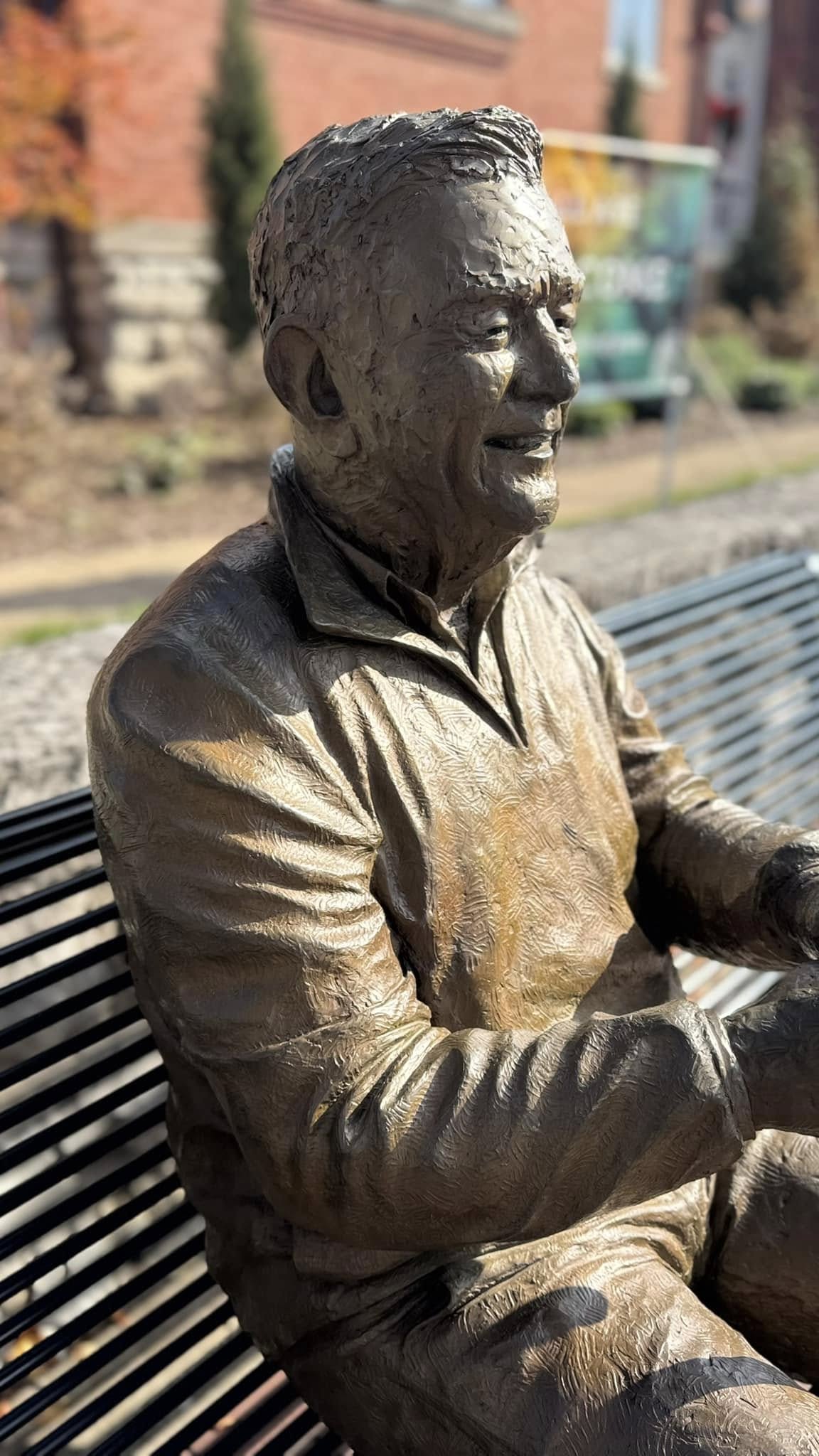 |
| Smiling Jimmy Gentry caught my eye. |
Steps away, I examined a historical marker.
“This statue is in the likeness of Franklin, Tn native and U.S. Army veteran Jimmy Gentry as he reflects on the rock wall and the memories of waiting there for the bus that would take him and many others off to war to fight for our country,” it reads. “These empty seats are in honor of all the heroes who fought for our nation, many of whom never returned.”
I vaguely remember a friend talking about Jimmy, who died in 2022, age 97. So I did some digging. My God, what a life this World War II veteran led. In 1945, he helped liberate Dachau, the German concentration camp near Munich.
True story: In 1992, while on our honeymoon in Germany, Mrs. B and I stopped in Munich. After a night of beer drinking and frivolity in a pub, we asked a white-haired gentleman traveling alone on the bus with our large group if he wanted to visit Dachau with us the next day.
“No,” Bill told us, “I was there in 1945.”
He had helped liberate Dachau, too. The experience haunted him.
 |
| A historical marker near the Gentry statue. |
“Off in the distance I saw boxcars lined up with hundreds of dead bodies inside. They looked starved and tortured,” said Gentry, who survived the Battle of the Bulge in 1944. “I asked another soldier, ‘Who are these people?’ He said, ‘They are Jews.'"
“No one told us what we would find. No one explained what our mission was. We saw a wall and that was the entrance to a prison camp like I have never seen.” “I can't understand it,” Gentry added. “Not then, not now."
What an experience. What a walk. We thank you for your service, Jimmy. And you, too, Bill, wherever you may be.
Sunday, November 03, 2024
Tales from the road: A hanging, 'Rebel gold' on Roper's Knob
 |
| Ben Nance of the State of Tennessee Archaeology Department explains how Civil War soldiers used a flag to signal each other. The U.S. Army had a signal station on Roper’s Knob. (CLICK ON ALL IMAGES TO ENLARGE.) |
Like this blog on Facebook | My YouTube videos
On a whim on New Year’s Day 2023, two bleary-eyed history-minded pals and I ascended to the summit of “Roper’s Knob” north of downtown Franklin, Tenn., only to discover the real Roper’s Knob stood way over yonder.
Thankfully, on this sun-splashed Saturday morning, our party of five Civil War adventurers had a qualified human being — Ben Nance, a 36-year employee of the State of Tennessee Archaeology Department — to guide us about the real Roper’s Knob.
"One of our fortifications occupies a spot, according to [a] report, [that] was previously rendered historic," Caleb Dudley Pillsbury wrote in a letter published in The Racine (Wis.) Advocate on July 8, 1863. "It is called 'Roper's Knob' and rises very abruptly to a hight [sic] of no less than two hundred feet, in the midst of a valley some six miles in diameter. On the summit there is still standing a large peach tree, now well laden with ripening fruit, on which, Mrs. Roper committed suicide by hanging herself.

“Have you ever seen strange symbols carved in the rocks on Roper’s Knob?” a caller asked Nance years ago.
While my thoughts drifted to launching my 250-gram drone, Nance pointed out at the summit the locations of the blockhouse — it was manned by 60 soldiers — and depressions in the ground for the fort cisterns. Years ago, he and his archaeology team unearthed a friction primer wire for a cannon, a flashlight and Thermos at the sites. Over the years, relic hunters have unearthed scores of artifacts on the knob. (Illegal now!)
“I think we’re on the wrong knob,” one of us geniuses remarked about the embarrassing sojourn. Blame New Year’s Eve champagne.
 |
| An illustration of the U.S. blockhouse that stood on this site at Roper’s Knob. |
In 1863 atop the 350-foot-high knob, the United States Army constructed a fort, blockhouse, earthworks, magazine, signal station, rifle pits and more. Four cannon protected the stronghold, which a New York Herald correspondent called "impregnable" in the summer of 1863. The Confederates (smartly) never attacked Roper's Knob.
“Five thousand men worked in shifts to construct it,” Nance explained to us trampers. Roper’s Knob is one of those “hidden” Middle Tennessee Civil War gems we history aficionados relish exploring.
On our way up the steep, osage orange-strewn trail to the summit, Nance took us to the remains deep in the woods of a circa-1829 stone house where mid-30ish Agnes Roper hanged herself in 1840. A 22nd Wisconsin chaplain referenced Agnes' hanging in a letter published in a Wisconsin newspaper in the summer of 1863, although he probably was mistaken about the location of the tragedy.
 |
| Remains of house where Agnes Roper lived. |
"This knob seems to have been planted here in view of this unholy rebellion for the purpose of commanding this valley; and the Rebs will find that it produces fruit of a more solid character than peaches should they venture too near. The view of the surrounding country from the summit of this knob is most beautiful, and [a] more desirable location for a camp in these sweltering days could hardly be found."
Closer to the summit, Nance showed us the trace of the road the Union Army used to haul cannons, ordnance, supplies and more to the summit. But what really piqued my interest was the tale about Roper’s Knob "Rebel gold."
 |
| Ben Nance of the State of Tennessee Archaeology Department inspects a stone outcropping for carvings. |
 |
| ABOVE AND BELOW: Carvings on an outcropping at Roper’s Knob. |

“Have you ever seen strange symbols carved in the rocks on Roper’s Knob?” a caller asked Nance years ago.
Knob visitors have carved their names on rock outcroppings between the fort and surrounding rifle pits, but Nance has never spied “strange symbols” that the caller said represented the Order of the Golden Circle. According to the man, that secret organization supposedly hid Confederate gold, silver, weapons and other valuables in a secret chamber on the knob. Outlaws Frank and Jesse James are said to have had a role in stashing the treasure.
My gawd, Mrs. B and I are going to skip watching football on fall weekends and spend much more time exploring Roper’s Knob.
 |
| Another carving on Roper's Knob. |
“I’d love to get ground penetrating radar up here,” Nance said.
Heck, I’d love to find a map for that Rebel “treasure.”
Now who has a contact at the Order of the Golden Circle?
 |
| Earthworks on Roper’s Knob. |
SOURCES
- New York Daily Herald, June 12, 1863
- The Racine (Wis.) Advocate, July 8, 1863
Tuesday, March 19, 2024
Video: Franklin (Tenn.) battlefield reclamation effort explained
Sunday, January 01, 2023
A Tennessee adventure: 'I think we're on the wrong knob'
 |
| From left: Civil War adventurers Taylor Agan, Jack Richards and John Banks. |
 |
| A cropped enlargement of a wartime map shows Roper's Knob, the "fake" knob, the location of U.S. Army troops and more. (Boyd Family Papers | Bancroft Library | University of California-Berkeley) |
Days ago, my Civil War adventurer pal Jack—who once hypnotized me at Fort Granger early one morning—suggested we climb Roper’s Knob, site of a U.S. Army signal station and blockhouse north of Franklin, Tenn.
 |
| Beer can, probably post-war. |
I had hoped to bring Mrs. B, but she nixed that idea during a conversation remarkable for its brevity.
“Do you want to go to Roper’s Knob on New Year’s morning?”
“No.”
So Jack invited our young friend Taylor, who has, like, 250 direct Civil War ancestors.
After a great breakfast—Taylor paid, so it tasted much better than a regular breakfast—we assaulted “Roper’s Knob,” passing old lawn chairs, climbing over an ancient farm wall, eluding barbed wire and plowing through nasty Osage branches.
After our arrival at the summit of “Roper’s Knob,” two members of our party came to a sad realization: “I think we're on the wrong knob.”
The real Roper’s Knob—much higher and steeper than the “fake” one—appeared in the near distance.
So we climbed the real Roper’s Knob—my ACLs shall weep for days—and discovered remains of a parapet, the possible remains of a cistern, one Budweiser beer can and a steel cable for who-knows-what.
In 1863, 50-some U.S. Army soldiers manned the blockhouse at the summit. In all, roughly 325 Union soldiers served up on the knob. What an adventure.
——
For more stories like this, read my book, A Civil War Road Trip Of A Lifetime, coming late-spring 2023. 🙏 Let’s keep history alive. 👊
 |
| Remains of a parapet at the summit. |
 |
| Jack Richards and Taylor Again hold a steel cable discovered at the summit. |
 |
| A close-up of the cable, perhaps used for logging. |
 |
| The descent. Gulp. |
— Have something to add (or correct) in this post? E-mail me here.
Sunday, October 23, 2022
Talking Civil War with a fellow Jew on the Franklin battlefield
 |
| Chuck Byrn and I on the Lotz House porch |
I hang a right into a small park, passing cannons marking a U.S. Army artillery position, foundation stones of the old Fountain Carter cotton gin, and brilliantly colored trees just showing off. Then I spot a pipe-smoking dude in a vest, checkered shirt, and blue jeans.
“Hey, Chuck.”
 |
| Chuck Byrn often communes with the spirits in this park in Franklin, Tenn. |
“I love this place,” he says as we stare at hallowed ground. This is where Byrn often comes to commune with the spirits.
Besides the Civil War, Byrn and I share a common heritage.
“You know I’m 2.6 percent Ashkenazi Jew,” I tell him as we walk to the Lotz House.” At least that’s what my 23andMe DNA test says.
At the Lotz House, 75 yards or so behind the Union line, Byrn waves me inside. He shows off a six-pound solid shot unearthed in the side yard with several others and invites me to look around. In a corner, under Plexiglas, stands a large cooking pot containing 10,000 Minies, found years ago by a relic hunter. I wonder who counted ‘em.
Outside, on the Lotz porch, Byrn and I shoot selfies and enjoy small talk. Then he greets guests from the comfort of a wooden bench and takes several tokes on his pipe.
“Flip that sign around to ‘Open,’” he tells a man from Colorado. Then I bid Chuck goodbye.
“I need to get back to Fort Granger.”
“I love that place,” he says.
——
You might read more about Byrn in my book, “A Civil War Road Trip Of A Lifetime,” coming spring 2023. 🙏
Let’s keep history alive. 👊
 |
| In a small park along the Columbia Pike in Franklin, Tenn., a cannon marks a U.S. Army artillery position. The stony path marks the line of Union earthworks. |
 |
| Foundation stones of wartime Fountain Carter cotton gin — the site of intense fighting on Nov. 30, 1864. |
— Have something to add (or correct) in this post? E-mail me here.
Saturday, January 29, 2022
A 'hidden' fort and spring, a mule park and a stud's grave
 |
| The "hidden" site of a Union Army on a hill in Franklin, Tenn. |
Let's start with a "hidden" site of a redan, a small, Union Army-built fort atop a hill along the Franklin Pike (State Route 31), about a mile north of the Franklin (Tenn.) square. Nathan Bedford Forrest, the notorious slave trader and cavalry genius, roamed this area, so the redan probably eased the minds of Union Army commanders.
 |
| According to this map by a Civil War vet, the Union Army parked mules on the west side of Franklin Pike. (See more here.) |
No historical marker denotes the site of the fort, which must be rectified. According to a local historian, a house once stood at the crest of the hill and the many depressions in the ground below it may be the work of a farmer rather than Yankee soldiers.
Bundled to withstand the 25-degree temperature, Jack and I walked the ground and wondered what Civil War treasure might be unearthed beneath it. Spotted: One prancing deer, one pile of bricks and one child's outdoor playset that I don't think dated to 1864.
Tipped off by a knowledgeable source about a nearby "hidden" spring used by Union soldiers, we navigated through briars and who-knows-what else to find The Spot near the railroad track. (The line follows the same path as the wartime Nashville & Decatur Railroad.) Trees, fallen limbs, mud and a lack of courage prevented an up-close inspection. Does that make us "spring chickens"?
"Is that gurgling over there?" I said, pointing to the spring between the "V" in a fallen tree. "Maybe," said Jack, leery of getting closer. But I think he might have been humoring me.
 |
| A "hidden" spring used by Union Army soldiers. |
 |
| One of the war's largest cavalry battles was fought here on Dec. 17, 1864. |
Next we headed across the pike to The Park at Harlindales Farm, roughly 200 acres of open space in exploding Franklin. The former breeding farm for Tennessee Walking Horses includes walking and hiking trails, a dog park and the Tractor Supply Co. Arena, where they hold polo matches and horse shows.
 |
| Midnight Sun, superstar |
Steps from the CWT marker rest the earthly remains of walking horse superstar Midnight Sun, a black stallion said to be "as powerful as the sun and as black as midnight." Powerful with the ladies, too—this "sire of sires" may have fathered as many as 2,600 foals, which must be some sort of world record. Naturally, someone built a statue to Midnight Sun after his death in 1965.
Whew! I'm exhausted. Until next time ... let's keep history alive. 👊
 |
| The grave of Midnight Sun, a black stallion that didn't have a lot of free time. |
— Have something to add (or correct) in this post? E-mail me here.
Friday, January 28, 2022
'Hidden' in plain sight: Fort location on Franklin (Tenn.) Pike
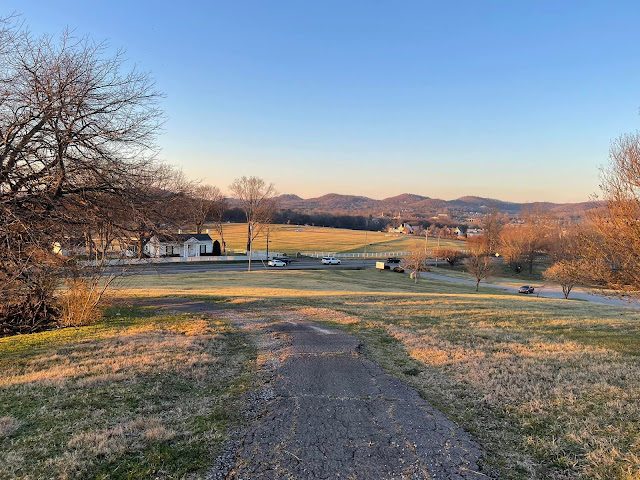 |
| The view looking northwest of Franklin Pike (State Route 31) from the location of a wartime fort. (CLICK ON ALL IMAGES TO ENLARGE.) |
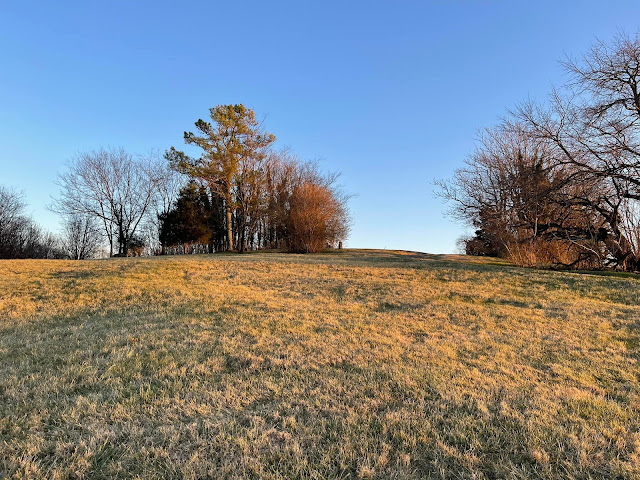 |
| A view from below the fort location. |
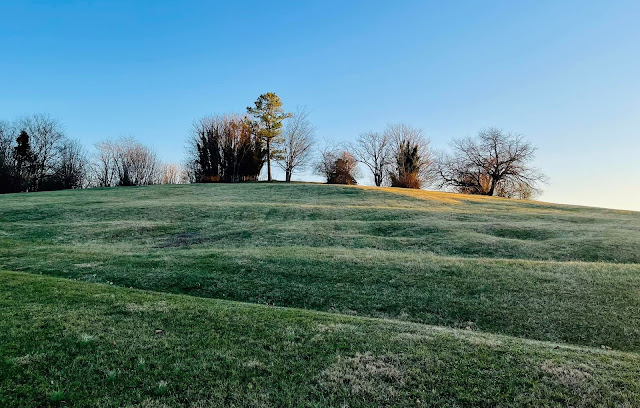 |
| Another view from below fort location. Could these be wartime trenches? Must investigate. |
Thousands of U.S Army troops camped in the fields near this small fort during the war, as the second map below shows. It also shows the locations of headquarters, military and “contraband” camps and other nearby earthworks. Today those fields are occupied by houses, apartments, a park, retail, commercial … and a taco place Mrs. B is dying to visit.
Fort Granger, a massive, earthen Union fort on the bluff above the Harpeth River, appears as that blob at the lower right of both maps. My Civil War pal Jack and I have explored the fort several times—I was even hypnotized there. It's worth your time to visit. If you really want to dig in, check out this doctoral dissertation,
Many “hidden” places like this small Franklin Pike fort remain throughout the Nashville area. So keep your eyes peeled. 😐
 |
| Cropped enlargement of a map from 9th Indiana Cavalry regimental history shows outskirts of Franklin and death sites of three officers in the regiment in a battle on Dec. 17, 1864. |
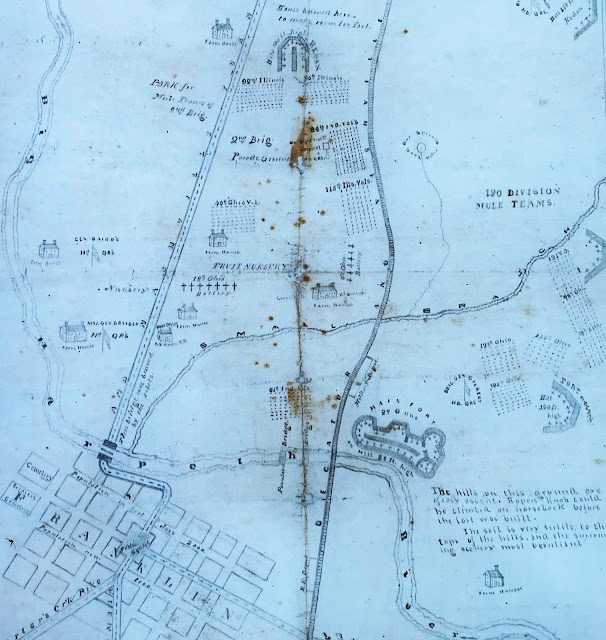 |
| Map from parking lot historical marker at Fort Granger in Franklin, Tenn. (Boyd Family Papers | Bancroft Library | University of California-Berkeley) |
— Have something to add (or correct) in this post? E-mail me here.
Tuesday, December 07, 2021
A forgotten Franklin battlefield where Indiana officers fell
 |
| On Dec. 17, 1864, 9th Indiana Cavalry Captain Volney Hobson was killed near this railroad abutment in Franklin, Tenn. Hobson photo: Hazzard's History of Henry County, Indiana, 1822-1906 |
The "forgotten" battlefield where Indiana cavalry officers fell on a wretched, wintry day looks nothing like it did in 1864. On the east side of the railroad tracks in Franklin, Tennessee, stands a hodgepodge of businesses; apartments and houses occupy the west side. Green and blue paint — modern mischief or art — coats the large stones of a 19th-century railroad trestle abutment. On Old Liberty Pike, a woman walks her poodle a pistol shot from a giant, inflatable snowman in the front yard of a modest, two-story residence.
Eager to get a United States Army soldier's view of this hallowed ground, I struggle up the railroad embankment, yapping dogs be damned. As the sun sets on this brisk afternoon, the scene from the track hardly enthralls. Downtown Franklin, about a musket shot through leafless trees, is out there ... somewhere.
 |
| An off-the-beaten path historical marker denotes the site of a little-known battle on the outskirts of Franklin, Tenn. |
Farms, groves of trees, a fruit nursery, a house or two occupy rolling countryside. A railroad line and the Franklin Pike slice through the landscape. (They still do.) After unrelenting rain, the macadamized pike is a quagmire, pounded by wagons, horses and thousands of retreating soldiers in John Bell Hood's ragtag Army of Tennessee.
As U.S. cavalrymen advance south on both sides of the pike, dueling with Hood's rearguard in the aftermath of the Battle of Nashville, they see Franklin on the far side of the Harpeth River. Scores of wounded from the major battle there nearly three weeks earlier remain in buildings in town.
On the near side of the winding river, 300 or so yards away, Confederate cannon and muskets fire from a small, earthen fort. Encircling the makeshift defense is telegraph wire attached to posts at intervals — a diabolical tripwire against cavalry. (Perhaps artifacts from the forgotten fort lay underneath back yards of these Daniels Drive houses.)
On Figuers Bluff to the left, the massive (and unoccupied) Federal Fort Granger looms above the river. On the opposite side of the pike, near an orchard and the Rozell place, shrubbery conceals Rebel sharpshooters.
 |
| The view Sergeant John Holt of the 9th Indiana Cavalry and his comrades had on Dec. 17, 1864. (CLICK ON ALL IMAGES TO ENLARGE.) |
"We formed under cover of the ravine, and then advanced down the railroad," recalled Sergeant John Holt of the 9th Indiana Cavalry. Bringing up the rear with his Company E, Holt asks a sergeant in another company if he likes where they are heading. Not much, the soldier replies, but what choice do we have?
"We charged down the railroad until we got to the wagon road, then went under the railroad, the grade being so high as to permit us to go under," Holt remembered.
And so he, lieutentants Jonathan M. Burroughs, James S. Watts, James M. Duvall and scores of other Indiana cavalrymen continue their advance. Bullets, canister, artillery shells fill the air. But the attack on the fort falters.
 |
| 9th Indiana Cavalry Lt. James S. Watts fell at the corner of Old Liberty and Franklin pikes. |
 |
| Jonathan Burroughs "was wounded by a fragment of a shell striking him on the head carrying away the superior portion of the left temporal bone," 9th Indiana Colonel George Jackson wrote. (Burroughs pension file | National Archives via fold3.com | WC69023) |
As two soldiers assist the dismounting Burroughs, a shell fragment tears through his skull, mortally wounding the officer. Did he fall in the parking lot of that taco place on Franklin Pike? Shot in the chest, Duvall falls, too. The wound plagues him until he dies in 1880.
 |
| Post-war image of Sergeant John Holt. (Ball State University via Henry County Museum) |
Shot through the heart, Captain Volney Hobson falls near the stone abutment at the railroad trestle. Or does he crumple closer to that earthen Confederate fort? The fog of war often obscures truth.
As Holt scrambles to the rear, Hobson's riderless horse gallops past him. Nearby, the captain — Holt's commanding officer — lays dying in a pool of his own blood. In a conversation with Burroughs earlier, the 36-year-old is overheard saying, "The rebel bullet is not molded that will kill me."
Hobson's death is a gut punch for his men. An adventurous spirit, he drove cattle across the Plains to supply gold miners with beef in California in the 1850s — he became a miner, too. In spring 1862, Hobson served as a clerk in the 19th Indiana, a regiment in the famed Iron Brigade. At Antietam, he snatched from a fallen South Carolina officer a gold watch and chain — a prized souvenir he gave to his half-brother. In December 1863, Hobson was commissioned as captain of Company E in the 9th Indiana Cavalary.
 |
| The gravestone of 9th Indiana Captain Volney Hobson in Batson Cemetery in Millville, Ind. (Find A Grave) |
A colonel plants the 9th Indiana regimental colors to establish a new line, perhaps near where the inflatable snowman wobbles in the wind on Old Liberty Pike. The Indianans bag two stands of enemy colors and roughly 200 prisoners — captures made "by individual prowess,... and not the result of concerted action."
"The charge was unwisely ordered, but bravely and brilliantly executed," an Indiana officer recalled. "To ride down in the face of a withering fire on a fort inaccessible to cavalry, defended by artillery and infantry ... was apparently a ride to death."
In the chaos of their retreat to the south side of the Harpeth, the Rebels dump four cannons in the river. Wary U.S. cavalrymen keep their heads down as Confederate sharpshooters, infantry and artillery maintain a steady fire from town.
Then a solid shot plows through a U.S. soldier's horse. "The astonishment of the boy holding the bridle, gazing at his disembowled but still erect horse, can be better imagined than described," a soldier recalled decades later. It's a gruesome exclamation point to an ugly day on Franklin's forgotten battlefield.
 |
| Lieutenant James S. Watts was buried at Stones River National Cemetery. |
 |
| A cropped enlargement of a map of fighting in Franklin, Tenn., shows where Captain Volney Hobson and fellow 9th Indiana Cavalry officers James S. Watts and Jonathan M. Burroughs (or Burrows) suffered mortal wounds on Dec. 17, 1864. (CLICK HERE TO VIEW COMPLETE MAP | 9th Cavalry history) |
-- Have something to add (or correct) in this post? E-mail me here.
- Comstock, Daniel Webster, Ninth Cavalry: One Hundred and Twenty-First Regiment, Indiana Volunteers, Richmond, Ind.: J.M. Coe, 1890
- Hazzard, George, Hazzard's History of Henry County, Indiana, 1822-1906, Newcastle, Ind., G. Hazzard, author and publisher, 1906
- Jonathan Burroughs widow's pension file, National Archives & Records Service, Washington, D.C. via fold3.com (WC69203)
- The National Tribune, March 22, 1888
Thursday, July 29, 2021
Thursday, July 08, 2021
Strange daze: A 'hypnohistory' session at a Tennessee fort
 |
| Before the hypnosis session at Fort Granger, I was a bundle of raw nerves. |
 |
| Humorist/retired lawyer Jack Richards offered hypnotic suggestions while I was blindfolded. |
 |
| Early morning reporting essentials at Fort Granger: toilet paper (don't ask), a notebook, and a pen. |
Me:“Hell yes. Let’s do it.”
A millisecond after sending the reply, extreme doubts creep in. Firstly, “Psych major” and “Penn State”? Seems sketchy. Secondly, what if under deep hypnosis I babble about some long-ago transgressions? At West Virginia University, pals and I dangled a small person by his belt from an upper floor of the freshmen dorm. Will Mrs. B seek an annulment if she reads this?
Throwing caution (and potentially 29 years of a solid-gold marriage) into the wind, I head to Franklin at 5:55 a.m. anyway. I am armed with toilet paper (don't ask), a reporter's notebook and pen, and an open mind. Arrival at Fort Granger: 6:21 a.m.Let the hypnosis begin!
SOURCE
But first, a primer: Built with the aid of Black labor, the fortification on Figuers Bluff above the Harpeth River was completed in early 1863. In its heyday, more than 10,000 Federal soldiers were stationed at Fort Granger and the surrounding area.
During the Battle of Franklin on Nov. 30, 1864, U.S. Army artillery from the fort devastated brigades in William Loring’s division on the Confederates' right flank, roughly a mile away as a cannon ball flies. "After sundown, the sparks of rifle fire and the lightning, thunder and groaning of the heavy cannons was splendid and awe-inspiring for the eye and ear," wrote a German immigrant in the 15th Independent Indiana Artillery Battery who witnessed Granger's guns blazing.
Decades after the war, the fort was left to nature and hobos. Today it’s a fairly well-maintained city park, with paths along massive, well-preserved earthen walls.
No hobos or any other humans are in sight when Jack and I plop our lawn chairs near the middle of Fort Granger. Then he offers his guinea pig hypnotic subject a green-and-white checkered bandana for a blindfold. “Relax,” Jack tells me. “Put this on.” I envision early rising fort walkers thinking, “Why is the man in a lawn chair holding that other man hostage at 6:35 a.m.?”
 |
| Stay off the earthworks! |
The next 25 minutes are a blur of hypnotic suggestions and historical tidbits.
“Tune out everything,” Jack says.
“Concentrate on my voice.”
“Focus on your feet.”
"Focus on your knees."
And then come words that make me feel really queasy: “Focus on your thighs. They are the biggest part of our bodies, and we rarely think about them.”
And then come words that make me feel really queasy: “Focus on your thighs. They are the biggest part of our bodies, and we rarely think about them.”
Oh, Lord.
 |
| Our hypnosis session was held near the middle of Fort Granger. |
I nod off into some strange netherworld. You’d probably feel the same if you drank a few cheap beers, burned incense, and watched The Twilight Zone on Netflix.
“Union troops hanged two Confederate spies here on June 9, 1863,” Jack says.
“Fort Granger guns, commanded by Captain Giles Cockerill, tore at the Confederates with vicious enfilade fire.”
“Fort Granger fired 163 rounds during the battle, or about 40 per gun.”
“Think about the passage of time.”
Now I’m not saying I was transported back to Nov. 30, 1864, but I did hear while under hypnosis church bells playing “My Country, Tis Of Thee” / ”God Save The Queen” and roosters crowing. Who knows if those sounds were real? I also heard cannon fire, but that was just my hypnotist playing a YouTube clip practically inside my eardrum.
Afterward, Jack and I compare notes and listen to “La Wally,” an excellent operatic song, from his robust Spotify collection. It's an otherwordly experience, for sure. Then a dog walker finally shows up, no doubt wondering what the oddballs in the lawn chairs are up to.
“Hypnohistory,” Jack calls our session.
“Is that a thing?” I ask.
“It is now.”
 |
| An overgrown area near the war-time entrance of the fort. |
We chuckle as only two Civil War nerds can.
 |
| Hypnotist Jack Richards walks on a trail near an imposing, earthen wall at Fort Granger. |
-- Have something to add (or correct) in this post? Email me here.
SOURCE
- Fout, Frederick, The Darkest Days of the Civil War, 1864 and 1865, Translation of Fout’s 1902 Die Schwersten Tage des Bürgerkriegs, 1864-1865.
Saturday, June 05, 2021
Two men and a zinc coffin, a Great Dane and a 'pile of goo'
 |
| History nerd Jack Richards and some dude in a Yellow Donkey beer T-shirt. |
Like this blog on Facebook | Follow me on Twitter
 |
| William "Bill" Shy, killed at Battle of Nashville. |
At the Williamson County Archives and Museum in Franklin, Tenn., my friend and fellow western Pennsylvanian Jack Richards and I perused the zinc coffin of 20th Tennessee Col. William Shy, who was killed at the Battle of Nashville and whose remains were unearthed by an apparent grave robber in 1977. How Shy was tucked into this tiny coffin is one of history’s mysteries. You can dig into this story — damn, sorry — by reading my “Rambling” column in Civil War Times magazine. (It includes a reference to a 150-pound Great Dane named “River” and the words “pile of goo.”)
Please note: My T-shirt is not necessarily an endorsement of Yellow Donkey pale ale.
 |
| A close-up of Colonel Shy's zinc coffin. How did he fit into that thing? |
-- Have something to add (or correct) in this post? Email me here.
Subscribe to:
Posts (Atom)