 |
| A December 2009 image of the farmhouse in Spring Hill, Tenn., where Richard Ewell lived after the Civil War with his wife, Lizinka. The couple died here within days of each other in winter 1872. (Hal Jespersen | Wikimedia Commons) |
In the final days of his life, Confederate Lt. Gen. Richard Stoddert Ewell sensed something terribly wrong. A “pall had fallen upon” his farmhouse in Spring Hill, Tennessee, and “a feeling of depression … was visible on every countenance.”
Lizinka, who, according to her obituary, "constantly cultivated ... and stored valuable information," was the general's first cousin and Russian-born daughter of the former U.S. minister to the Court of Tsar Alexander. She was 51.
And so a grieving Ewell ordered preparations for his own death. A will was made; so were arrangements for disposition of his property. After the war, the Virginia-reared Ewell had settled on a farm in Spring Hill, 35 miles south of Nashville, with Lizinka, a wealthy heiress. (Her first husband, James Percy Brown, a notorious philanderer, died in 1844.) The Ewells raised Jersey cattle and sheep, bred harness-racing horses and turned the farm into one of the area's most prosperous.
"I understand from some of his neighbors that he has been remarkably successful in managing his freed men employees," a Spring Hill man wrote about Ewell in 1867. "He is very liberal and kind to them; at the same time he is firm in support of his rights, and this is the secret of his success.
"My rank while in the Confederate service might be inscribed upon one of the stones," the 54-year-old Confederate veteran reportedly told attendants at the farmhouse, "but I wish nothing in the inscription which will cast any reflection upon the Government of the United States."
Known for enduring lasting criticism for failing to seize Cemetery Hill on the first day at Gettysburg, Ewell was now fighting a different battle. For nearly two weeks, his wife of almost eight years had cared for him as he battled pneumonia or a similar illness. But now she was nowhere to be found.
There was a reason for that. Days earlier, Lizinka Ewell had died of the same disease that was now killing “Old Bald Head.”
 |
| A historical marker in Spring Hill, Tenn., for the Ewell Farm, where Richard Ewell died on Jan. 25, 1872. He was 54. |
"His senses had become so keenly susceptible to everything transpiring around him," a Nashville newspaper reported, "that even the thoughts of his attendants seemed laid bare to his perception." Because of Ewell's precarious health, the family delayed revealing the news.
Lizinka, who, according to her obituary, "constantly cultivated ... and stored valuable information," was the general's first cousin and Russian-born daughter of the former U.S. minister to the Court of Tsar Alexander. She was 51.
And so a grieving Ewell ordered preparations for his own death. A will was made; so were arrangements for disposition of his property. After the war, the Virginia-reared Ewell had settled on a farm in Spring Hill, 35 miles south of Nashville, with Lizinka, a wealthy heiress. (Her first husband, James Percy Brown, a notorious philanderer, died in 1844.) The Ewells raised Jersey cattle and sheep, bred harness-racing horses and turned the farm into one of the area's most prosperous.
 |
| Headlines in the Nashville Tennessean on Jan. 26, 1872, the day after Richard Ewell's death. |
"By the way, " the man added, "he has the best crop of wheat that I have seen."
In spring 1870, the Ewell farm supplied the Maxwell House Hotel in Nashville with 100 pounds of butter a week. The general even became president of the Maury County Agricultural Society. "No man in Tennessee," an account noted, "ever exhibited more interest in improving the breeds of cattle and sheep."
Ewell wanted a simple funeral — no ostentation, no parade. Friends and comrades were to show their respect without fanfare. A plain headstone and footstone would do, he supposedly said, "like those over the graves of my father and my mother in Virginia."
In spring 1870, the Ewell farm supplied the Maxwell House Hotel in Nashville with 100 pounds of butter a week. The general even became president of the Maury County Agricultural Society. "No man in Tennessee," an account noted, "ever exhibited more interest in improving the breeds of cattle and sheep."
Ewell wanted a simple funeral — no ostentation, no parade. Friends and comrades were to show their respect without fanfare. A plain headstone and footstone would do, he supposedly said, "like those over the graves of my father and my mother in Virginia."
"My rank while in the Confederate service might be inscribed upon one of the stones," the 54-year-old Confederate veteran reportedly told attendants at the farmhouse, "but I wish nothing in the inscription which will cast any reflection upon the Government of the United States."
 |
| The Ewells, who died of illness in the winter 1872, were buried in Nashville City Cemetery, near downtown. (CLICK ON ALL IMAGES TO ENLARGE.) |
Barely able to speak, Ewell even mulled a possible cause of his death: exposure to cold because he wore a thin pair of Federal blue military pants purchased before the Civil War. "After all my fighting against the United States so long," said Ewell, who had lost his right leg at Brawner's Farm in August 1862, "it is strange that an old pair of infantry pantaloons should kill me at last."
Shortly before Ewell's death, attendants carried Lizinka's coffin to his room. Too weak to show much emotion, Ewell was raised from his pillow so he could view the shrouded remains. The general whispered he wanted to be buried next to his wife, whose picture dangled from his neck.
On the brink of death and unable to accept many visitors, Ewell signaled what he needed with gestures. The end came at 2:30 in the morning on Jan. 25, 1872. "His countenance wore a look of placid resignation and was more life-like in expression after than a short time before his death," the Nashville Tennessean reported the next day.
Tennessee newspapers published extensive obituaries of Ewell, a U.S. officer during the war against Mexico, lauding him as a "great Confederate commander." The Nashville Banner only briefly mentioned Gettysburg, noting — erroneously — that Ewell "took 5,000 prisoners and 5 or 6 guns" there.
At the funeral service at Christ Church in Nashville, where Ewell's wife had lived for decades, hundreds of mourners gathered. Tennessee Gov. John Brown attended as did former Confederate generals Lucius Polk, William Bate, William Hicks Jackson, Richard Lilley and Edmund Kirby Smith. An escorted hearse bore Ewell's remains a short distance to the city cemetery near old Fort Negley, key defense during the U.S. Army's' occupation. A stone carver inscribed Ewell's wartime affliation on an ornate marker: "Lt. Gen., C.S.A."
The controversy that had followed him since the first day at Gettysburg seemed absent from the somber procession. As he wished, Ewell was buried next to his wife.
"Before the fresh earth had time to settle on the grave of the wife of his bosom, the clods fell on his own coffin," a newspaper wrote in a lengthy tribute to the general. "The rays of the winter's sun that shimmered on the mound that marked her last resting-place cast their light in the newer-made grave, as if to welcome him once more to her side."
SOURCES
Shortly before Ewell's death, attendants carried Lizinka's coffin to his room. Too weak to show much emotion, Ewell was raised from his pillow so he could view the shrouded remains. The general whispered he wanted to be buried next to his wife, whose picture dangled from his neck.
On the brink of death and unable to accept many visitors, Ewell signaled what he needed with gestures. The end came at 2:30 in the morning on Jan. 25, 1872. "His countenance wore a look of placid resignation and was more life-like in expression after than a short time before his death," the Nashville Tennessean reported the next day.
 |
| Close-up of inscription on the grave marker for Richard Ewell and his wife Lizinka in Nashville City Cemetery. |
At the funeral service at Christ Church in Nashville, where Ewell's wife had lived for decades, hundreds of mourners gathered. Tennessee Gov. John Brown attended as did former Confederate generals Lucius Polk, William Bate, William Hicks Jackson, Richard Lilley and Edmund Kirby Smith. An escorted hearse bore Ewell's remains a short distance to the city cemetery near old Fort Negley, key defense during the U.S. Army's' occupation. A stone carver inscribed Ewell's wartime affliation on an ornate marker: "Lt. Gen., C.S.A."
The controversy that had followed him since the first day at Gettysburg seemed absent from the somber procession. As he wished, Ewell was buried next to his wife.
"Before the fresh earth had time to settle on the grave of the wife of his bosom, the clods fell on his own coffin," a newspaper wrote in a lengthy tribute to the general. "The rays of the winter's sun that shimmered on the mound that marked her last resting-place cast their light in the newer-made grave, as if to welcome him once more to her side."
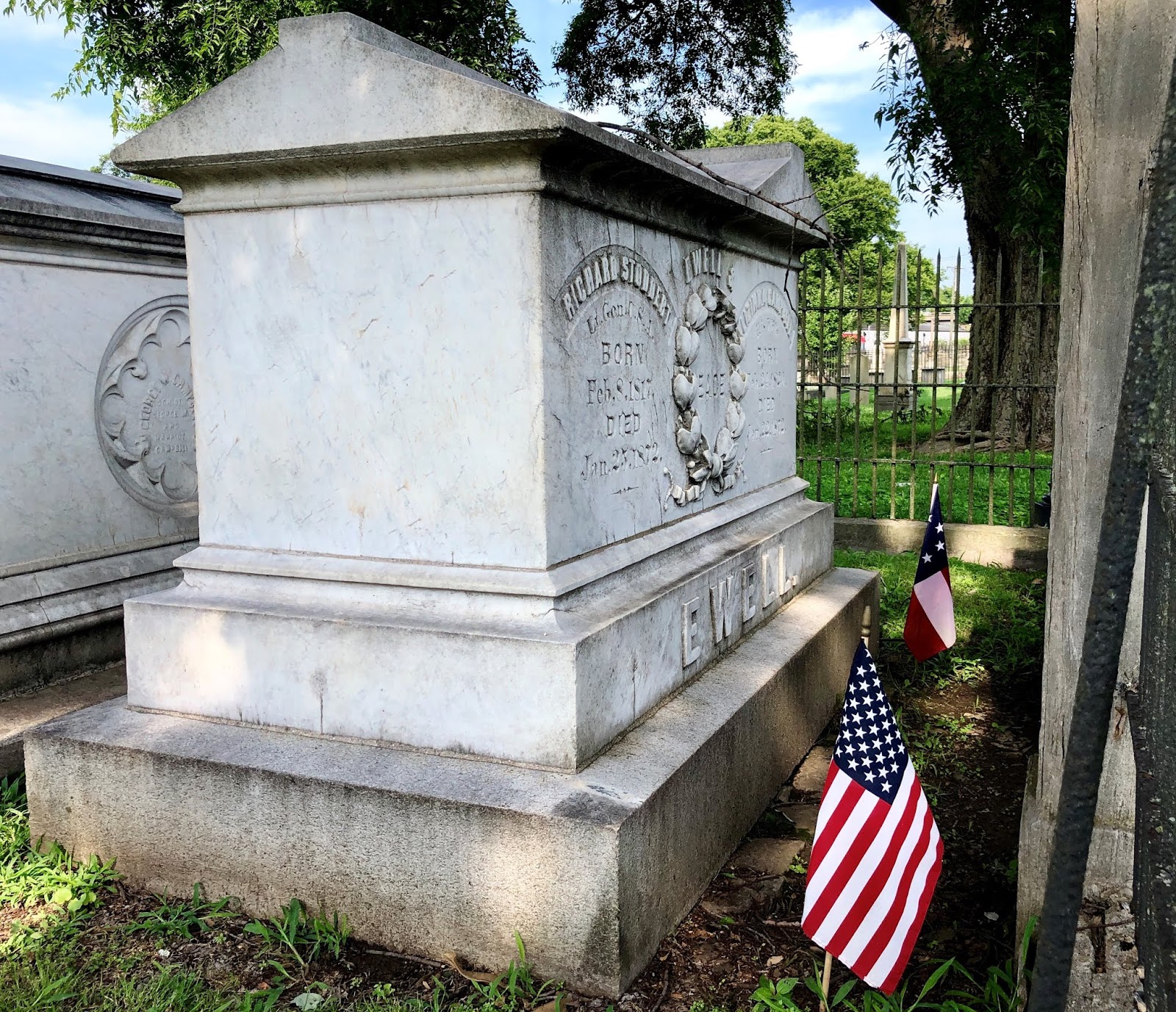 |
| Richard Ewell wanted a plain headstone and footstone. He got a more elaborate marker. |
 |
| Behind and iron fence, Richard and Lizinka Ewell rest for eternity. The couple died within days of each other. |
-- Have something to add (or correct) in this post? E-mail me here.
SOURCES
- Intimate Strategies of the Civil War: Military Commanders and Their Wives, edited by Carol K. Bleser and Lesley J Gordon, New York, Oxford University Press, 2001
- Memphis Avalanche, Jan. 27, 1872
- Nashville Tennessean, March 6, 1870. Jan, 26, 1872
- Nashville Union and American, Jan. 27, 1872
- The Home Journal, Winchester, Tenn., April 25, 1867


