Showing posts with label Private Wells Bingham. Show all posts

Tuesday, February 27, 2018

'Masterpiece' no more: Antietam secretary exposed as fake

The "Antietam secretary" in Massachusetts antiques dealer Harold Gordon's house in 2011.
Read my story on the fake in The New York Times | Like this blog on Facebook

The eight-foot-high memorial secretary -- a piece of American folk art with a tie to the Battle of Antietam -- has been described as "astonishing," "a rare example of a Civil War mourning rite," "extraordinary" and a "profound piece."

Now there's a new description for the ornate piece of furniture in the collection of the Wadsworth Atheneum Museum of Art in Hartford, Conn.:

"One of the best folk art fakes of all time."

The secretary on display at Hartford's Wadsworth Atheneum
Museum of Art in August 2017.
In a lengthy story posted Monday afternoon, Clayton Pennington of Maine Antique Digest reported the secretary was a forgery created by Massachusetts antiques dealer and craftsman Harold Gordon. “I’m going to keep this short. I did it. I made it," he told Pennington.

In 2014, Gordon sold the secretary to noted Connecticut-based antiques dealer Allan Katz, who had the piece tagged at $375,000 at a 2015 winter show. In March 2015, the Wadsworth purchased it from Katz for an undisclosed price, and the museum had it prominently displayed last summer.

Gordon had touted the secretary as a gift presented on July 4, 1876, by Civil War veterans to Wells Bingham in honor of his brother,  John, who was killed at Antietam. The brothers served as privates in the 16th Connecticut. (I first blogged about the secretary in 2011 here, and mentioned it in a story about the Bingham brothers in my 2013 book, Connecticut Yankees at Antietam.)

"Allan fell for it, and to be honest with you, I want to make him whole," Gordon told Pennington. "It was not fair what I did. It was a terrible thing, but I did it for the money — I didn’t do it for the glory." Gordon said there was "nothing" on the secretary when he began turning it into "Antietam" folk art -- a project that took him months to complete.

Spelled out in cattle bone on the ornate front are the words "Antietam" and "Sept. 17, 1862" as well as John's first two initials and last name. A Ninth Corps badge is mounted between the "18" and "76," which are also made of cattle bone. The knobs are bird's-eye maple with bone inset circles. A clock, crowned with an eagle and including the words "The Union Preserved" near the base, is mounted on top. When the inside right front door is opened, "Yankee Doodle Dandy" plays on a music box.

All expertly faked, of course.

Pennington told me the clincher for him was a 2011 photo of the secretary that I had taken at Gordon's house. He compared my image, seen at the top of this post, to another image of the secretary -- unadorned with the bells and whistles -- in the same spot in Gordon's house. In 2011, Gordon told me he had purchased the secretary from a member of the Bingham family.

A close-up of the front of the secretary at the Wadsworth Atheneum Museum of Art.
Katz said he plans to offer the Hartford museum a full refund. In a statement e-mailed to me this morning, the Wadsworth Atheneum Museum of Art said:
As stated clearly in our mission statement, we hold our collections in trust for all people, and we are dedicated to advancing knowledge and inspiring everyone to experience and appreciate excellence in art and culture. To realize that mission, we work to acquire items for our collections. In the acquisition and accession process we strive to confirm the authenticity of every item in accordance with our Collections Management Policy.

In late 2016, we received an anonymous report that one of the items acquired for our folk art collection in February 2015 – a piece of antique furniture adorned with relics of the civil war at the time of the American centennial, 1876 – was fake. We began to investigate and in 2017 took the item off view at the Atheneum until the investigation could be completed. One of the steps we took was to engage a materials scientist to try to determine the age and timeframe of the adornments. Other steps included a thorough review of a wide variety of historical sources and our own records in an attempt to scrutinize the authenticity. 
This week, we learned that a Massachusetts antiques picker and craftsman has reportedly confessed to adorning the antique secretary himself, forging the provenance documentation, and misleading the dealer to whom he sold the piece. That dealer, who sold it to the Atheneum, has offered the museum a complete and total refund. We are also in contact with the appropriate authorities to follow up on this matter.

While it can be difficult to authenticate folk art of this kind, and this was by all accounts a masterful forgery that fooled a number of experts in this field, we will review our accession process and make every effort to ensure that art we acquire is what it purports to be.

We thank the concerned individuals who brought this to our attention and pursued this matter to this conclusion. We take our role as a steward of the public trust to be paramount and appreciate your support. Collections are fundamental to this institution’s identity, essential to its core function as a place for art and public engagement, and a defining element of our present and future plans. We will continue to do our best to identify, authenticate, acquire, preserve and present culturally significant works of art in our collections.

-- Have something to add (or correct) in this post? E-mail me here.

Saturday, August 12, 2017

A remarkable gift in honor of 'poor, poor John' Bingham

The name and date of the bloodiest day in American history appear on the front of the secretary.
(CLICK ON IMAGES TO ENLARGE.)
Crafted to honor Private John Bingham, the secretary is on display at the Wadsworth Museum of Art.
 Like this blog on Facebook.

UPDATE: The secretary mentioned 
in this post was exposed in 2018 as a forgery.


The story of a remarkable piece of handcrafted furniture on display at a Hartford museum involves the death of a teen-aged soldier at Antietam, a piece of a flag that may have been secreted away at a notorious Civil War POW camp, a suicide in New Jersey in the summer of 1904 -- and plenty of questions.

Carving of Lincoln in cattle bone
on the front of the secretary.
This tale began for me in November 2011, when antiques dealer Harold Gordon e-mailed about an unusual soldier memorial he had purchased in 2006 from descendants of Civil War soldiers John and Wells Bingham, brothers from East Haddam, Conn. Eager to show off his impressive acquisition, Gordon invited me to see the secretary in the cramped living room of his small house in central Massachusetts.

 A 17-year-old private in the 16th Connecticut, John Bingham had been killed in the 40-Acre Cornfield on Sept. 17, 1862. His 16-year-old brother, Wells, broke the awful news to his father.  "It is a sad tale which I am about to tell you," the private in Company H of the 16th Connecticut wrote three days after the battle. "Poor, poor John is no more." (See interactive panorama of 40-Acre Cornfield on my photo blog.)

As he went to view John's body on the battlefield, Wells was so overcome by the gruesome death scenes in the vast, rolling field just outside the village of Sharpsburg, Md., that he couldn't bear to look at his brother. "I thought that if he looked like any of them which I saw there," the teenager wrote, "I did not want to see him."

Left: 16th Connecticut Private John Bingham, 17, was killed at Antietam. Right: His 16-year-old
brother Wells survived. (Photos courtesy of Military and Historical Image Bank)
A small plaque on the front of the secretary was made from a shard of John Bingham's knife.
A typewritten note inside the front drawer of the secretary is signed by Wells Bingham's son, Edgar.
About 1876, 16th Connecticut veterans gave Wells an impressive gift in John's memory: a beautiful, 8-foot secretary made predominantly of walnut and oak. Spelled out in cattle bone on the ornate front are the words "Antietam" and "Sept. 17, 1862" as well as John's first two initials and last name. A Ninth Corps badge is mounted between the "18" and "76," which are also made of cattle bone. The knobs are bird's-eye maple with bone inset circles. A clock, crowned with an eagle and including the words "The Union Preserved" near the base, is mounted on top. When the inside right front door is opened, "Yankee Doodle Dandy" plays on a music box.

A newspaper story about the 16th Connecticut's 
reunion at Antietam in 1889 appears under
glass inside a secretary door.
On a small plaque on the front of the secretary are these words:
"Presented to Wells A. Bingham by his friends. The secretary a rememberance of his brother John F. Bingham who offered up his life at Antietam, Maryland Sept. 17, 1862. The encased star a remnant of the colors carried that day by the 16th Infantry. The memory plaque made from a shard of his knife."
Old newspaper clippings about the 16th Connecticut flag and a regimental reunion at Antietam are mounted under glass inside doors on the front of the secretary, now on display at Hartford's Wadsworth Atheneum Museum of Art. An unsigned note from 1900 found in a drawer of the secretary references "battlefields' thunder and flame." And glued inside another drawer is this typewritten note signed in ink by Wells Bingham's son, Edgar:
"This desk made for my father Wells Anderson Bingham. A tribute to his brother John killed September 17, 1862 at the battle of Antietam. They both served in the Connecticut Volunteer Infantry Company H. Both enlisted August 17, 1862 at South Manchester. The cased part of the regiment's flag was givin [sic] in honor by my father's close friend and comrade Sergeant Edgar C. Wheeler. I am proud to carry his name. The knife handle was in the possession of my father and with great sadness taken from the body of his brother after the battle." 
-- Edgar M. Bingham
Northhampton, Massachusetts
September 22, 1972
Age 93
Antiques dealer Harold Gordon (right) examines the 16th Connecticut flag in the Hall of Flags
at the State Capitol Building in Hartford in 2013.
A canister attached to the secretary may hold a piece of the 16th Connecticut regimental flag..
A Vietnam veteran and an Abraham Lincoln lookalike, Gordon was especially intrigued with the small canister on the front of the secretary. If it indeed held a piece of the the 16th Connecticut's regimental flag, it would be an amazing find. After the regiment was captured nearly en masse at Plymouth, N.C., on April 20, 1864, hundreds of 16th Connecticut soldiers were imprisoned at Andersonville, the deadliest prison camp of the war. On detached duty, Wells luckily was not among them. "Could not have been happier or more envied," he wrote after the war, "if I had been chosen to be a Major General."

After the war, pieces of the 16th Connecticut regimental flags were gathered by Andersonville survivors, sewn together to form a shield and scroll and mounted in the middle of a new silk flag, which was created by Tiffany and Co. in New York. During a 2013 visit with me to the State Capitol Building in Hartford where that flag is displayed, Gordon aimed to match his piece of flag with the shield and scroll on the flag made after the war. His comparison was inconclusive, but it merits an expert investigation.

Like his brother, Wells Bingham met a sad end. Alone in his Bloomfield, N.J., house at 58 Monroe Place while his wife, two sons and a daughter were away, the 58-year-old businessman inhaled "illuminating gas," killing himself on Aug. 16, 1904. An employee from his wallpaper company discovered his body. Bingham had $238.70 in his pocket. A suicide note to his wife "said his business worries prevented his sleeping and advised his sons never to enter the same business."

John Bingham's name appears prominently on the front of secretary.
Ill and eager to sell the secretary, Gordon, whom I had lost contact with since 2013, sold it to an Connecticut antiques dealer for a handsome profit in 2014. That winter, the asking price at a New York show was $375,000. In March 2015, the secretary was acquired by the Wadsworth Atheneum Museum of Art. On Saturday morning, Brandy Culp, museum curator of decorative arts, showed me the secretary -- the first time I had seen it since Gordon showed it off in his cluttered living room nearly six years ago. "Patriotic symbols and mottoes cover this secretary," reads the placard next to Wells Bingham's long-ago gift, "dangling like medals on a Civil War veteran's uniform."

An inkwell mounted on front.
A student of history herself, Culp is as eager as I am to find out more about the memorial to a 17-year-old soldier who was killed at Antietam. We have many questions:

Who crafted this impressive piece of furniture?

Who were the 16th Connecticut veterans who gave the unique piece of American folk art to Wells Bingham? What was so special about Wells that he merited such a beautiful gift?

Does the small canister on the front of the secretary really contain a remnant of the 16th Connecticut regimental flag? Was it part of the regimental flag at Antietam?

Who was Edgar Wheeler, namesake of Edgar Bingham, who gave the "cased part of the regiment's flag" to Wells? Where did he get the small piece of "flag"?

Did the horrors Wells Bingham witnessed at Antietam have anything to do with his suicide?

And, finally, how did this amazing work of art ever get out of the Bingham family's hands?

We'll keep you posted.

An unsigned note from July 1900 found in the desk drawer.
A clock, crowned with an eagle and including the words "The Union Preserved" 
near the base, is mounted on top.
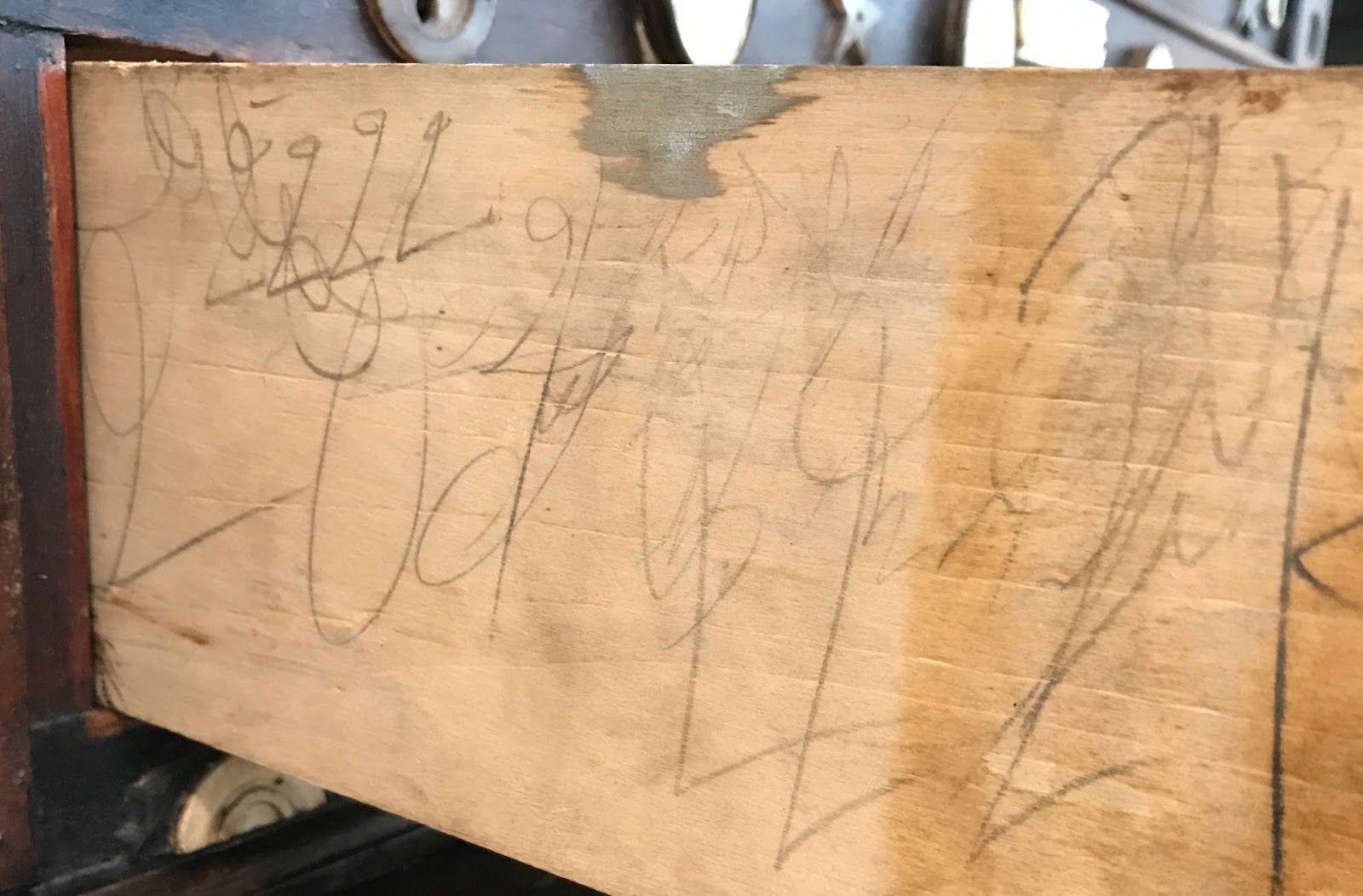
Pencil scrawling, perhaps by a child, on a secretary drawer.
The secretary on display at the Wadsworth Atheneum Museum of Art in Hartford.
(CLICK ON IMAGES TO ENLARGE.)

Have something to add (or correct) in this post? E-mail me here.


SOURCES:

-- Marquis de Lafayette GAR Post No. 140 Record Book, April 13, 1904.
-- New York Times, Aug. 17, 1904.
-- Private Wells Bingham's letter to his father, Sept. 20, 1862, Antietam National Battlefield Research Library.

Tuesday, April 21, 2015

Furniture with Antietam tie purchased by Hartford museum

The "Antietam" secretary in Harold Gordon's living room.
The front of the secretary includes the word "Antietam" and the date of the battle.
John Bingham (left) was killed at Antietam. 
His brother, Wells,  survived. 
 (Photos courtesy Military Historical Image Bank)
UPDATE: The Antietam secretary in this post was exposed in 2018 as a forgery.


Three years ago, I visited a Massachusetts antiques dealer named Harold Gordon, who loved to talk about the Civil War and one of his recent purchases: a Victorian-era secretary with a direct tie to the Battle of Antietam. The unique piece of furniture was a gift from 16th Connecticut veterans to Wells Bingham in memory of his 17-year-old brother, John, a private in the regiment who was killed in the battle. Also a private in the 16th Connecticut, Wells survived Antietam unscathed physically.

In his cramped living room that day, Harold delighted in showing me details of the 8-foot antique secretary -- the beautiful clock atop it that includes the words "The Union Preserved" near the base; a small tin on the front that may have held a piece of the 16th Connecticut regimental flag that was at Antietam and a door that when opened played "Yankee Doodle Dandy" on a music box. Spelled out in cattle bone on the front of the one-of-a-kind gift are the words "Antietam" and "Sept. 17, 1862," as well as John F. Bingham's name.

Does this case on the front of the secretary
 hold a piece of the 16th Connecticut flag 
that was at Antietam? 

Only 16 at Antietam, Wells wrote of the news of his brother's death in a heart-rending, seven-page letter to his father that I discovered in the Antietam National Battlefield Library months after I visited with Harold. It was the first letter I saw in a stack of transcripts and other copies of letters from Connecticut soldiers about Antietam.  "John, poor, poor John, is no more," Wells wrote about his brother's death to Elisha Bingham in East Haddam, Conn. Added the teenager: "You can imagine my fealings [sic] better than I can describe them." I wrote about the Bingham brothers and the secretary in my book, Connecticut Yankees at Antietam.

Today, the story of the secretary came full circle for me when a reader of the blog pointed out that it had been purchased by Hartford's Wadsworth Atheneum Museum from a Woodbridge, Conn., antiques dealer, who had purchased it from Gordon. I have no idea what the museum, which plans to display the secretary this summer, paid for it, but the asking price at a winter antiques show in New York was $375,000. Not a bad chunk of change.  I've lost touch with Harold since we inspected the 16th Connecticut flag at the Hall of Flags at the State Capitol Building in Hartford nearly two years ago during our small-time investigative effort to solve the mystery of whether a piece of it really was in the tin on his secretary. (Don't descend into that deep rabbit hole.) I imagine that he's quite pleased that the amazing piece of folk art that once dominated his living room will soon be seen by a much wider audience in the state where the Bingham brothers' story began.

Harold Gordon (right) inspects the 16th Connecticut flag at the Hall of Flags
 at the State Capitol Building in Hartford.