Showing posts with label Mary Locher cabin. Show all posts

Sunday, May 06, 2018

Five notable Antietam sites you may have missed

Samuel Poffenberger farmhouse. The structure at left is a post-war addition.
(PRIVATE PROPERTY; DO NOT TRESPASS.)
These ancient steps lead to the front door. Who trod on these stones in 1862?
(CLICK ON ALL IMAGES TO ENLARGE.)
Like this blog on Facebook

A look at five seldom-seen Antietam sites:

SAMUEL POFFENBERGER FARM


NOTABLE: Hundreds of  Union wounded (and some Confederates) were cared for at the Poffenberger farm, also known as the "Stone House" hospital for obvious reasons. Famed nurse Clara Barton is believed by some to have served at the Poffenberger farm, but that's in dispute. According to Oliver T. Reilly, who grew up in the area and claims to have witnessed the battle as a youngster, Poffenberger hid eight horses in his large cellar to prevent their theft by the armies.

HOW TO GET THERE: The farm is private property, but it may be viewed from Mansfield Road. If you want to take a photo of the farm, be especially mindful of traffic on this narrow back road near the battlefield.


WIDOW SUSAN HOFFMAN'S FARM


Circa-1840 farmhouse of widow Susan Hoffman, whose farm became a Union hospital site.
(PRIVATE PROPERTY; DO NOT TRESPASS.)
Original foundation of the barn, which sheltered scores of Union wounded.
NOTABLE: Hundreds of Union wounded were cared for at Hoffman's farm, located off Keedysville Road. Jonathan Franklin Dyer, a Federal surgeon, described the scene there in early October 1862:
"We have been removing the wounded as fast as possible, but have yet one hundred fifty here, all of them severe cases, amputations, fractures, etc. We have seven surgeons of whom three or four each day are unfit for duty, on account of the severe labor of the past fortnight, but each one has his ward to attend, and each one is obliged to dress all the wounds in his ward, none of this being left with nurses. We would have been glad if those surgeons who visited the army soon after the battle had remained to assist us, but they did not seem willing to remain and dress stumps.
"Many die of course, as the nature of their wounds is such that a large percentage of deaths is to be expected. I hope that all will soon be removed, as the atmosphere of the whole neighborhood is tainted."
HOW TO GET THERE: The Hoffman farm hospital site is also private property. You may view the farm from Keedysville Road, but be especially mindful of traffic on the narrow, two-lane country road. A Save Historic Antietam Foundation sign by the road notes the farm's use as a hospital site.


JOHN OTTO FARMHOUSE, BARN RUINS


John Otto's circa-1830s farmhouse is on National Park Service property.
Ruins of the Otto barn, used as a makeshift Federal hospital.
NOTABLE:  On the morning before the battle, John Otto and his family fled the farm, located on a hill opposite Joseph Sherrick's property. Hillary Watson, a former Otto slave, recalled in 1915 an encounter in the farmhouse that day with a Confederate soldier:
"I stayed on the place. Once, I fastened up the house tight and walked up in the field. By and by, I had the feeling that I'd better go back, and I went. I found someone had broke a pane of glass in a window and reached in and took out the nail that kept the sash down. Then he'd raised the window and crawled in. Close by, inside of the room, was a wash bench, and he'd set a crock of preserves and a crock of flour on it ready to carry away. I took the things and put 'em where they belonged and started on the trail of that thief. It was easy follerin' him, for he left all the doors open which he went through. In the dining room he'd poured out a lot of sugar on a handkerchief to take along, and he'd gone into my old bosses room and strewed his papers around the floor. Next he'd gone upsteps, and I went up 'em too, and hyar he was in a little pantry. He was a Rebel soldier -- a young feller -- and not very large. I was skeered, but he was no mo' skeered than I was -- certainly he was; and I said, 'you dirty houn' you, I have a notion to take you and throw you down those steps' ... He didn't say anything. He left. I rekon I was too big for him." 
HOW TO GET THERE: There is no convenient place to park at the Otto farmhouse, so consider parking at the nearby Joseph Sherrick farm on Burnside Bridge Road. Walk across the road and up the hill to the Otto property. Alternatively, consider parking at the Burnside Bridge lot and walking a trail back to the Otto farmhouse.

The ruins of the barn, used as a makeshift Federal hospital, are adjacent to a strip of woods, approximately 125 yards behind the house. Although the Otto house may be viewed from the outside, it's not open to the public, a pity because a 9th New York soldier carved his name on a window frame in a northeast corner bedroom.


MARY LOCHER CABIN/ALFRED POFFENBERGER FARM


View of Alfred Poffenberger root cellar and cabin, which is protected by a canopy.
15th Massachusetts dead were buried here on the northwest side of the cabin.
NOTABLE: During fighting in the nearby West Woods, Alfred Poffenberger's farm was occupied by Confederates. Poffenberger, who lived here with his wife and two young children in 1862, leased this farmstead from Mary Locher. The foundation of the Poffenberger barn, used as an aid station/makeshift hospital by the Rebels, is near the cabin and a stone root cellar, which pre-dates the war.

Here's how to contribute to the
Save Historic Antietam Foundation:
Donate | Mission | More
On the northwest side of the cabin, 15th Massachusetts dead were buried. "The corpes [corpses] were buried by Co., that is the members of each Co. Are put together," 15th Massachusetts Private Roland Bowen wrote. "Co. H was buried first in the uper [sic] end of the trench next [to] the woods. They are laid in two tiers, one [on] top of the other. The bottom tier was laid in, then straw laid over the head and feet, then the top tier laid on them and covered with dirt about 18 inches deep." The bodies were eventually disinterred and re-buried elsewhere.

HOW TO GET THERE: Before visiting the Locher cabin, consult with park rangers at the Antietam visitors' center. There is no convenient place to park off busy Maryland Route 65, so the best way to get to the cabin is by walking there on the trail leading from Dunker Church and then carefully crossing Route 65. The cabin, a section of which is believed to have been built in the 1760s, is an ongoing National Park Service restoration project and protected by a canopy. (For more on the Poffenberger farm on my blog, go here.)


15TH MASSACHUSETTS MONUMENT IN WEST WOODS


15th Massachusetts monument was dedicated on Sept. 17, 1900, the 38th anniversary of the battle.
The impressive wounded lion on the 15th Massachusetts monument.

NOTABLE: Nearly 200 veterans and members of their families -- about 500 people in all -- gathered at the 15th Massachusetts monument for its dedication at 10 a.m. on Sept. 17, 1900, the hour the regiment went into action 38 years earlier. The Star-Spangled Banner was sung and John W. Kimball, a lieutenant colonel in the regiment, delivered an impressive speech.

The imposing wounded lion.
"We are gathered on this great battlefield of the Civil War to dedicate this monument," the 72-year-old veteran said, "the voluntary and generous gift, I am proud to say, of the few surviving members of the 15th regiment infantry, Massachusetts volunteers, to the memory of our loved comrades who gave up their lives, and whose great heroic spirits went up to God from this field through the fire and smoke of battle."

Few battlefield tourists today, however, venture into the West Woods to see my favorite Antietam monument, which is topped by a magnificent wounded lion. Soldiers killed or mortally wounded in the 15th Massachusetts (and Andrew's Sharpshoooters) are listed on a large plaque mounted on back of the monument. Among those Antietam dead is 15th Massachusetts Private Justus Wellington, whose ambrotype image is part of my modest collection.

HOW TO GET THERE: Walk the trail several hundred yards behind the Dunker Church, past the 125th Pennsylvania and 34th New York monuments, to Maryland Rt. 65. The 15th Massachusetts monument is on a knoll overlooking the busy state road, an unfortunate 20th-century addition cutting through the battlefield landscape.


-- Have something to add (or correct) in this post? E-mail me here.


SOURCES

-- Dyer, Jonah Franklin Dyer, The Journal of a Civil War Surgeon, edited by Michael B. Chesson, Lincoln, Neb., University of Nebraska Press, 2003.
-- From Ball’s Bluff to Gettysburg…And Beyond: The Civil War Letters of Private Roland E. Bowen, 15th Massachusetts Infantry, 1861-1864. edited by Gregory A. Coco, Gettysburg, Pa: Thomas Publications, 1994.
-- Reilly, Oliver T., The Battlefield of Antietam, Hagerstown Bookbinding and Printing Co., Hagerstown, Md., 1906
-- The Baltimore Sun, Sept. 18, 1900.

Sunday, October 16, 2016

Hidden Antietam: Seldom-seen Alfred Poffenberger farm

In early 1960s,  Rt. 65 bypass construction cut through a major section of the Antietam battlefield.
(Antietam Library and Research Center | Click on image to enlarge.)

       Google Street View of Rt. 65. 15th Massachusetts monument in far distance at right.
 
Like this blog on Facebook | Follow me on Twitter

Every time I drive down this road, especially in the eerie, inky blackness of a western Maryland night, I feel like I am trampling on hallowed ground. This is Rt. 65, which cuts through a section of the Antietam battlefield probably unknown except to diehards. Imagine a busy highway slicing through Devil's Den at Gettysburg or cutting across the slope at Malvern Hill or, as my friend Jim Buchanan of Walking the West Woods blog notes, through Bloody Lane at Antietam.

Pan to the right in the Google Street View to see the West Woods, scene of savage fighting on the morning of Sept. 17, 1862. Just beyond the woods is the iconic Dunker Church. To the left, behind the trees, is site of the seldom-visited Alfred Poffenberger farm, also scene of bitter fighting; a staging area for Confederate troops funneled into the West Woods and beyond; and a Rebel aid station. On Hauser's Ridge, beyond the farm, Confederate artillery fire rained on the Federals.

In the early 1960s, construction of the Rt. 65 bypass cut through the heart of this area of the battlefield, leaving the original terrain largely to our imagination. The road is roughly a dividing line between Confederate and Union troops.

For an excellent, detailed account of the fighting here, read The Maryland Campaign of September 1862 Vol. II, Antietam by Civil War veteran and battle participant Ezra Carman and edited by the foremost Antietam expert, Tom Clemens. Or for a good overview of the fighting here, check out the recently published A Field Guide to Antietam by Carol Reardon and Tom Vossler. Or find Buchanan, an Antietam battlefield guide, at the Antietam visitor's center or sitting in a chair on weekends near the Philadelphia Brigade monument in the West Woods. (See Jim's posts on the Poffenberger farm here, here, here and here.)

On the 154th anniversary of the battle, I walked through the West Woods and over to the old Poffenberger farm. Here's a look at a part of the battlefield you may not have realized existed.


PLEASE NOTE: Consult with park rangers before visiting this site.


        PANORAMA: 15th Massachusetts dead were buried (foreground) near the cabin.
Protected by a canopy, the Mary Locher cabin is an ongoing restoration project.
A section of the cabin may date to the 1760s.
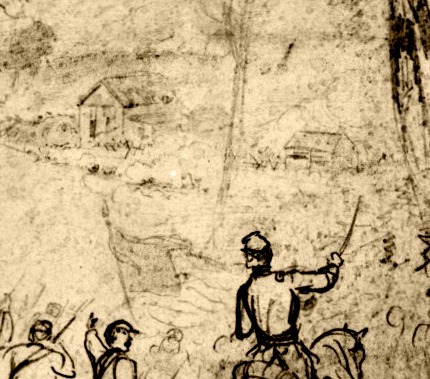
This rare sketch entitled "Antietam: The Fight at Poffinberger's [sic} Farm" shows the barn 
and house (enlargement below)  in the right background on Sept. 17, 1862.  Schell was a 
sketch artist during  the Civil War.  (Francis Schell | The Becker collection, used with permission)
An enlargement of the sketch above. (The Becker collection, used with permission)
This sketch is believed to show Rebels firing toward the West Woods  from behind a rock ledge 
on the Alfred Poffenberger farm. (Alfred Waud | Library of Congress collection)
In 1862, Alfred Poffenberger, who leased this farmstead from Mary Locher, lived here with his wife and two young children. He and his family fled once it was clear a battle would be fought.

Justus Wellington: 
15th Massachusetts
private was killed
 in the 
West Woods.
(Read more here.)
The 15th Massachusetts, which suffered 75 killed and 255 wounded in about 20 minutes in the West Woods, advanced to Poffenberger's farm, where it was attacked by regiments from Georgia and Virginia. After the battle, 15th Massachusetts dead were buried on the northwest side of the Mary Locher cabin in a trench that was "25 feet long, 6 feet wide and 3 feet deep," according to a Roland E. Bowen, a private in the regiment.

"The corpes [corpses]," he noted, "were buried by Co., that is the members of each Co. Are put together. Co. H was buried first in the uper [sic] end of the trench next [to] the woods. They are laid in two tiers, one [on] top of the other. The bottom tier was laid in, then straw laid over the head and feet, then the top tier laid on them and covered with dirt about 18 inches deep."

15th Massachusetts Private Justus Wellington, a 23-year-old shoemaker from West Brookfield, Mass., was killed in the West Woods and probably buried here.  The bodies were later re-interred, many in Antietam National Cemetery.

The cabin, a section of which is believed to have been built in the 1760s, is an ongoing restoration project and protected by a canopy..

The cabin is beyond this old root cellar, which dates to the battle.
The foundation is all that remains from the old Poffenberger barn, where wounded huddled during 
and after the battle. Confederate artillery was stationed on Hauser's Ridge, beyond the barn.
             Google Earth: Barn foundation and cabin to left of Rt.-65 (Sharpsburg Pike) .


PLEASE NOTE: Consult with park rangers before visiting this site.


SOURCE:

From Ball’s Bluff to Gettysburg…And Beyond: The Civil War Letters of Private Roland E. Bowen, 15th Massachusetts Infantry, 1861-1864. Gregory A. Coco, editor, Gettysburg, Pa: Thomas Publications, 1994.