Showing posts with label Kentucky. Show all posts

Monday, March 31, 2025

Tales from the road: Underwear, battlefields and Horse Cave

House in Munfordville built by Union General Thomas Wood's father in 1834.

                                    Like this blog on Facebook | My YouTube videos

Eager for adventure, I head north from Nashville, zooming at 80 mph by the Fruit of the Loom underwear world HQ and National Corvette Museum in Bowling Green, before arriving in central Kentucky's cave and Lincoln country. My objective is Munfordville, one of those 10,000 places where the armies clashed and boyhood home of United States Army General Thomas J. Wood. On a rise behind the county courthouse, a musket shot from the Civil War mural just off Main featuring Wood's mustachioed mug, stands the house his papa built in the 1830s.

Thomas Wood appears on a
Civil War-themed mural
in Munfordville, Kentucky.
As a child in Hart County, it is said, Wood sought adventure underground with his friend, delightfully named Simon Bolivar Buckner, the future West Point grad, Mexican War vet, Rebel general and Kentucky governor. It’s a footnote that ignites a fire in some of us, until we realize, as Sherman supposedly said of war, “I am tired and sick of [it]. Its glory is all moonshine.”

Near downtown Munfordville, the railroad track and an 1,800-foot iron bridge over the meandering Green River, a 26-year-old Scotsman and Confederate colonel from Mississippi named Robert Alexander Smith fell — one of dozens of dead from the Battle of Munfordville, fought September 14-17, 1862. To honor Smith's memory, his brother commissioned a limestone battlefield monument — it stands on private property, behind a wrought-iron fence, among flags, inscribed markers and shadows. Visit it if you dare.

After exploring the Munfordville and nearby Rowlett Station battlefields, I steer south to Horse Cave (pop. of 2,300), home to Just In Gypsy Antiques and 5 Broke Girls, a favorite spot for country grub. At the corner of Main and Cave, across the street from a man sleeping in his beat-up black Chevy pickup near the “Welcome to Horse Cave” mural, I spy the entrances to Hidden River Cave and American Cave Museum. With time to spare before returning to the loving arms of Mrs. B, I venture inside. Rumor has it that the cave has a Civil War connection after all.

Hidden River Cave in
Horse Cave, Kentucky.
Inside the cave command center stand a few 20- and 30-somethings. Guides and staffers, as it turns out. They somehow endure a volley of questions from me.

“Didn't they hide horses in this cave during the Civil War?”

"No, not much happened here during the Civil War,” replies a long-haired, red-headed dude, instantly destroying a soul. Minutes later, he directs me to the cave entrance. At the bottom of a long staircase, a gratis view awaits.

By the yawning gap, I ponder whether Wood, Buckner or any other Civil War soldier had inscribed his name inside and consider taking a stroll across the “world's longest swinging cave bridge.” Instead, I retrace my steps, sending my FitBit heart rate into overdrive.

Upon returning to the CCC, I meet Al, a mandolin player in a bluegrass band. He’s a local who once lived in obscure places in west Tennessee. Al is a cave employee, too.

“What do people do in Horse Cave?”

"Not much besides caving,” he tells me. To catch a movie, locals visit “E-town” — Elizabethtown — roughly 40 miles away.

Then Al notices my T-shirt for Lambert's Cafe, the “throwed rolls” restaurant near Wilson's Creek battlefield in Missouri. In 15 minutes, we bond over memories of heaps of food at Lambert’s, bluegrass star Bill Monroe and Abe Lincoln, born over in Larue County, several hundred thousand roll tosses distant. Before my departure, Al waves me over to the front counter and signs off on a tour ticket for two, a $50 value. I’d use it today, but alas, those loving arms await.

Let’s keep history alive. 👊

My new pal Al, a Hidden River Cave guide and mandolin player in a bluegrass band.

Sunday, January 14, 2024

Tales from the road: Where 'The Wizard,' 'Stovepipe' fought

"Cannons are loud," reads the marker on the Battle of Sacramento (Ky.) reenactment site. 

                   Like this blog on Facebook | Follow me on Twitter | My YouTube videos

The Civil War was fought in 10,000 places,” historian David McCullough told us in Ken Burns’ epic TV documentary Civil War, “from Valverde, N.M.,, and Tullahoma, Tenn., to St. Albans, Vt., and Fernandina on the Florida coast.” Here’s another one of those 10,000 places, Sacramento, Ky. — a blink-and-you’ll-miss-it, no-stoplight town a two-hour drive north of Nashville.

Adam "Stovepipe" Johnson
Since 2009, Betty Howard has served as mayor of Sacramento (population 425), which holds a reenactment of the battle in the spring. “Caution: Cannons are loud,” reads a marker on the battlefield about the event. (Who knew?) In town, I spotted one carwash, one battlefield monument, one Dollar General, two service stations and bristled at the yapping of two nervous hounds.

Now, how many of you have heard of the Battle of Sacramento?

Here, on Dec. 28, 1861, notorious slave trader Nathan Bedford Forrest — the Rebels’ “Wizard Of The Saddle” — earned his first victory and honed fighting skills that would serve him later in the war. “Forrest’s First Fight,” the locals call the battle against United States cavalry.

Casualty figures are murky, perhaps as few as a dozen total, but loved ones mourned the dead of Sacramento just as they did the dead of major battles at Shiloh, Antietam, Gettysburg and elsewhere. Confederate Capt. Ned Meriwether — the father of six — fell here. Two bullets to the head. So did 45-year-old Captain Albert Gallatin Bacon of the 3rd Kentucky Cavalry (United States), mortally wounded by thrusts of a sword by Forrest.

A report in the Jan. 14, 1862, Daily Selma (Ala.) Reporter of  the death of Albert Bacon.

Forrest scout Adam “Stovepipe” Johnson — who later became a semi-famous Confederate guerrilla — fought here, too. The former drugstore employee earned his nickname during an 1862 raid by his scant force on Newburgh, Ind., a town astride the Ohio River. As a ruse, Johnson tied pieces of stovepipe to blackened logs and pointed out the “cannons” in the far distance to a Unionist in Newburgh. (What a day to not carry binoculars.)

Mollie Morehead's grave
Blinded in a skirmish in 1864 at Grubbs Crossroads, “Stovepipe” Johnson served out the war as a POW at Fort Warren, in Boston Harbor. After the war, he made his way to Texas, where be founded Marble Falls, which became known as “The Blind Man’s Town.”

For the Rebels, this battle also featured a heroine/amateur scout. As Forrest’s cavalrymen approached Sacramento, they spotted a young woman riding a bareback horse. “There the Yankees are! Right over there!" 18-year-old Mollie Morehead shouted, pointing back over a hill.

In the northeast corner of Cumberland Presbyterian Church Cemetery, near a toppled tombstone, I found Mollie’s grave. The wife of a dentist, she died during child birth in 1870, 13 days after her 27th birthday.

Let’s keep history alive. 👊 

Enjoy stories like this? Consider purchasing a copy of my book, A Civil War Road Trip Of A Lifetime. Email me a jbankstx@comcast.net for details on how to get an autographed copy.

A Commonwealth of Kentucky historical marker in Sacramento.
Where United States and Rebel cavalry clashed during the Battle of Sacramento (Ky.). 
Take the driving tour of the battlefield. 

Saturday, February 12, 2022

Did this man save Abraham Lincoln from drowning?

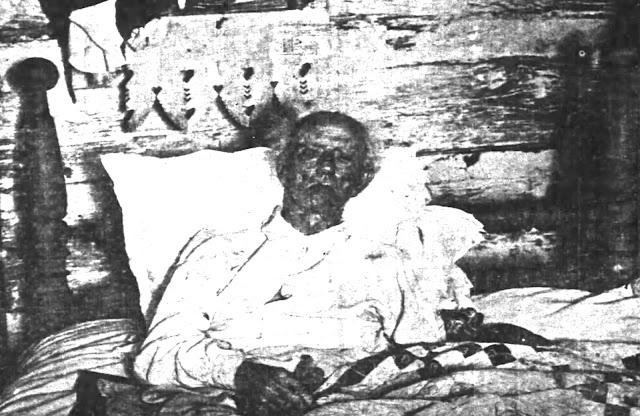
In 1897, the Louisville Courier-Journal propped up a frail Austin Gollaher
in his bed for this photo. (Newspapers.com)

Like this blog on Facebook | My YouTube videos 

Well into his old age, Austin Gollaher delighted telling about how he saved his boyhood friend Abraham Lincoln from drowning in a rain-swollen creek near Hodgenville, Ky. A version of the story went like this:

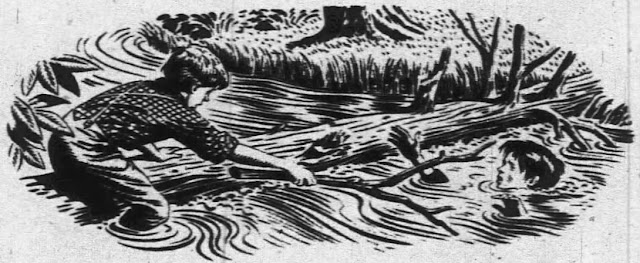
In 1816, Gollaher, then 9 or 10, and 7-year-old Abraham went to Knob Creek to scare up some possum. (Or was it pigeons?) Lincoln's family lived on a farm along the creek. Gollaher lived nearby. The only way to cross the creek when the water was running high was by straddling a log. About halfway over, Lincoln—who didn't know how to swim then—slipped and fell in. Gollaher couldn't swim either, so he grabbed a sycamore branch and shoved it into the water. Lincoln grabbed it, and his friend hauled him to safety. Roughly 20 minutes later, Abraham had finally recovered from his near-death experience. 

Lincoln apparently never mentioned the event during his presidency. In an 1889 Lincoln biography by William Herndon, the president's former law partner, the drowning story earned two sentences. Respected 21st-century Lincoln scholar Michael Burlingame also briefly mentioned the story in his Lincoln biography. His sources were two Gollaher interviews. Based solely on Gollaher's account, the drowning story appeared in many late-19th century newspapers throughout the United States.  

But there's no doubt Lincoln and Gollaher were close at one time. "I would rather see Gollaher than than any man living," Lincoln said while in the White House.  

So, does this story, ahem, hold water?

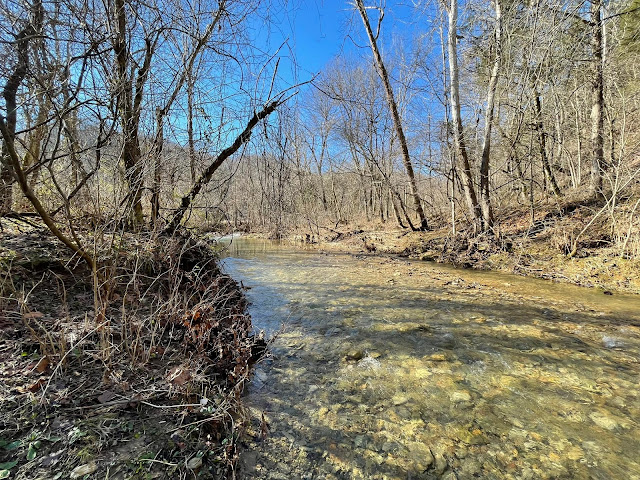
Knob Creek, where Lincoln played as a youth--and may have nearly drowned.
An illustration of the rescue at Knob Creek published in the St. Louis Globe-Democrat on Feb. 7, 1954.

To learn more about Lincoln's childhood playmate, I dived into the swimming rabbit hole of newspapers.com. One story—a lengthy feature published in the the Louisville Courier-Journal on Sept. 26, 1897—captured my attention. By then, the once-heavyset, tobacco-chewing Gollaher—"Uncle Austin" to those who knew him well—apparently was on his deathbed. A devout Christian, Gollaher suffered from rheumatism, among other ailments.  

An image of
Austin Gollaher
published in the 
St. Louis Globe-Democrat 
on Feb. 7, 1954.
"Austin Gollaher, aged almost ninety-two years, sire of four living generations, patriarch of a county and the only known surviving playmate of Abraham Lincoln's boyhood days is slowly but nonetheless surely drawing toward the end of his earthly career," read the opening paragraph.

I don't think my 20th-century journalism professors would approve of that lede.

In a weak, halting voice, Uncle Austin talked about attending school with his friend, protecting him against bullies, and about the near-drowning—Abraham "spit up about two quart [of water]" after his rescue, Uncle Austin said. Gollaher "brightened up" when asked about Lincoln and his sister, Sarah, a "purty gal" who also went by "Sally." "We were sweethearts then," he told the reporter. 

The Courier-Journal even propped up the frail Gollaher for a photograph in his bed at the spartan, backwoods house where he lived with his son. Reported the newspaper:
"As the artist's camera was placed and brought into range with the old man his talk drifted back to the war at the sight of what he took to be a gun. The sudden explosion of the flash-light powder caused him a geniune shock. However, be it said to his credit as a warrior, he was not alarmed beyond the first surprise. He merely gave one tremendous lurch: then, shading his eyes with his hand and peering sharply at the instrument through the ascending smoke, in a cool, yet anxious voice, he asked: 'Did you hit anybody that time?' and receiving in reply the assurance that it was only target practice."
Courier-Journal be damned, Gollaher hung on until Feb. 21, 1898. He left seven children, dozens of grandchildren, and a story that, if true, changed history. 

After a visit to the Lincolns' Knob Creek Farm, I paid respects at Gollaher's grave at Pleasant Grove Baptist Cemetery, near Hodgenville. Atop his marker I left a penny, Lincoln side up of course.


 — Have something to add (or correct) in this post? E-mail me here.


SOURCE

Burlingame, Michael. Abraham Lincoln: A Life, Volume One, Baltimore: John Hopkins University Press, 2008.

Saturday, February 05, 2022

'Life of an ox': Where Abraham Lincoln lived ages 2 through 7

Knob Creek Farm, near Hodgenville, Ky.

Like this blog on Facebook | Follow me on Twitter 

Steep, heavily wooded hills — “knobs” —  rise on each side of the Knob Creek farm where Abe Lincoln lived from ages 2 to 7. On a frosty, deep-blue sky morning, I visited the secluded site for a story for The History Channel. What a beautiful spot. But life was difficult here near Hodgenville, Ky., for the Lincolns, as it was for all frontier families.

Gravestone of Abe Lincoln's brother,
Thomas, who died in infancy.
The marker is in the visitors' center
at Lincoln's birthplace in Hodgenville, Ky
.
“Life on the frontier was little better than the life of an ox,” Lincoln historian Michael Burlingame told me. But the Lincolns, he says, were especially poor.

The family — Abraham, father Thomas, mother Nancy and sister Sarah — lived in a one-room cabin with a dirt floor, On the farm's wide fields, Lincoln’s father planted corn and pumpkins.

In front of the Lincolns’ door, on the road from Louisville to Nashville, the world passed: pioneers with heavily laden wagons, peddlers, slaves, local politicians, missionaries and soldiers returning from the War of 1812.

In rain-swollen Knob Creek in 1816, a Lincoln playmate may have saved Abraham from drowning. That story bears more scrutiny. In 1812, Lincoln’s infant brother Thomas died on the farm. 

Roughly two miles down the road from Knob Creek farm, Lincoln sporadically attended with Sarah an ABC school—a so-called “blab” school in which the students repeated oral lessons from a teacher. 

In the winter of 1816, the family left Knob Creek for a settlement in southern Indiana

A replica of the cabin the Lincolns lived in at Knob Creek.
Knob Creek, where Lincoln may have nearly drowned.
Avoid snakes near Knob Creek!
A "knob" looms near Lincoln farm site.
The Lincolns planted corn and pumpkins here in the rich soil.
Roughly two miles from the farm, Lincoln and his sister attended a school at this site.

 — Have something to add (or correct) in this post? E-mail me here.

Tuesday, January 11, 2022

In baby steps of Abraham Lincoln in Hodgenville, Kentucky

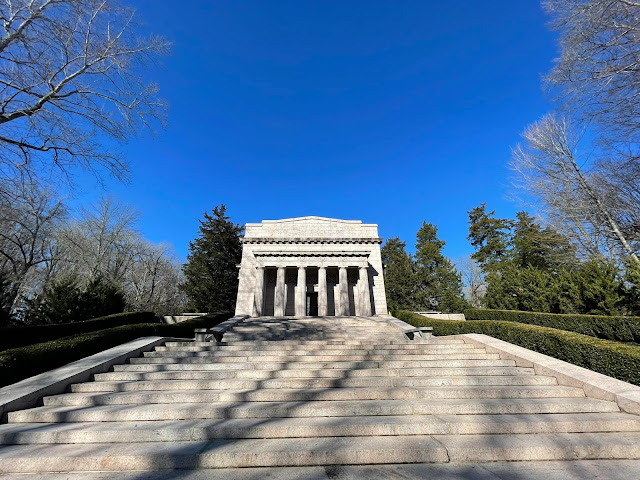
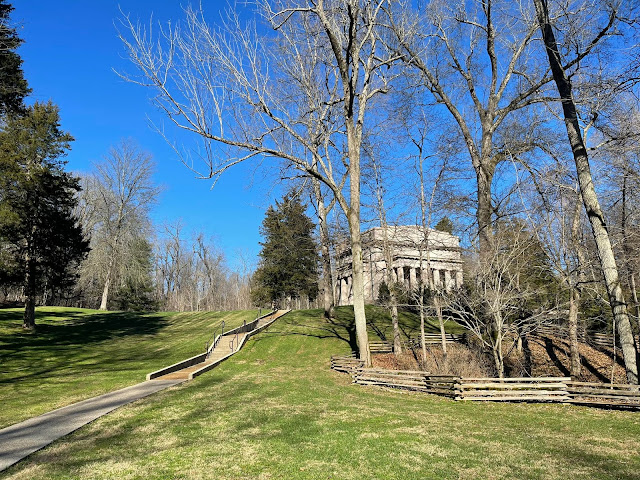
Fifty-six steps to the top -- one for every year of Lincoln's life.
I made it to the top, slightly winded.

Like this blog on Facebook | Follow me on Twitter

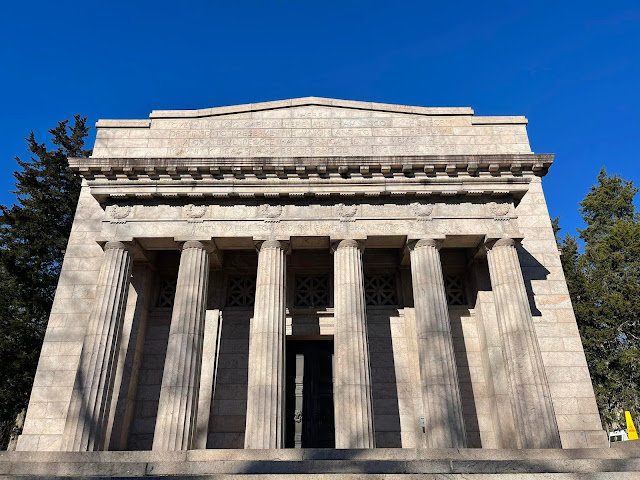
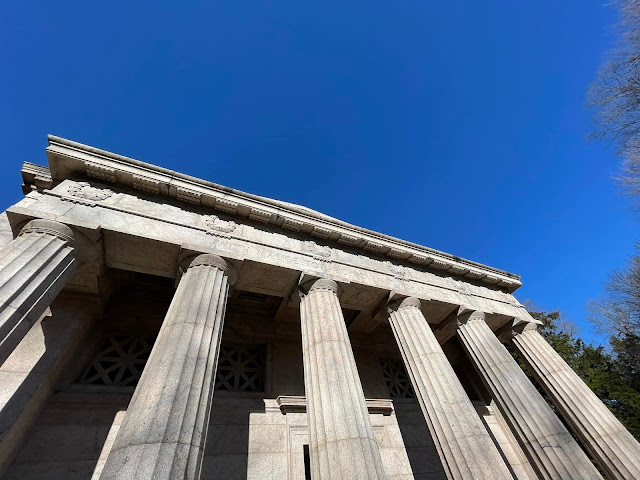
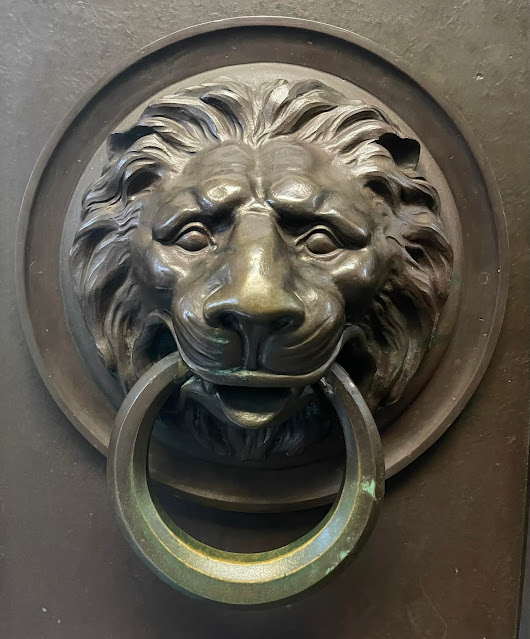
On Monday morning, I visited the birthplace of Abraham Lincoln at Sinking Spring Farm in Hodgenville, Ky. No, he didn’t live in this impressive structure. (Loved the lion door handle flourishes there, by the way. 😁) But inside there’s a replica of the one-room cabin he was born in on Feb. 12, 1809. Archaeologists found nothing at this site, a National Park Service employee told me. Lincoln mentioned living on a hill above a spring, so hence the memorial was built here. I checked out the spring, too. In 1811, the Lincolns moved to nearby Knob Creek Farm—much different topography there. Enjoyed walking in the baby steps of a great American on a frosty, deep-blue sky day.

The deep-blue sky made for an excellent backdrop.
The view from the Lincoln memorial.
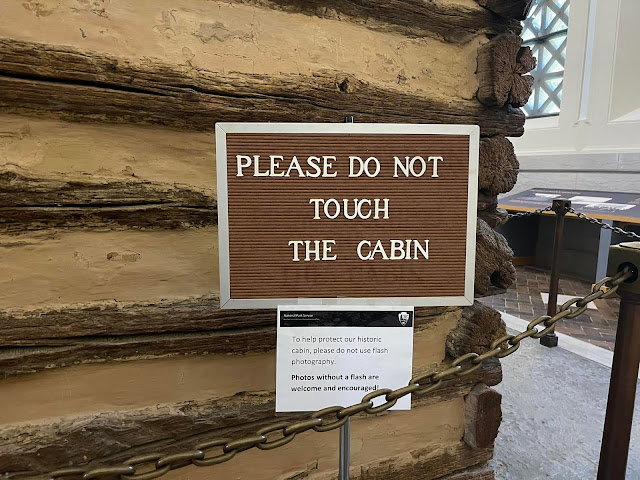
A replica of the cabin on the site where Lincoln was born on Feb. 12, 1809.
Don't get handsy at the replica cabin.
Lion's door handles would be nice addition to Banks Manor.
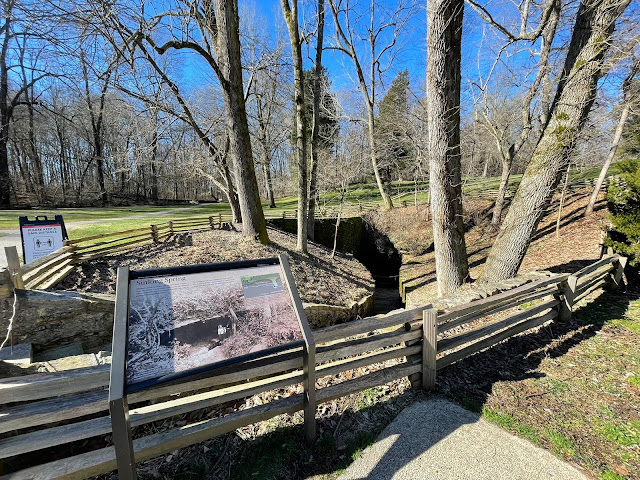
A historical marker explains Sinking Spring.
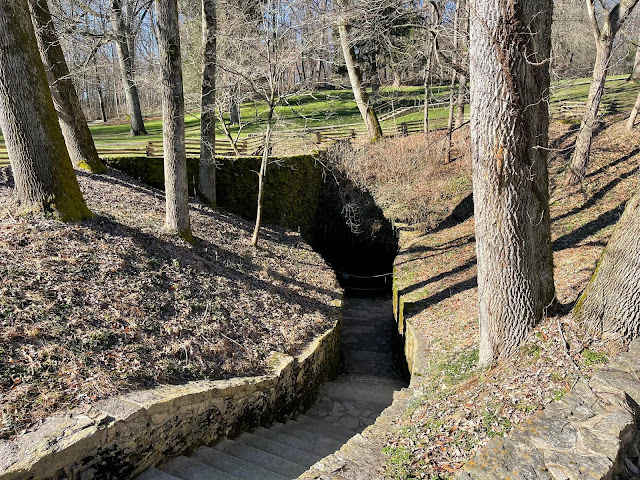
Another view of the spring.
The spring (right) is below the memorial.

 Have something to add (or correct) in this post? E-mail me here.

Friday, October 23, 2020

What caught my eye at haunting Perryville (Ky.) battlefield

Henry Bottom's restored farmhouse on the Perryville (Ky.) battlefield. Please do not
 trespass on this private property. (CLICK ON IMAGES TO ENLARGE.)

Like this blog on Facebook | Follow me on Twitter

Poor Henry Pierce Bottom.

"Squire" was a successful cabinet maker/farmer in Perryville, Ky., raising cows, sheep and pigs and growing corn and oats on more than 600 rolling acres near Doctor's Creek. Then came Oct. 8, 1862, when thousands of soldiers from both armies swept over his property, destroying crops, setting a barn afire with artillery, and wrecking his farmhouse-turned-makeshift military hospital.

A post-war image of Henry Pierce Bottom
(and a pest) on an interpretive marker near
his old farmstead.
Bottom's psyche was wrecked, too. Asked during his war claim testimony after the war if "Squire" recovered from his losses, a Perryville doctor replied, "No sir, he never did. He was broken in spirit from that time on until he died." The 53-year-old's losses included nine cows, 30 sheep, two horses, 4,500 pounds of bacon, 3,000 bushels of corn, 22 tons of hay, and 50 bushels of oats. 

Bottom sought more than $4,000 in compensation from the U.S. government -- a princely sum at the time -- but the supposed Southern sympathizer never saw a penny of it during his lifetime. Long after 92-year-old Henry's death in his bullet-riddled battlefield house in 1901, his heirs were finally awarded a whopping $228.66.

I recently walked the ground on Bottom's old farmstead, examining ground unsuccessfully defended early in the battle by the Don Carlos Buell-led Army of the Ohio. What a hauntingly beautiful field -- hallowed ground where more than 7,600 soldiers  (4,201 Federal, 3,401 Confederate) became casualties in perhaps the war's most unheralded battle. 

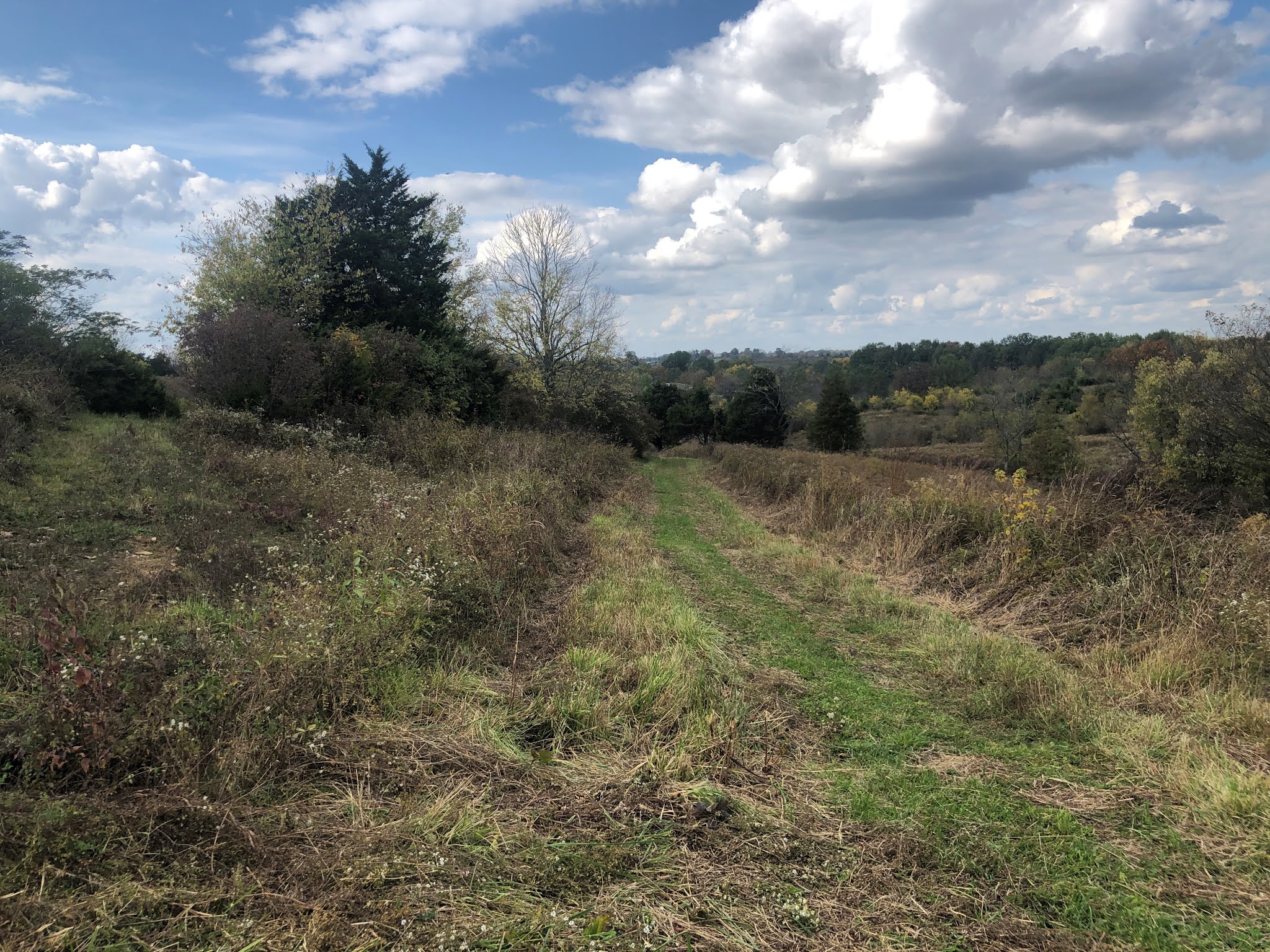
Scouting report: Lord, what's with all these heart-racing hills? Perryville looks like a wool blanket haphazardly tossed on the floor. On a captivating fall afternoon, I topped out at 122 bpm on my FitBit during a particularly tough stretch. And I was only armed with an iPhone ... Remove the power lines, markers and the few memorials and you're living in 1862. So beautiful; so pristine. And the 19 miles of trails in the state historic site are excellent. It's the Western Theater version of Antietam (and another Union victory, too.) ... Interpretive markers: Outstanding, although some are weather-worn and badly need TLC. (Only one mention of "hail of fire" noted. Yikes!) ... Names to know: Parsons Ridge, Dixville Crossroads, Starkweather's Hill, Hartzell's Fence, Devil's Lane ... Road kill spotted: One skunk, one raccoon, one possum. 

Here's what else caught my eye: 


DOCTOR'S CREEK, where thirsty 42nd Indiana soldiers were filling their canteens with water near these cliffs when Confederates struck. The first enemy cannon shot ripped apart tree limbs, a Hoosier recalled; the next one knocked away a stand of guns. What a fearful sight for a rookie regiment. 

GROUND COVERED BY DANIEL ADAMS' BRIGADE: Here where the one-eyed general -- Adams lost the other at Shiloh -- and his soldiers attacked the Federals, who held ground near Bottom's burning barn in the far distance. Some wounded Yankees died in that ghastly inferno.  

A RE-CREATION OF WAR-TIME STONE WALL on the Bottom farm. In 1862, the wall here was  used as meager cover by Confederates.


EERIE COLOR. At the crest of Union-defended Starkweather Hill, an interpretive sign told of ground made slippery with blood during a Confederate assault. Two eagles soared overhead in a deep-blue sky. Then I looked down and saw this lone patch of brilliant color at the foot of the hill. 


THESE BEASTLY HILLS: 900 Mississipians advanced here under fire here against a numerically far superior enemy on the opposite ridge. The men and boys who did this weren't just soldiers, they were athletes."Of all the horrible suffering," a Union soldier recalled of the sight, "I [hope] I may never witness the like again."  

Decades later, a Confederate veteran speculated about why many of his comrades suffered so many head and mouth wounds. "...it was in a desperate charge on the enemy, who were posted on advantageous ground and were first-class marksmen," he recalled. "The Confederates in making the charge were yelling with all their might. There was little to obstruct the vision of the Yankees, who drew a fine bead on the charging and yelling Confederates." 

MICHIGAN'S IMPRESSIVE PRESENCE ... Wolverines!


A KNOLL OF DEATH: John Russell's ideally situated home became Union General Alexander McCook's HQ. Then it became a hospital. Scores of horribly wounded men and boys from both sides lay in and around the two-story, Federal-style house. Fighting here was fierce. "Trees not more than one foot in diameter contained from twenty to thirty musket-balls and buck shot, put into them during the battle," a Perryville doctor recalled. 

At a soldiers' reunion 24 years later, the battlefield yielded scores of relics. "The ground was tickled," a Kentucky newspaper reported, "and it gave forth a crop of canister shot, bullets, old sabre points, pieces of shells, and other evidences of the destructive material which had been used in that engagement. ... We hardly believe we exaggerate when we say a half bushel of minie balls, grape and canister shot and shells was picked from the furrows of the now tilled fields that day."

WHERE "DIXIE" DIED: After Patrick Cleburne's Confederates advanced up this hill, the Irish-born general's horse was shot from under him, supposedly by a one-in-a-million artillery shell fired from 1,650 yards. Miraculously, the "Stonewall Jackson of the West" only suffered an injured ankle, and he continued to lead his troops on foot.

WHERE A UNION GENERAL FELL ATOP PARSONS RIDGE: "Impressive in person, graceful in manner, kindly, chivalrous, he was the highest type of Kentucky gentleman,” the historical marker describes James S. Jackson, a 39-year-old brigadier general. The New York Times 1862 obituary wasn't as kind: "He leaves no family to mourn his loss. In manner he was brusque and overbearing, and as a consequence was a party to numerous quarrels, which sometimes resulted in duels. One of the most notable of these difficulties was a street fight in Hopkinsville, Ky., in which he had the misfortune to kill his antagonist."


WHERE OHIOANS FLED ... and in a cornfield in the left distance, green soldiers from Wisconsin nervously waited as Confederates routed their comrades on Parsons Ridge.

WHERE A CONFEDERATE GENERAL NARROWLY ESCAPED: Leonidas Polk found himself behind Union lines here. Somehow he deftly rode his horse back to his own lines and ordered “no man to ... fire a gun unless he had dead aim on a Yankee.” The result was devastating for the U.S. Army. Less than two years later, at Pine Mountain (Ga.), Polk was killed by a well-aimed, three-inch Federal artillery shell that went through his chest.


WHERE U.S. ARMY AVERTED DISASTER: Dozens of Union supply wagons were parked here, near the Dixville Crossroads. If Braxton Bragg's Army of the Mississippi captured them, the Yankees' I Corps would have been cut off from the rest of the Union Army.

SIMON BOLIVAR BUCKNER'S HEADQUARTERS: John Dye's home was occupied by the Confederate general, who eight months earlier had unconditionally surrendered Fort Donelson to Ulysess Grant. Interested in blood-stained floors? You'll find them here on the second floor.

THE DEMONIC EYES ON THE STATUE of the musket-toting soldier atop the memorial at the Confederate mass grave on Farmer Bottom's war-time property. "Squire" buried most of these unfortunates. 

AND IN THE CONFEDERATE CEMETERY, A MARKER FOR THE FALLEN, who remain unforgettable.


-- Have something to add, correct? E-mail me at jbankstx@comcast.net


SOURCES

-- Kentucky Advocate, Danville, Ky., Oct. 15, 1886.
-- Nashville Banner, March 18, 1911.
-- New York Times, Oct. 11, 1862.
-- Perryville battlefield interpretive markers.