Showing posts with label John Otto. Show all posts

Sunday, May 12, 2013

Antietam panorama: Ruins of John Otto's barn

                                             Click on image for full-screen panorama.


John Otto's farm house, photographed from Burnside Bridge Road.
Seldom seen by battlefield visitors today, the remains of John Otto's Pennsylvania-style bank barn may be found just beyond a strip of woods, about 100 yards behind Otto's large farmhouse at Antietam battlefield.

After the battle, Otto's house and barn, used as makeshift Federal field hospitals, were the scene of horror and anguish. Wounded soldiers from the 16th Connecticut were first treated here before they were moved to other hospitals, such as the German Reformed Church on Main Street in Sharpsburg. Otto, whose buildings were used as hospitals until Nov. 4, 1862, filed a compensation claim with the government in 1873 for $2,350.60 but was eventually awarded only $893.85, according to research by John Nelson on his outstanding "As Grain Falls Before the Reaper" CD.

John Rogers, who blogs about 8th Connecticut Pvt. Oliver Case, and I visited the remains of the barn during a recent overcast afternoon. All of Otto's Civil War-era outbuildings, including a kitchen, spring house and hog pen, are long gone, but ruins of a root cellar may also be found behind the house.

The immediate area around the Otto house looks much different than it did during the Civil War. For example, open ground to the left of the house in the image below is now woods. The Otto house sits high on a hill, overlooking the road that leads to Burnside Bridge, about a quarter-mile away. In Otto's 40-acre cornfield, about a half-mile behind the house, the 16th Connecticut suffered 43 killed and 161 wounded. (See full-screen panoramas of Otto's cornfield here.)

An early 20th-century image of the Otto farm shows five outbuildings, including the
 large Pennsylvania-style bank barn behind the house. The Otto farm house and
 barn were used as Federal field hospitals after Antietam.
Ruins of farmer John Otto's barn, 100 yards behind the Otto farm house.

Wednesday, November 21, 2012

Antietam: If only we could be a fly on the wall ...

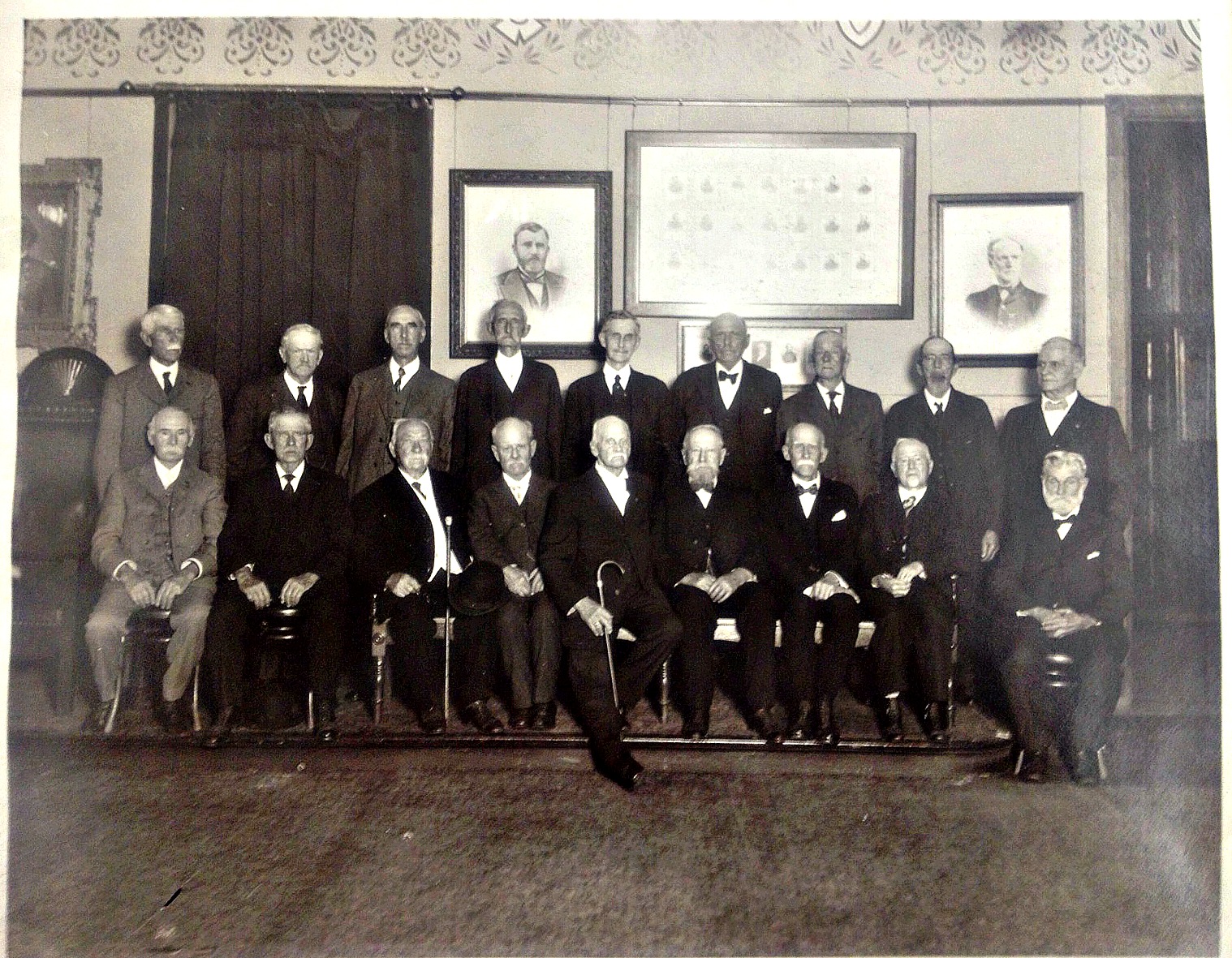
Veterans of the 16th Connecticut gathered for this photo on Sept. 17, 1921 -- 
the 59th anniversary of the Battle of Antietam. It was published in the
 Hartford Courant on Oct. 2, 1921. 
(Photo: Connecticut State Library archives; CLICK ON IMAGE TO ENLARGE.)  

With large pictures of  Civil War generals Grant and Sherman looming in the background, 18 veterans of the 16th Connecticut gathered for this photograph in the Grand Army Hall in Hartford on Sept. 17, 1921 -- the 59th anniversary of the Battle of Antietam.  Nearly all these men fought at Antietam, where their regiment was routed in farmer John Otto's 40-acre cornfield. Just imagine the stories these old men, in their late 70s or early 80s, swapped as they smoked cigars, sipped a little whiskey and kicked back in leather-bound chairs.
Robert Kellogg (right) , a private in the 16th Connecticut, 
 described the horrors of Andersonville in a book published  
in 1865.
(Photo courtesy
Connecticut History Online/
Connecticut State Library.)

Henry Adams, seated and clutching a cane in his right hand in the center, suffered gunshot wounds in his legs and then lay on the battlefield for at least 17 hours before he was discovered by comrades. His mother traveled south from Connecticut to help nurse him back to health, but he was not released from a Maryland hospital until April 1, 1863, nearly seven months after the battle.  "Was no April Fool day to me, when my mother and her cripple boy on crutches started 'Homeward Bound.' " he bitterly noted about that day. "I received my discharge papers at Hagerstown (Md.) and my full pay for doing ... nothing -- except to be maimed for life and to draw a U.S. pension." (1)

Four other veterans in this photograph also were wounded at Antietam: George Whitney (seated at far left); Maranthon Keendey (seated at far right); Walter Smith (standing behind Adams); and Jasper Harris (standing, third from right). Harris became a prisoner of war at Antietam and was not paroled until Oct. 6, 1862.

After Antietam, at least 13 of these men suffered further trauma. On April 20, 1864, nearly the entire 16th Connecticut was captured at Plymouth, N.C., and sent to rebel prisons. Many men in the regiment died in Andersonville, the most notorious prison camp of the Civil War. Robert Kellogg, seated third from the right in the front row, was a private in Company A when he captured. After the war, he wrote a book about his experience at Andersonville.

"I ... wished that the President, under whose banner we had fought, could look in upon our sufferings, for surely the sight would move him to help us, if anything could be done," Kellogg wrote. "Live worms crawled upon the bacon that was given us to eat. 'It is all right,' we said; 'we are nothing but Yankee prisoners, or, as the rebels usually speak of us, 'damned Yankees.' " (2)
 
Some of the 16th Connecticut soldiers released from rebel prisons never recovered, including Wallace Woodford of Avon and Austin Fuller of Farmington, both of whom died at home. I often wonder what terrible war memories some of the ex-POWs in this photograph carried with them for the rest of their lives.

(1) George Q. Whitney Collection, Connecticut State Library
 (2) "Life And Death In Rebel Prisons," Robert H. Kellogg, 1865, Page 166