Showing posts with label John Banks' blog. Show all posts
Showing posts with label John Banks' blog. Show all posts
Wednesday, April 21, 2021

Saturday, March 11, 2017
'Quietly sunk away': Friend's tribute to Massachusetts private
 |
| At Second Manassas, Major General Fitz John Porter's V Corps, which included the 18th Massachusetts, charged across this field to attack Confederates in the Unfinished Railroad Cut. (Library of Congress) |
(Click at upper right for full-screen panorama.)
Like this blog on Facebook
In cold, clinical language, a Union surgeon described the condition of gunshot victim William D. Fuller, who had recently been admitted to Union Chapel Hospital in Washington.
"...circular wound of arm, four inches below acromion process of scapula; shoulder swollen," William H. Butler wrote shortly after the 18th Massachusetts private had arrived from the Second Manassas battlefield, the regiment's first major action of the war. "Complains of pain on motion. Some yellowish discoloration over outer part of scapula and tenderness on pressure. Applied cold water constantly which had the effect to reduce the swelling."
For the next several weeks, Butler documented his observations of his 30-year-old patient. On Sept. 3, 1862, a piece of a musket ball, "greatly misshaped and irregular," was removed from Fuller's shoulder. Two days later, another piece of the ball was removed from that wound, easing the pain of the shoemaker from Needham, Mass. Ten days later, pieces of small bone were found in his dressing, apparently caused by a "copious discharge."
On Sept. 18, Fuller, whose hospital diet included mutton and oyster broth, had an "anxious look" and a fever. A day later, the nervous soldier complained that the church hospital at the corner of Pennsylvania Avenue and 20th Street was noisy. At night, Fuller, described as "very yellow," was "sleepy and dosy," muttering as he lay in a "heavy typhoid state." He talked "rather thick," Butler noted, "evidently the result of pus absorption."
 |
| Another view of Unfinished Railroad Cut, (Photo courtesy Shelly Liebler. More of her images here.) |
18th Massachusetts Private William Fuller died here on Sept. 25, 1862.
(Google Street View)
Butler's patient sipped wine, and Fuller's hemorrhaging wound was controlled by frequent changes of bandages. But early on Thursday morning, Sept. 25, 1862, the married father of four children died. Cause of death: pyemia. An autopsy later that day revealed Fuller had suffered from a fractured shoulder blade and gangrene, among other health issues.
Of course, Butler's detailed account of Fuller's treatment hardly presented a full picture of the life of the 18th Massachusetts private.
On Nov. 21, 1862, nearly two months after Fuller died in a hospital near the White House, an obituary for him appeared in The Liberator, a weekly Boston newspaper published by ardent abolitionist William Lloyd Garrison. Information may have been supplied by Fuller's army comrade or a Needham resident, who wanted a friend to be remembered. We know him only by his initials -- E.S.A. Could he have been 18th Massachusetts Sergeant Eli Atwood Jr., who was killed at Fredericksburg, Va., a little less than two months later?
"Notices like the above are so sadly common at present that they hardly excite attention, much less provoke comment," The Liberator noted in a paragraph after the who, what, when and where of the death of Fuller, an ardent abolitionist himself. "The individuality of a private soldier, in an army of a million of men, is so far lost, that but for the watchfulness of friends, heroism and cowardice would be buried in one common oblivion. In this instance, as in thousands of others, it is left to a friend's hand to snatch from forgetfulness the memory of a brave and good soldier."
 |
| The beginning of Fuller's eloquent obituary in The Liberator on Nov. 21, 1862. |
Mr. Fuller was one of the earliest to enlist under the first call for three years men. He was induced to take this step, not by the mere enthusiasm of the moment, but after careful consideration of the subject, and counsel with friends, he chose a soldier's life from a sense of duty. Though he left behind him a wife and four children, his high purpose never faltered from the first, His frequent letters were a mixture of womanly tenderness and manly resolve. He knew what he had to leave before he left; he understood what he was to undergo before he encountered it. No man had a juster comprehension of the sacrifice to be made, and no man made it with more thorough heartiness, or with more self-forgetful courage.
 |
| William Fuller's gravestone in Washington's U.S. Soldiers' and Airmen's Cemetery, formerly Military Asylum Cemetery. (Edna Mode | Find A Grave) |
He fell on the fatal field of Bull Run, With a single comrade he was skirmishing on the edge of the battle. A rebel sharpshooter, behind a pile of railroad iron, was annoying the men, and he was determined to silence him, which, after a few shots, he succeeded in doing, and then turned his attention to a second, who, hidden behind a similar breastwork, flaunted a small secession flag every time he fired. Just as he was preparing to fire, a ball from his enemy pierced his lungs, and he fell. His comrade raised him, and was about to carry him from the field, but he refused, saying he wanted to see the fight out. Stretched on the field, he watched the shifting phases of the conflict, till, feeling exhausted from loss of blood, he tried to make his way to the rear. He had gone but a short distance when he was struck in the leg by a spent cannon ball and 2was so disabled that he was obliged to be carried from the field, He was put into an ambulance and sent to Alexandria, a distance of twenty-five miles, "the longest ride," he says, "I ever took," and thence to Washington, where , after two operations, the ball was at length removed from the shoulder, where it had lodged. He was supposed to be out of danger and doing well until a few hours before he died, when hemorrhage ensued, and he quietly sunk away into the sleep that knows no wakening.
In this hour, when bereavement is such a general heritage that men are in danger of forgetting all but their own private griefs, a friend who knew and loved the departed would lay this humble tribute on his distant grave. Brave soldier and true man, he realized the promise --
"To them who, by patient continuance in well-doing, seek for glory, honor, and immortality, eternal life"
Grantville, Oct. 28, 1862
E.S.A.
Fuller was buried in Military Asylum Cemetery, now called U.S. Soldiers' and Airmen's Cemetery. His gravesite is Plot B 745.
 |
| Another view of Fuller's gravestone (center) in U.S. Soldiers' and Airmen's Cemetery in Washington. (Edna Mode | Find A Grave) |
Have something to add (or correct) in this post? E-mail me here.
SOURCES
-- Buffalo Medical and Surgical Journal, Edited by Julius F. Miner, M.D., Buffalo: Joseph Warren & Co. Printers, 1863.
-- The Liberator, Boston, Mass., Nov. 21, 1862.
Saturday, March 19, 2016
Decades after Battle of Bentonville, a Connecticut vet suffers
 |
| In a photo probably taken shortly after the Civil War, Jesse Rice, a private in the 20th Connecticut, poses in the studio of a photographer in New Haven, Conn. (Photo: Blogger's collection) |
On March 19, 1865, less than a month before Lee surrendered to Grant, Jesse Hull Rice suffered a gunshot wound to his right arm at the Battle of Bentonville (N.C.). The 20th Connecticut private's limb was amputated nearly two months later, but the surgeon apparently botched the operation, leaving Rice with a painful, lasting reminder of his 38 months in the Union Army.
After the war, Rice twice tried to be outfitted for an artificial arm, but a physician wrote it was not possible “for reason that end of bone is so sharp & and whole stump is so painful." The veteran had trouble sleeping because of the amputation.
A New Haven, Conn., physician noted a litany of maladies for Rice, all largely due to the “nervous shock from loss of [the] arm and the disadvantage to which this loss put him.” Rice, only 53 at the time, suffered from “severe constipation,” dizziness, a double hernia, frequent attacks of diabetes, “great pain in defecation,” and an “inability to properly digest food,” among other ailments. Once weighing about 185 pounds, Rice only had 140 pounds on his 5-foot-11 frame.
“His condition in a general way is as bad as it could be and but for a strong will and superior intellect he would be absolutely helpless,” wrote a doctor, adding, “If [Rice] long survives it must be through constant and daily medical attention and judicious nursing.”
In 1895, another doctor wrote in a pension affidavit for Rice that his patient suffered from attacks of severe retching and vomiting that would continue for two or three days and then recur a day or two later. “It appears to have become a chronic condition for him,” noted the physician, who attributed Rice’s awful health to his war wound.
In a post-war diary in which he recorded the weather, deaths in the neighborhood, the assassination of President Garfield and the butchering of his 428-pound hog, Rice barely made mention of the Civil War. Perhaps it was just easier to forget.
“18 years since Bentonville,” the married farmer simply wrote in 1883 on the anniversary of his wounding.
When he died in 1915 at 71, Rice, who lived in Cheshire, Conn., was on government rolls for a $55-a-month war pension.
Have something to add (or correct) in this post? E-mail me here.
SOURCES:
-- Jesse Rice pension file, National Archives and Records Service, Washington D.C.
-- Jesse Rice diary, Connecticut Historical Society, Hartford, Conn.
Sunday, August 23, 2015
A visit to grave of first Union general killed during Civil War
 |
| General Nathaniel Lyon was buried in his hometown of Eastford, Conn., on Sept. 5, 1861. |
No day in rural Eastford, Conn., may ever surpass the late summer day when the body of native son Nathaniel Lyon — the first Union general to die during the Civil War — made the trip home for burial.
"The funeral brought together more people than the town ever saw convened within its limits before or will again for many years to come," the Hartford Daily Courant reported.
Nearly four weeks earlier, on Aug. 10, 1861, the commander of the Army of the West had died from a bullet wound to the chest at the Battle of Wilson's Creek in Missouri. A West Point graduate and Mexican War veteran, Lyon was only 43.
Throughout the North, citizens mourned the general. In St. Louis, where Lyon's remains arrived on Aug. 26, "the whole city seemed buried in the profoundest grief." In Cincinnati, thousands passed by Lyon's body as he lay in state Aug. 29, and in New York, flags hung at half-mast throughout the city after the arrival of his remains.
When attendants transported Lyon's body from the train station in Hartford to lay in state at the Senate Chamber, the bell of the State House tolled and soldiers fired minute guns. Two days later, on Sept. 4, 1861, Lyon's remains traveled by special train to Willimantic, Conn., where flags hung at half-mast, bells tolled and "every balcony and windows [were] filled with people."
During the four-hour, 12-mile journey from Willimantic to Eastford, mourners lined the roads to view the 300-wagon procession. In a poignant moment, mourners carried a physically challenged girl from her house to the roadside to witness the historic event. At about nightfall, men, women and children, some carrying lamps or candles, followed Lyon's hearse as it arrived in Eastford.
At sunrise the next morning — a "bright and cool" Thursday — "people began to pour into the village in continuous streams," noted an observer. "For miles around, the principal roads were filled with long and nearly unbroken lines of conveyances."
"Windham County opened hospitable doors," the Daily Courant reported, "and the extraordinary tax upon the capacity of the community was duly honored. All the guests were well cared for by willing people, with willing hearts."
Atop Lyon's coffin in front of the pulpit lay the general's hat and sword. A "banner which he had followed so devotedly, and upheld so gloriously," wrote an observer, "threw its graceful fold over the head of the sleeping warrior."
Lyon's casket remained closed, no doubt a wise move given the time elapsed since his death and the treatment of his remains after his death. After the battle, doctors tried to preserve the body with injections of arsenic but apparently had little success. (The U.S. Army twice lost track of Lyon's body, which had first been placed in an outdoor cellar and covered with straw on the farm of a staunch Unionist. Later, the woman had the remains buried on another part of her property. Thankfully, the Union Army eventually took custody of the body.)
For the 2 1/2-mile journey from the Congregational Church to Phoenixville Cemetery, attendants placed Lyon's body in a hearse trimmed with American flags and built by noted Hartford undertaker William Roberts. The cemetery grounds formed a "perfect amphitheater," a witness wrote, for a crowd estimated at up to 15,000 people. Pall bearers that afternoon included Connecticut Gov. William Buckingham, Rhode Island Gov. William Sprague and two generals. While attendants lowered Lyon's coffin into a family plot, the Hartford City Guards fired a three-volley salute.
"When the last echoes of the musketry over Lyon's grave rattled through the ravines of Windham County," the Daily Courant reported, "there was not one of all the throng who did not leave the sacred place with a sadder, even if not a better and more patriotic heart."
(See below for the complete account of Lyon's funeral in the Hartford Daily Courant on Sept. 6, 1861.)
The train arrived in due season at Willimantic, and found the people gathered there by thousands. All the buildings in the vicinity of the depot were covered, and every balcony and windows filled with people. The flags were dressed in mourning and drooped at half-mast, and the bells of the village were tolled. The procession started at 3 1/2 o'clock for Eastford, which was reached in about four hours.
From the time the body left Hartford, to the hour when it was deposited in the Congregational Church in Eastford, all classes and conditions of people paid it, in sundry ways, some token of respect.
It was nearly dark when the procession wound over the hills in the vicinity of Eastford, and found the flags in sable trimming plentifully displayed. The groups which had been a feature of the route, now grew more frequent. At one house, a young woman who has been an invalid for fifteen years, was brought out upon the bank by the roadside, that she might see the train go past. As the village lights were seen in the distance, the military formed in line and preceded the corpse to the centre. Here it was followed by the crowd, men, women and children, some carrying lighted lamps, and some lighted candles, up the hill to the church, where the body was laid for the night.
Windham County opened hospitable doors, and the extraordinary tax upon the capacity of the community was duly honored. All the guests were well cared for by willing people, with willing hearts.
Thursday was bright and cool, a beautiful day being promised -- a promise which was fulfilled subsequently. Soon after sunrise the people of the County came flocking in, and a continual stream of carriages continued for hours. The churches and some of the other buildings of the town were covered with black. A booth for the speakers and invited guests was erected on the slope east of the Congregational Church, and in front of and around this the thousands gathered. Col. Sabin came in with a company of one hundred horsemen from Woodstock. The Tiger Engine Company, of Southbridge, preceded by a band, and the Home Guard, of the same place, were among the organizations present. Among the guests were Gov. Buckingham, Adjt.-Gen. Williams, Senator Foster, Hon. A.A. Burnham, M.C. from the Third District; Major-Gen. Pratt, Mayor Deming and Postmaster Cleveland, of Hartford; Major Warner and Lieut. Holcomb, of the Third Connecticut Regiment, and Lieut.-Col. Young, of the Second, from Connecticut; Gov. Sprague and Staff, Col. Gardiner, Col. Frieze, Col. Harris, Col. Sprague, Col. Knight and Attorney-General Burges, from Rhode Island; Adjt.-Gen. Schouler and Lieut.-Col. Witherell, of Gov. Andrew's Staff, from Massachusetts; Hon. Richard Busteed, of New-York; Hon. Galusa A. Grow, of Pennsylvania; Col. Casey, of the U.S. Army, and Paymaster Adams, of the U.S. Navy; Lieut. J.B. Dunlap, Thirty-eighth New-York Regiment; Hon. J.B. Colt, of Missouri.
At sunrise a gun was fired by a detachment of the Hartford City Guard, and this was followed by a signal gun at 9 o'clock. At the time the multitude, arriving on foot, or by all manner of conveyances, begun to gather on the slope in front of the church. It was nearly 11 o'clock when the City and Light Guards came from the direction of Danielsonville, towards which they had gone to meet Gov. Sprague and suite. The exercises of the day commenced soon afterwards, Ex-Gov. Cleveland presiding.
The choir sang the hymn, "Hark from the tombs a mournful sound."
Rev. Mr. Willians, of Chaplin, made a prayer; the choir sang "America;" and Judge Carpenter, of Killingly, was called to the stand. He gave a brief review of the life and character of Gen. Lyon.
Hon. Galusha A. Grow followed. He eulogized Gen. Lyon as a true patriot and brave man.
In a similar strain, Gov. Buckingham, Gov. Sprague, and Judge Colt, of St. Louis, spoke. Remarks were also made by Capt. Edgar, Maj. Conant, and others of the Army in Missouri, and by Messrs. Deming, Busteed, Schouler, and Senator Foster. After the speeches, the exercises of the forenoon were finished. The military and guests were marched to a grove and collated.
In the afternoon, the line was formed and marched to the grove. The body was conveyed in the splendid hearse of Roberts, of this city. The vehicle was decorated with silver trappings, trimmed with American flags, surmounted by plumes, and drawn by four black horses. By its side walked the citizens who came with the body from St. Louis, and whose mission was now coming to a close, and the honorary bearers designated by Ex-Gov. Cleveland, consisting of Gov. Buckingham, Gov. Sprague, Gen. Pratt, and Gen. Casey. As the procession neared the grove, the detachment of the City Guard fired a National salute from a high hill near at hand.
After arrival at the grave, the Episcopal burial service was read by Rev. C.C. Adams, the Methodist Clergyman of Eastford. The body was lowered into the earth, the City Guard fired three volleys over the place, and the vast assembly dispersed.
Gen. Lyon was literally buried with his fathers in the family burial-ground, in the town of Eastford, near the Ashford line. The funeral brought together more people than the town ever saw convened within its limits before, or will again for many years to come. The estimation in which Lyon was held by all patriot people, amounting almost to idolization, was shown by the multitude who gathered to pay this last tribute of respect and affection to his remains. It is estimated that 15,000 were present; and when the last echoes of the musketry over Lyon's grave rattled through the ravines of Windham County, there was not one of all the throng who did not leave the sacred place with a sadder, even if not a better and more patriotic heart.
Nearly four weeks earlier, on Aug. 10, 1861, the commander of the Army of the West had died from a bullet wound to the chest at the Battle of Wilson's Creek in Missouri. A West Point graduate and Mexican War veteran, Lyon was only 43.
Throughout the North, citizens mourned the general. In St. Louis, where Lyon's remains arrived on Aug. 26, "the whole city seemed buried in the profoundest grief." In Cincinnati, thousands passed by Lyon's body as he lay in state Aug. 29, and in New York, flags hung at half-mast throughout the city after the arrival of his remains.
 |
| Lyon suffered three wounds at the Battle of Wilson's Creek. A bullet to the chest proved fatal. (Library of Congress) |
During the four-hour, 12-mile journey from Willimantic to Eastford, mourners lined the roads to view the 300-wagon procession. In a poignant moment, mourners carried a physically challenged girl from her house to the roadside to witness the historic event. At about nightfall, men, women and children, some carrying lamps or candles, followed Lyon's hearse as it arrived in Eastford.
At the 10 a.m. memorial service at the Eastford Congregational Church, thousands gathered while notables gave speeches from a booth set up on a slope. The governors of Connecticut and Rhode Island governors attended the service, as did an ex-governor of Connecticut, a U.S. Senator, the mayor of Hartford, army generals and Speaker of the U.S. House of Representatives Galusha Grow of Pennsylvania, an Eastford native.
"Windham County opened hospitable doors," the Daily Courant reported, "and the extraordinary tax upon the capacity of the community was duly honored. All the guests were well cared for by willing people, with willing hearts."
Atop Lyon's coffin in front of the pulpit lay the general's hat and sword. A "banner which he had followed so devotedly, and upheld so gloriously," wrote an observer, "threw its graceful fold over the head of the sleeping warrior."
Lyon's casket remained closed, no doubt a wise move given the time elapsed since his death and the treatment of his remains after his death. After the battle, doctors tried to preserve the body with injections of arsenic but apparently had little success. (The U.S. Army twice lost track of Lyon's body, which had first been placed in an outdoor cellar and covered with straw on the farm of a staunch Unionist. Later, the woman had the remains buried on another part of her property. Thankfully, the Union Army eventually took custody of the body.)
For the 2 1/2-mile journey from the Congregational Church to Phoenixville Cemetery, attendants placed Lyon's body in a hearse trimmed with American flags and built by noted Hartford undertaker William Roberts. The cemetery grounds formed a "perfect amphitheater," a witness wrote, for a crowd estimated at up to 15,000 people. Pall bearers that afternoon included Connecticut Gov. William Buckingham, Rhode Island Gov. William Sprague and two generals. While attendants lowered Lyon's coffin into a family plot, the Hartford City Guards fired a three-volley salute.
"When the last echoes of the musketry over Lyon's grave rattled through the ravines of Windham County," the Daily Courant reported, "there was not one of all the throng who did not leave the sacred place with a sadder, even if not a better and more patriotic heart."
(See below for the complete account of Lyon's funeral in the Hartford Daily Courant on Sept. 6, 1861.)
 |
| An illustration in Frank Leslie's Illustrated, a popular Civil War newspaper, depicts Lyon's wounding at the Battle of Wilson's Creek on Aug. 10, 1861. Lyon is on horseback. |
Hartford Courant, Sept. 6, 1861
The escort accompanying the body of Gen. Lyon left Hartford, by special train, at 12 1/2 o'clock Wednesday noon. In addition to the special escort detailed from the Army in Missouri, and the friends of Gen. Lyon, which we mentioned Tuesday, there were present at this time the Hartford City Guard, Capt. Prentice, with 60 men, and Colt's Armory Band; the Hartford Light Guard, Lieut. Kipplin, with 40 men; Col. Burnham, of the First Regiment Connecticut Volunteers; Capts. Gore and Durivage, and Lieut. Merrills, of the Second.The train arrived in due season at Willimantic, and found the people gathered there by thousands. All the buildings in the vicinity of the depot were covered, and every balcony and windows filled with people. The flags were dressed in mourning and drooped at half-mast, and the bells of the village were tolled. The procession started at 3 1/2 o'clock for Eastford, which was reached in about four hours.
From the time the body left Hartford, to the hour when it was deposited in the Congregational Church in Eastford, all classes and conditions of people paid it, in sundry ways, some token of respect.
 |
| A service for Lyon was held at the Eastford Congregational Church on Sept. 5, 1861. Thousands gathered here to pay their respects to the general. |
Windham County opened hospitable doors, and the extraordinary tax upon the capacity of the community was duly honored. All the guests were well cared for by willing people, with willing hearts.
Thursday was bright and cool, a beautiful day being promised -- a promise which was fulfilled subsequently. Soon after sunrise the people of the County came flocking in, and a continual stream of carriages continued for hours. The churches and some of the other buildings of the town were covered with black. A booth for the speakers and invited guests was erected on the slope east of the Congregational Church, and in front of and around this the thousands gathered. Col. Sabin came in with a company of one hundred horsemen from Woodstock. The Tiger Engine Company, of Southbridge, preceded by a band, and the Home Guard, of the same place, were among the organizations present. Among the guests were Gov. Buckingham, Adjt.-Gen. Williams, Senator Foster, Hon. A.A. Burnham, M.C. from the Third District; Major-Gen. Pratt, Mayor Deming and Postmaster Cleveland, of Hartford; Major Warner and Lieut. Holcomb, of the Third Connecticut Regiment, and Lieut.-Col. Young, of the Second, from Connecticut; Gov. Sprague and Staff, Col. Gardiner, Col. Frieze, Col. Harris, Col. Sprague, Col. Knight and Attorney-General Burges, from Rhode Island; Adjt.-Gen. Schouler and Lieut.-Col. Witherell, of Gov. Andrew's Staff, from Massachusetts; Hon. Richard Busteed, of New-York; Hon. Galusa A. Grow, of Pennsylvania; Col. Casey, of the U.S. Army, and Paymaster Adams, of the U.S. Navy; Lieut. J.B. Dunlap, Thirty-eighth New-York Regiment; Hon. J.B. Colt, of Missouri.
The choir sang the hymn, "Hark from the tombs a mournful sound."
 |
| A West Point graduate and Mexican War veteran, Lyon was 43 when he died at Wilson's Creek. |
Hon. Galusha A. Grow followed. He eulogized Gen. Lyon as a true patriot and brave man.
In a similar strain, Gov. Buckingham, Gov. Sprague, and Judge Colt, of St. Louis, spoke. Remarks were also made by Capt. Edgar, Maj. Conant, and others of the Army in Missouri, and by Messrs. Deming, Busteed, Schouler, and Senator Foster. After the speeches, the exercises of the forenoon were finished. The military and guests were marched to a grove and collated.
In the afternoon, the line was formed and marched to the grove. The body was conveyed in the splendid hearse of Roberts, of this city. The vehicle was decorated with silver trappings, trimmed with American flags, surmounted by plumes, and drawn by four black horses. By its side walked the citizens who came with the body from St. Louis, and whose mission was now coming to a close, and the honorary bearers designated by Ex-Gov. Cleveland, consisting of Gov. Buckingham, Gov. Sprague, Gen. Pratt, and Gen. Casey. As the procession neared the grove, the detachment of the City Guard fired a National salute from a high hill near at hand.
After arrival at the grave, the Episcopal burial service was read by Rev. C.C. Adams, the Methodist Clergyman of Eastford. The body was lowered into the earth, the City Guard fired three volleys over the place, and the vast assembly dispersed.
Gen. Lyon was literally buried with his fathers in the family burial-ground, in the town of Eastford, near the Ashford line. The funeral brought together more people than the town ever saw convened within its limits before, or will again for many years to come. The estimation in which Lyon was held by all patriot people, amounting almost to idolization, was shown by the multitude who gathered to pay this last tribute of respect and affection to his remains. It is estimated that 15,000 were present; and when the last echoes of the musketry over Lyon's grave rattled through the ravines of Windham County, there was not one of all the throng who did not leave the sacred place with a sadder, even if not a better and more patriotic heart.
 |
| The date the monument was placed in old Phoenixville Cemetery is unknown. |
 |
| When he was shot at the Battle of Wilson's Creek, Lyon was on horseback, leading Iowa troops. This is a close-up of the front of the memorial. |
 |
| Another close-up of the front of Nathaniel Lyon's memorial in Eastford, Conn. |
 |
| Crossed swords and cannons and a shield on the front of Lyon's monument. |
 |
| General Lyon Cemetery was formerly known as Phoenixville Cemetery. |
-- Have something to add, correct? E-mail me at jbankstx@comcast.net
Wednesday, December 10, 2014
16th Connecticut reunion ribbons and visit with Joe Newman
 |
| Joe Newman, 83, served in the U.S. foreign service in London, Paris and Rome. |
Spend 90 minutes with 83-year-old Joe Newman, a gregarious New Jersey native, and this is what you'll probably discover:
He's passionate about baseball. (He officially "retired" from playing in 2008.)
He enjoys telling tales about his family. (Newman wrote a book about growing up in Maplewood, N.J.)
He's a stickler for grammar.
 |
| As a private in the 16th Connecticut, Augustus Funck was wounded at Antietam and survived imprisonment at Andersonville and Florence, S.C. (Photo: Connecticut State Library archives) |
On a raw, rainy day in Connecticut, Newman bounded from room to room in his beautiful, early 19th-century house, showing me his vast collection of books, art and historical treasures, some of which were collected during his days as a U.S. foreign service officer in Paris, London and Rome.
In his office/library, he pointed out first-edition memoirs of Grant and Sherman; a huge history book published in 1611 that he purchased in London; a typewritten letter written to him and signed by LBJ and a magnificent, rare early 20th-century book on the history of baseball.
In the living room, near several other shelves of books, he showed off two metal lanterns and then handed me a small box that included an old tag. The lanterns, the tag noted, were from Old North Church, the one of Paul Revere fame in Boston.
"And here's the piece de resistance, John," he said, gesturing to a large box on a table in another room. Inside it were original New York newspapers that covered the shelling of Fort Sumter that ignited the Civil War, the Battle of Gettysburg, Lee's surrender at Appomattox and Lincoln's assassination.
Of course, I was most captivated by the collection of 16th Connecticut reunion ribbons on a four-foot, brown wooden board mounted high on the wall in his library/office. Newman's ancestor, Private Augustus Funck of the 16th Connecticut, was wounded at Antietam, captured at Plymouth, N.C., on April, 20 1864, and survived nine months in Rebel captivity in Andersonville, Ga., and Florence, S.C. (His brother, Henry, perished in Florence.) As did many of his fellow veterans, Augustus attended post-war gatherings of his comrades, including an excursion to Antietam at which the 16th Connecticut monument was unveiled on Oct. 11, 1894.
An immigrant from Germany, Augustus was a self-made man, taking over his father's undertaking/furniture business after the war and becoming a prosperous businessman. "He worked harder than anybody else in the business for years," the Hartford Daily Courant noted in his obituary in 1911, "and the success of the big enterprise was due to no one else but himself."
After our visit concluded, Newman put on his hat and gloves and headed out into the light rain for a short walk on his 150-acre property. "Come back again, John," he said with a wave and a smile. Makes sense to me, Joe, makes sense to me.
 |
| 16th Connecticut veteran Augustus Funck's reunion ribbons. (CLICK ON IMAGES TO ENLARGE.) |
 |
| Augustus Funck attended a gathering of 16th Connecticut veterans at Antietam on Sept. 17, 1889, the 27th anniversary of the battle. |
 |
| 16th Connecticut reunion ribbons from 1894 and 1895. |
 |
| Funck attended 16th Connecticut reunions in 1898, 1899, 1903, 1904 and 1905. |
 |
| Augustus Funck survived Andersonville, but his brother died in a Rebel prison in Florence, S.C. |
-- Have something to add (or correct) in this post? E-mail me here.
Wednesday, June 11, 2014
Second Manassas: 'A stream of blood spurting a foot'
(Click here for my interactive battlefield panoramas of Antietam, Cedar Mountain, Chickamauga, Gettysburg, Harris Farm, Salem Church, Spotsylvania Courthouse and more.)
A portion of the Unfinished Railroad Cut at Second Manassas battlefield.
Like this blog on Facebook.
On a spectacular April day, the morning after a hard rain, I trudged by myself about 3/4 of a mile through muddy fields, a patch of woods and over a small stream to look at a large ditch. Peaceful and unremarkable today, the Unfinished Railroad Cut on the Second Manassas battlefield was the scene of death and destruction on a large scale on Aug. 29, 1862. Perhaps the most horrific account of the fighting there comes from John H. Worsham, who, as a 23-year-old private in J.R. Jones' Brigade, helped stop a Union attack at the railroad embankment. As Rebels counterattacked, they came under artillery fire, killing at least four men in Worsham's 21st Virginia regiment.
"The striking of one shell sounded like "a thud on my right, as if one had been struck with a heavy fist," according to the post-war account by Worsham, who was horrified by the result:
On a spectacular April day, the morning after a hard rain, I trudged by myself about 3/4 of a mile through muddy fields, a patch of woods and over a small stream to look at a large ditch. Peaceful and unremarkable today, the Unfinished Railroad Cut on the Second Manassas battlefield was the scene of death and destruction on a large scale on Aug. 29, 1862. Perhaps the most horrific account of the fighting there comes from John H. Worsham, who, as a 23-year-old private in J.R. Jones' Brigade, helped stop a Union attack at the railroad embankment. As Rebels counterattacked, they came under artillery fire, killing at least four men in Worsham's 21st Virginia regiment.
 |
| Wounded in the left leg in 1864, John Worsham was left permanently disabled. (Photo courtesy Robert Caudle) |
"Looking around, I saw a man at my side standing erect, with his head off, a stream of blood spurting a foot or more from his neck. As I turned farther around, I saw three others lying on the ground, all killed by this cannon shot. The man standing was a captain in the 42nd Va. Regt., and his brains and blood bespattered the face and clothing of one of my company, who was standing in my rear. This was the second time I saw four men killed by one shot. The other occurred in the battle of Cedar Run, a few weeks earlier. Each time the shot struck as it was descending -- the first man had his head taken off, the next was shot through the breast, the next through the stomach, and the fourth had all his bowels torn out."Wounded in the left leg at the Third Battle of Winchester on Sept. 19, 1864, Worsham was left permanently disabled. He was 81 when he died in 1920, 56 years to the day of his wounding in Virginia. While the physical toll of the war is clear, one wonders about the mental effects on men such as Worsham and others who witnessed up close the terrible mangling of their comrades. Post-traumatic stress disorder was largely unknown during most of Worsham's lifetime. So, we're left to wonder: What did John Worsham see in his nightmares?
 |
| The Groveton monument near the Unfinished Railroad Cut was dedicated by Union veterans in June 1865. |
Friday, December 06, 2013
Antietam: A small piece of history returns to Sharpsburg
 |
| Private Horace Lay lay wounded in the German Reformed Church after the Battle of Antietam. This envelope, part of my collection, was addressed to Lay in November 1862. |
In October 1862, Irish-born surgeon Edward McDonnell cared for many of the horribly wounded men in this building, then known as the German Reformed Church. Later, he detailed in a casebook the treatment of 16 wounded men, including Horace Lay, a married father of an 11-year-old son named Horace Jr. A private in the 16th Connecticut, Lay suffered from wounds in both legs and his left femur was fractured. "Patient declining and must die unless … saved by an amputation,” McDonnell wrote in the casebook about Lay on Oct. 11, 1862. “His thigh being quite small, would seem to invite the knife, but I am sick today myself and cannot pursue active treatment."
Later, Lay presumably had his left leg amputated, but he died on Nov. 16, 1862, with his wife Charlotte by his side. Recently, I acquired an envelope, postmarked Nov. 2, 1862, that was addressed to Lay, perhaps by Charlotte before she ventured on an agonizing journey from Connecticut to Sharpsburg. Today, probably for the first time in 151 years, that envelope returned to the church where the 36-year-old shoemaker from Hartford breathed his last.
Tuesday, June 04, 2013
A rare up-close look at 16th Connecticut flag
 |
| Facilities administrator Eric Connery (left) and Bill Caughman remove the 16th Connecticut flag from its large case... |
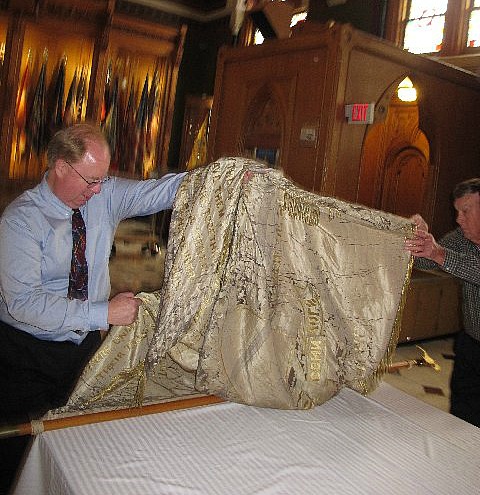 |
| ... and carefully lay it on a table in the Hall of Flags at the State Capitol in Hartford. |
 | |
| The 16th Connecticut flag rarely is taken from its case, according to Eric Connery, facilities administrator at the State Capitol. |
 |
| Massachusetts antiques dealer Harold Gordon (right) examines the 16th Connecticut flag. |
The goal of solving a small mystery wasn't achieved, but I did get an up-close look at rare piece of Connecticut Civil War history recently. First, here's a little background:
Part of a hugely outnumbered Union garrison at Plymouth, N.C., most of the 16th Connecticut surrendered on April 20, 1864 and was sent to prisoner-of-war camps, including the most notorious one of the war at Andersonville, Ga. Before a white flag was waved that day, the 16th Connecticut's lieutenant colonel ordered the regimental flags ripped from the poles and torn to shreds, which were distributed to the men. Some of the Connecticut soldiers who survived the camps kept the pieces of the flags throughout their imprisonment. After the war, pieces of the regimental flags were gathered by veterans, sewn together to form a shield and scroll and then mounted in the middle of a new silk flag, which was created by Tiffany and Co. in New York. The story has been recounted many times, including here and here.
On Sept. 17, 1879, in one of the grandest celebrations in Hartford history, more than 8,000 Connecticut Civil War veterans marched from the old State Arsenal building with their battle-scarred regimental flags to the new State Capitol building. Nearly 70,000 people, many waving American flags, turned out for "Battle Flag Day" on the 17th anniversary of the Battle of Antietam. The build-up leading up to the event was massive in the local newspaper, with story after story noting plans for the big day. The old flags, the centerpiece of the celebration, were almost treated with the same reverence given to holy relics.
 |
| Does the star from this secretary belong to the pieces of flag sewn into the 16th Connecticut flag at the Hall of Flags in the State Capitol in Hartford? |
"If the veterans of the war, whose love for the old flag brings them to the city to-day, could have looked in at the state arsenal last week and seen the tender, loving care with which the old flags were inspected and repaired by the committee of ladies selected for that purpose, they would prize them still more highly," the Hartford Courant reported on the day of the event. "The Day We Celebrate! All Honor to old flag and the heroes who defended it!" blared a headline in the Courant on "Battle Flag Day."
A lengthy six-column story in the next morning's Courant called the event a huge triumph, noting "the walks were thronged with lookers on, and with the strains of music and the blending of colors added to the moving scene, it photographed itself on the memory, never to be obliterated." After the march to the State Capitol, the regimental flags, including the 16th Connecticut's, were displayed in huge cases in the Hall of Flags, where many of them remain today.
About a year and a half ago, Massachusetts antiques dealer Harold Gordon contacted me about a piece of furniture he bought with an amazing tie to Antietam. In 1876, in honor of his brother, a private in the 16th Connecticut who was killed at Antietam, Wells Bingham was given an ornate 8-foot secretary made predominantly of walnut and oak. Spelled out in cattle bone on the ornate front are the words "Antietam" and "Sept. 17, 1862," as well as the name John F. Bingham, Wells' brother. A IX Corps badge is mounted between the "18" and "76." The knobs are bird's-eye maple with bone inset circles. A clock, crowned with an eagle and including the words "The Union Preserved" near the base, is mounted on top. When the inside right front door is opened, "Yankee Doodle Dandy" plays on a music box. On the plaque just below the bookshelf are these words:
"Presented to Wells A. Bingham by his friends. The secretary a rememberance of his brother John F. Bingham who offered up his life at Antietam, Maryland Sept. 17, 1862. The encased star a remnant of the colors carried that day by the 16th Infantry. The memory plaque made from a shard of his knife."
Ever since he bought the magnificent piece of folk art in 2006, Gordon was curious if the piece of flag inside a tin mounted on the secretary belonged to the 16th Connecticut flag in the Hall of Flags at the State Capitol in Hartford. Bill Caughman, whose wife Geraldine wrote the definitive book on Connecticut Civil War flags, arranged for our visit. The 16th Connecticut flag was carefully removed from its huge case and placed on a small table for our half-hour perusal. To our untrained eyes, Gordon's star didn't appear to match stars on the flag, but the opportunity to check out one of state's most significant Civil War relics was a treat. The flag, according to State Capitol facilities administrator Eric Connery, is rarely removed from its case.
 |
| "Antietam" appears in gold lettering near the top of the flag. |
 |
| A gold eagle tops the staff of the 16th Connecticut flag. |
Saturday, March 30, 2013
Antietam: Send in the Marines!

Subscribe to:
Posts (Atom)