Showing posts with label Hodgenville. Show all posts

Saturday, February 12, 2022

Did this man save Abraham Lincoln from drowning?

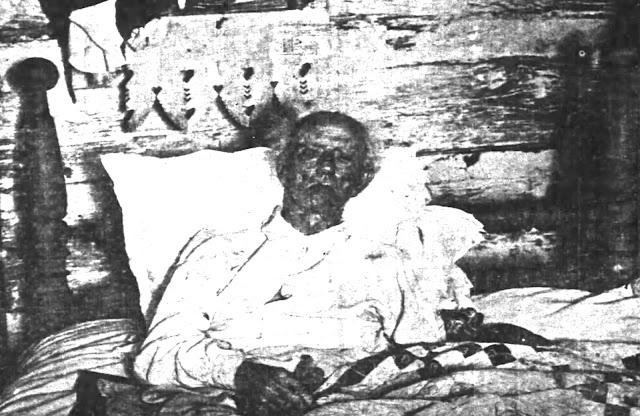
In 1897, the Louisville Courier-Journal propped up a frail Austin Gollaher
in his bed for this photo. (Newspapers.com)

Like this blog on Facebook | My YouTube videos 

Well into his old age, Austin Gollaher delighted telling about how he saved his boyhood friend Abraham Lincoln from drowning in a rain-swollen creek near Hodgenville, Ky. A version of the story went like this:

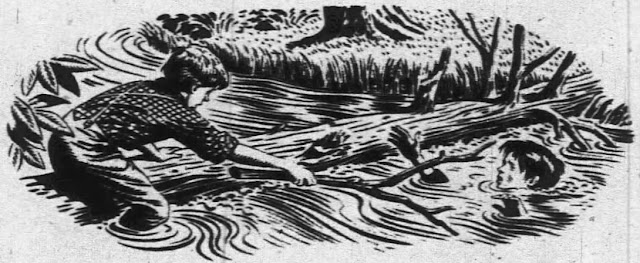
In 1816, Gollaher, then 9 or 10, and 7-year-old Abraham went to Knob Creek to scare up some possum. (Or was it pigeons?) Lincoln's family lived on a farm along the creek. Gollaher lived nearby. The only way to cross the creek when the water was running high was by straddling a log. About halfway over, Lincoln—who didn't know how to swim then—slipped and fell in. Gollaher couldn't swim either, so he grabbed a sycamore branch and shoved it into the water. Lincoln grabbed it, and his friend hauled him to safety. Roughly 20 minutes later, Abraham had finally recovered from his near-death experience. 

Lincoln apparently never mentioned the event during his presidency. In an 1889 Lincoln biography by William Herndon, the president's former law partner, the drowning story earned two sentences. Respected 21st-century Lincoln scholar Michael Burlingame also briefly mentioned the story in his Lincoln biography. His sources were two Gollaher interviews. Based solely on Gollaher's account, the drowning story appeared in many late-19th century newspapers throughout the United States.  

But there's no doubt Lincoln and Gollaher were close at one time. "I would rather see Gollaher than than any man living," Lincoln said while in the White House.  

So, does this story, ahem, hold water?
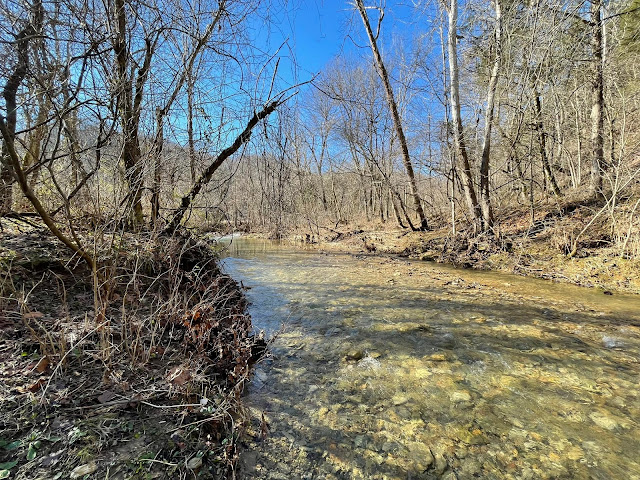
Knob Creek, where Lincoln played as a youth--and may have nearly drowned.
An illustration of the rescue at Knob Creek published in the St. Louis Globe-Democrat on Feb. 7, 1954.

To learn more about Lincoln's childhood playmate, I dived into the swimming rabbit hole of newspapers.com. One story—a lengthy feature published in the the Louisville Courier-Journal on Sept. 26, 1897—captured my attention. By then, the once-heavyset, tobacco-chewing Gollaher—"Uncle Austin" to those who knew him well—apparently was on his deathbed. A devout Christian, Gollaher suffered from rheumatism, among other ailments.  

An image of
Austin Gollaher
published in the 
St. Louis Globe-Democrat 
on Feb. 7, 1954.
"Austin Gollaher, aged almost ninety-two years, sire of four living generations, patriarch of a county and the only known surviving playmate of Abraham Lincoln's boyhood days is slowly but nonetheless surely drawing toward the end of his earthly career," read the opening paragraph.

I don't think my 20th-century journalism professors would approve of that lede.

In a weak, halting voice, Uncle Austin talked about attending school with his friend, protecting him against bullies, and about the near-drowning—Abraham "spit up about two quart [of water]" after his rescue, Uncle Austin said. Gollaher "brightened up" when asked about Lincoln and his sister, Sarah, a "purty gal" who also went by "Sally." "We were sweethearts then," he told the reporter. 

The Courier-Journal even propped up the frail Gollaher for a photograph in his bed at the spartan, backwoods house where he lived with his son. Reported the newspaper:
"As the artist's camera was placed and brought into range with the old man his talk drifted back to the war at the sight of what he took to be a gun. The sudden explosion of the flash-light powder caused him a geniune shock. However, be it said to his credit as a warrior, he was not alarmed beyond the first surprise. He merely gave one tremendous lurch: then, shading his eyes with his hand and peering sharply at the instrument through the ascending smoke, in a cool, yet anxious voice, he asked: 'Did you hit anybody that time?' and receiving in reply the assurance that it was only target practice."
Courier-Journal be damned, Gollaher hung on until Feb. 21, 1898. He left seven children, dozens of grandchildren, and a story that, if true, changed history. 

After a visit to the Lincolns' Knob Creek Farm, I paid respects at Gollaher's grave at Pleasant Grove Baptist Cemetery, near Hodgenville. Atop his marker I left a penny, Lincoln side up of course.


 — Have something to add (or correct) in this post? E-mail me here.


SOURCE

Burlingame, Michael. Abraham Lincoln: A Life, Volume One, Baltimore: John Hopkins University Press, 2008.

Saturday, February 05, 2022

'Life of an ox': Where Abraham Lincoln lived ages 2 through 7

Knob Creek Farm, near Hodgenville, Ky.

Like this blog on Facebook | Follow me on Twitter 

Steep, heavily wooded hills — “knobs” —  rise on each side of the Knob Creek farm where Abe Lincoln lived from ages 2 to 7. On a frosty, deep-blue sky morning, I visited the secluded site for a story for The History Channel. What a beautiful spot. But life was difficult here near Hodgenville, Ky., for the Lincolns, as it was for all frontier families.

Gravestone of Abe Lincoln's brother,
Thomas, who died in infancy.
The marker is in the visitors' center
at Lincoln's birthplace in Hodgenville, Ky
.
“Life on the frontier was little better than the life of an ox,” Lincoln historian Michael Burlingame told me. But the Lincolns, he says, were especially poor.

The family — Abraham, father Thomas, mother Nancy and sister Sarah — lived in a one-room cabin with a dirt floor, On the farm's wide fields, Lincoln’s father planted corn and pumpkins.

In front of the Lincolns’ door, on the road from Louisville to Nashville, the world passed: pioneers with heavily laden wagons, peddlers, slaves, local politicians, missionaries and soldiers returning from the War of 1812.

In rain-swollen Knob Creek in 1816, a Lincoln playmate may have saved Abraham from drowning. That story bears more scrutiny. In 1812, Lincoln’s infant brother Thomas died on the farm. 

Roughly two miles down the road from Knob Creek farm, Lincoln sporadically attended with Sarah an ABC school—a so-called “blab” school in which the students repeated oral lessons from a teacher. 

In the winter of 1816, the family left Knob Creek for a settlement in southern Indiana

A replica of the cabin the Lincolns lived in at Knob Creek.
Knob Creek, where Lincoln may have nearly drowned.
Avoid snakes near Knob Creek!
A "knob" looms near Lincoln farm site.
The Lincolns planted corn and pumpkins here in the rich soil.
Roughly two miles from the farm, Lincoln and his sister attended a school at this site.

 — Have something to add (or correct) in this post? E-mail me here.

Tuesday, January 11, 2022

In baby steps of Abraham Lincoln in Hodgenville, Kentucky

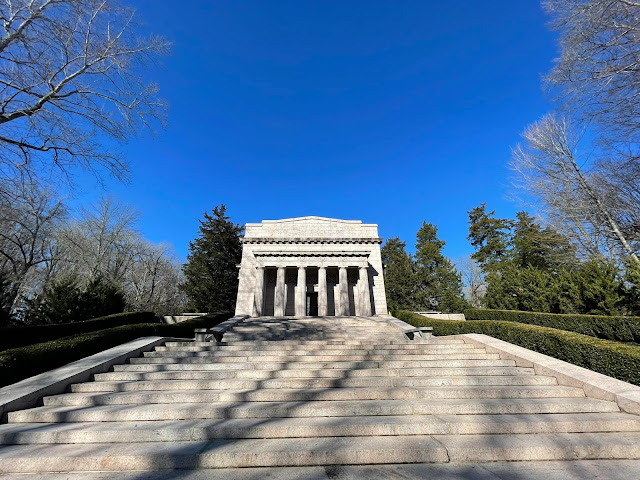
Fifty-six steps to the top -- one for every year of Lincoln's life.
I made it to the top, slightly winded.

Like this blog on Facebook | Follow me on Twitter

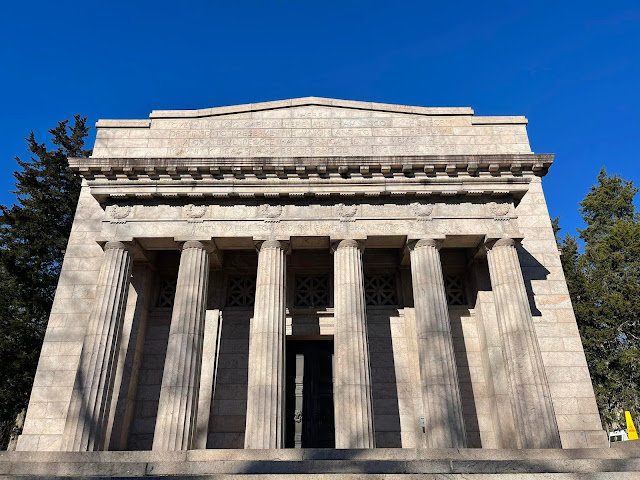
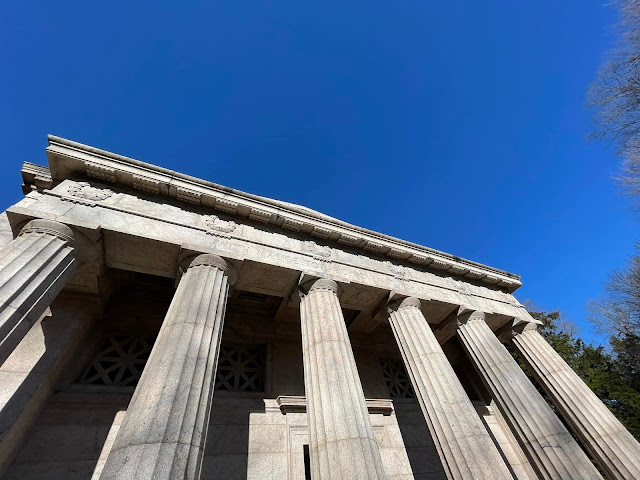
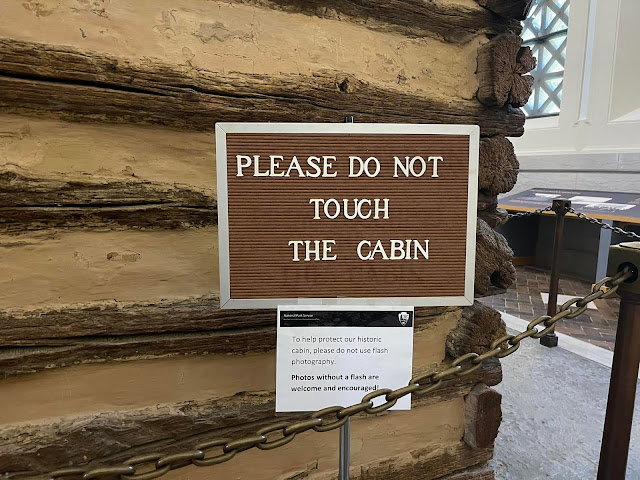
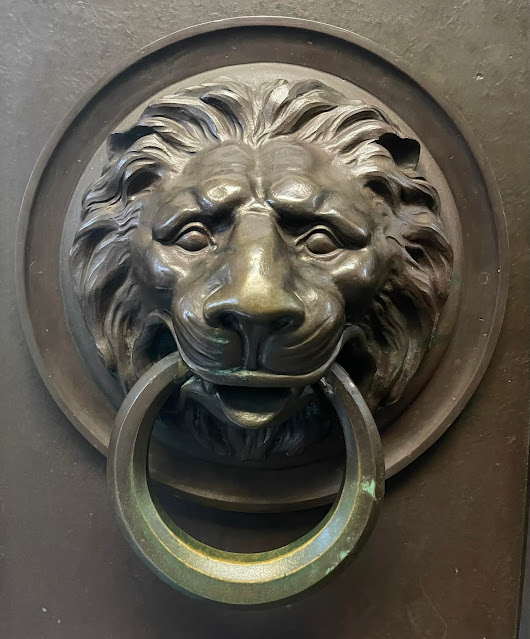
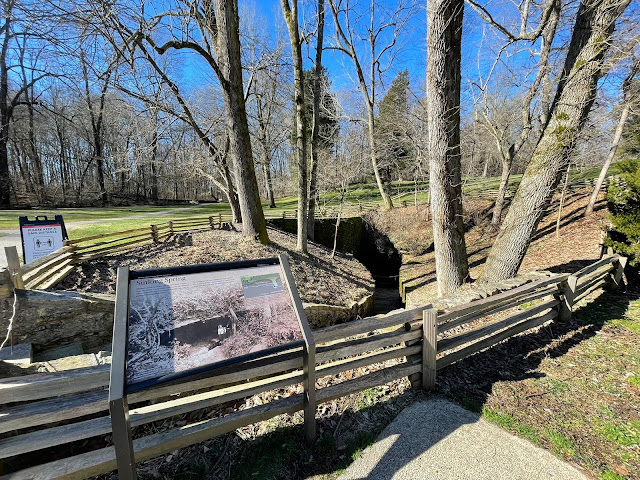
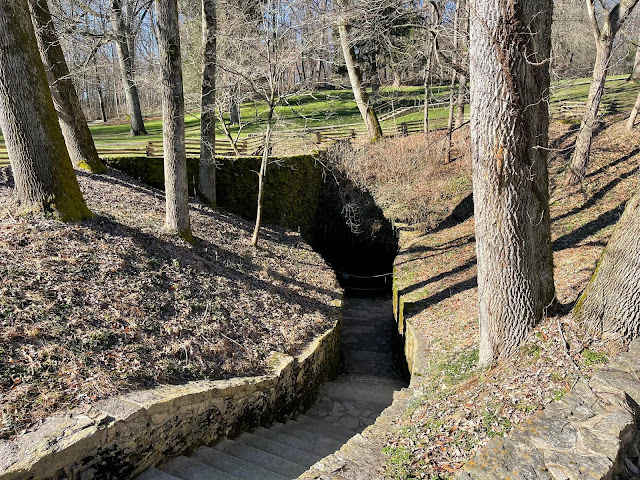
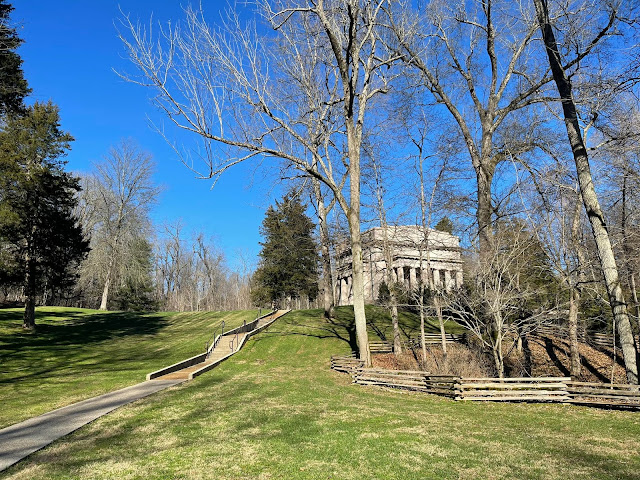
On Monday morning, I visited the birthplace of Abraham Lincoln at Sinking Spring Farm in Hodgenville, Ky. No, he didn’t live in this impressive structure. (Loved the lion door handle flourishes there, by the way. 😁) But inside there’s a replica of the one-room cabin he was born in on Feb. 12, 1809. Archaeologists found nothing at this site, a National Park Service employee told me. Lincoln mentioned living on a hill above a spring, so hence the memorial was built here. I checked out the spring, too. In 1811, the Lincolns moved to nearby Knob Creek Farm—much different topography there. Enjoyed walking in the baby steps of a great American on a frosty, deep-blue sky day.

The deep-blue sky made for an excellent backdrop.
The view from the Lincoln memorial.
A replica of the cabin on the site where Lincoln was born on Feb. 12, 1809.
Don't get handsy at the replica cabin.
Lion's door handles would be nice addition to Banks Manor.
A historical marker explains Sinking Spring.
Another view of the spring.
The spring (right) is below the memorial.

 Have something to add (or correct) in this post? E-mail me here.