Showing posts with label 54th Massachusetts. Show all posts

Monday, April 10, 2017

'Til death do us part: What Union soldiers left behind

Unidentified Union soldier and a woman, presumably his wife.
(Liljenquist Family Collection | Library of Congress)
Like this blog on Facebook 

Although the marriage documents below don't have nearly the visual impact of the photograph of the couple above, they do have a certain poignancy about them. Each piece of paper, found in Civil War widow's pension files in the National Archives, represents a union tragically ended or disrupted during a brutal war that forever altered the lives of hundreds of thousands of families. Two of the documents are in German, likely denoting the marriage of immigrants to the United States.  Another was completed in England, before the couple journeyed to America to begin a new life. Here are snapshots of the lives of those Union soldiers:
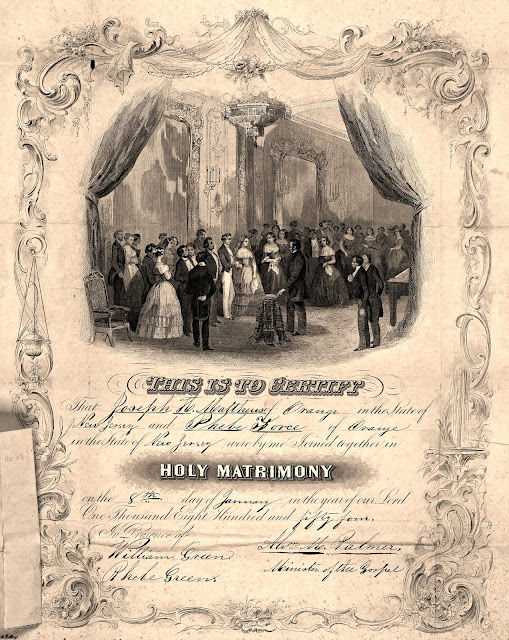
National Archives via fold3.com.
CLICK ON ALL IMAGES TO ENLARGE.
KILLED AT PORT HUDSON ON MAY 27, 1863:  Official word of Joseph H. Matthews' death apparently didn't reach his family in Michigan until weeks after he was killed during an assault on the Rebel fortress along the Mississippi River.  The 6th Michigan private "was a good soldier respected by his comrades," Sergeant Lewis Tryon wrote to Phoebe Matthews on Oct. 15, 1863. "I don't think that he lived anytime after he was shot. He was shot with a minie ball through the breast. He was close to the enimes works. He was buried with all the respect that could be shown in sutch a place."

No mementoes of the 29-year-old soldier were sent to Mrs. Matthews.

After the battlefield burial at about midnight, Tryon went through Joseph's pockets but only discovered a watch and a box of tobacco. The timepiece was given back to the soldier from whom Joseph bought it. Matthews' knapsack was found at the river, where he had left it before the assault, and given to the regiment's orderly sergeant. "[He] has since died," Tryon wrote, "and I don't know what has become of the things ..." Joseph's blanket and overcoat were lost on the battlefield.

In addition to Phoebe, whom he married on Jan. 8, 1855, Joseph was survived by four children: William, 8; Albert, 6; John, 4; and Frederick. 2.

National Archives via fold3.com.
MORTALLY WOUNDED AT ANTIETAM ON SEPT. 17, 1862: Wounded in the leg near the Dunker Church, Private Nicholas Decker of the 125th Pennsylvania was transferred to Camp G hospital near Frederick, Md. His leg was amputated, and Decker died on Oct. 11, 1862, leaving behind three children: Maria, 8; Letitia, 6; and William, 2. Elizabeth Heifner, whom he had married in Huntingdon, Pa., on Dec. 16, 1852, died in 1861.

National Archives via fold3.com
KILLED AT FREDERICKSBURG ON DEC. 13, 1862: Richard Keegan, a private in the 69th New York of the famed Irish Brigade, married Ann Carroll at the Church of St. Joseph in New York on Oct. 7, 1853. He also left behind two children, Mary, 8, and Frank, 3.

National Archives via fold3.com.
KILLED AT FREDERICKSBURG ON DEC. 13, 1862: Matthew Robbins, a private in the 142nd Pennsylvania, married Margaret Swift on Sept. 1, 1862, in Connellsville, Pa. The couple had no children. Margaret died in 1902, having never re-married.

Narional Archives via fold3.com.
DIED OF DISEASE ON SEPT. 20, 1862: Joseph Heiland, an orderly sergeant in the all-German 20th New York, suffered from "disease of the lungs" at Harrison's Landing, Va., in July 1862, according to the regiment's surgeon. He died months later in a hospital in West Philadelphia, leaving behind a wife named Mary, whom he married in 1854 in New York City, and a daughter named Eliza, not quite 10 months.

National Archives via fold3.com.
DIED OF DISEASE ON FEB. 15, 1864: John Freeman of the famed 54th Massachusetts, one of the first black regiments during the war, married Charity Thomas in Burlington, Vt., on Dec. 1, 1858. When he enlisted as a private on Dec. 16, 1862,  he also left at home a 3-year-old daughter named Mary. Shortly after he was mustered into the army, according to a comrade, he contracted a "disease of the throat" that bothered him during the regiment's journey south. In the winter of 1863, his condition worsened, and he died of "quinsy" at U.S. General Hospital in Beauforrt, N.C.

National Archives via fold3.com.
KILLED IN A SKIRMISH ON JUNE 7, 1862: Christian Essig, a private in the largely German 4th Kentucky Cavalry, married Elizabeth Albert in a ceremony at a church in Sandusky, Ohio, on Jan. 21, 1851. The couple had a daughter named Mary in 1856. While returning to Murfreesboro, Tenn., on scouting mission, the 4th Kentucky Cavalry was confronted by Nathan Bedford Forrest's horsemen, and Essig was shot and killed. Elizabeth re-married in 1863.

National Archives via fold3.com.
DIED OF DISEASE ON JULY 31, 1862:  On Oct. 29, 1848, 28-year-old miller James Cable, the son of a cordwainer, marrried 24-year-old Savannah March, whose 'condition" was listed as "spinster," in the Parish of Longsgtock in Southhampton, England. The couple moved to America with their son George, settling in Boston, where they had two more children, Elizabeth and William.

On July 25, 1862, Cable, a private in the 29th Massachusetts, suffered from a bad case of pneumonia and was admitted to the U.S. General Hospital in Point Lookout, Md. He died there six days later. On Aug. 1, 1863, the Point Lookout head surgeon wrote a short letter to Savannah noting the meager effects her husband left behind: one cigar case and a silver watch. "By you sending a receipt with the necessary expenses to forward them to you," the surgeon matter-of-factly wrote, "they will be sent."

National Archives via fold3.com.
DIED AFTER WAR FROM EFFECTS OF BATTLE WOUNDS: When he arrived at Armory Square General Hospital in Washington on May 28, 1864, Douglas Murray was in ghastly shape. At Spotsylvania Courthouse on May 18, a Rebel artillery shell had broken his collar bone and four ribs and mangled his left arm, necessitating amputation three inches below the shoulder. A little more than six months later, the sergeant in 63rd New York,  part of the Irish Brigade, was discharged because of the disability to go home to his wife , Mary Ann, and their three children: James, 8; Catharine, 5; and Elizabeth, 4. (The Murrays had another child, Susan, born in 1866.)

Douglas' wounds plagued him the rest of his few remaining days. While in Carlisle, Pa., where he married his wife in 1855, he came down with "traumatic fever" in the summer of 1866, apparently a result of the battlefield wounds he had suffered a little more than two years earlier. Sent to a hospital in Washington, he died there on July 19, 1866.

 Have something to add (or correct) in this post? E-mail me here.


Sunday, February 22, 2015

Five neat soldier discoveries at the National Archives

A trip to the National Archives in Washington is often like a trip to Las Vegas. You "bet" big, hoping the soldiers' pension files you pull during a two-day stay have an outstanding payoff, perhaps a letter from a soldier documenting his battle experience or a note from father to son about army life in the Deep South. Your time is limited -- the Archives is open from 9 a.m. to 5 p.m. during the week --  so you want to make the most of your stay. In the end, it's often a crap shoot, with some files revealing little to nothing about a soldier's war experience or post-war life. A recent research trip to the massive building not far from the White House yielded lots of great info. Here are five cool things I found:


1. AN AMPUTEE'S TINTYPE IMAGE

A private in the 20th Connecticut from Cheshire, Jesse Rice suffered the amputation of his right arm after he was shot at the Battle of Bentonville (N.C.) on March 19, 1865, in the last stages of the war. "His most serious difficulty at the present time," a doctor noted in Rice's pension claim, "consists of a severe form of nervous irritability produced by the condition of the stump of the right arm."


2. THREE-PAGE LETTER IN GERMAN

Four days before he was wounded at the siege of Petersburg (Va.) on August 16, 1864, 20-year-old August Freitag wrote a letter in German to his parents in Collinsville, Conn. “One must always pay attention and make sure that the ink jar is not taken out of his hand by a bombshell,” he complained, “because, large or small, the balls are whistling through here day and night.” He died of his wounds on August 26 at Fortress Monroe, Virginia, only nine months after Henry and Rosa Freitag went with their son to Hartford for his enlistment in the 1st Connecticut Heavy Artillery. 


3. ENVELOPE ADDRESSED TO A FATHER

While camped near steamy New Orleans with his 12th Connecticut comrades, 19-year-old Private Howard Hale delighted in writing long letters to his father, who lived 1,500 miles away in Collinsville, Conn., and missed his oldest son desperately. Howard sent $35 home  to his father in this envelope. On April 13, 1863, Hale was mortally wounded in the abdomen at the Battle of Fort Bisland (La.) and died two days later.


4. EVIDENCE OF A PRIVATE'S PAIN

On May 2, 1863, Private Michael McMahon, an Irish-born soldier in the 14th Connecticut, was wounded in the left side at the Battle of Chancellorsville (Va.) and hospitalized for 10 months. In an application for a pension, it was also noted that he was shot in the belt plate, resulting in a rupture that apparently plagued him the rest of his life. 


5. A SOLDIER'S SIGNATURE

Milo Freeland was a private in the 54th Massachusetts, the famed black regiment whose experience was brilliantly told in the movie "Glory." After the war, he moved with his wife and children from Massachusetts to East Canaan, Conn., where he died of pneumonia in 1883. Believed to be the first black soldier to enlist in the Union army, he was only 43.

Friday, October 19, 2012

History-making soldier buried in East Canaan, Connecticut

A laborer from Sheffield, Mass., Milo Freeland enlisted in the 54th Massachusetts 
on Feb. 16, 1863. He's buried in East Canaan, Conn. 
(Photo of Freeland: State Archives of Florida, Florida Memory)
Like this blog on Facebook | Follow me on Twitter

Tired, hungry and thirsty, Private Milo J. Freeland and his 54th Massachusetts comrades hugged the beach on the morning of July 18, 1863, as Federal land batteries and warships in the Atlantic traded fire with the 1,700-man Confederate garrison inside Fort Wagner.

Recruiting poster for 54th Massachusetts. 
(Massachusetts Historical Society)

"A fresh breeze blew that day; at times the sky was clear; the atmosphere, lightened by recent rains, resounded with thunders of an almost incessant cannonade," the 54th Massachusetts regimental historian wrote of the attack near Charleston, S.C. "Smoke-clouds hung over our naval vessels, our batteries, and those of the enemy."

Although some soldiers in the regiment had gobbled down hard bread from a rain-soaked box found on the beach near Fort Wagner, most of the black troops had little to eat or drink since their baptism of fire two days earlier. At nearby James Island, the regiment suffered 14 men killed, 18 wounded and three missing in a skirmish described as a "supreme moment for the Fifty-fourth." A historic event, it was the first major battle in which black troops had been deployed during the Civil War.

"The sight of wounded comrades had been a trial," the regimental historian noted. "And the screaming shot and shell flying overhead, cutting the branches of trees to the right, had a deadly sound. But the dark line stood stanch, holding the line at a vital point."

The attack on Fort Wagner would prove to be much different -- and much deadlier. Instead of taking a supporting role, the 54th Massachusetts -- one of the first black units in the Union army and soon to be the most famous -- had been ordered to spearhead the attack. And the assault was to be made at night, a rare occurrence during the Civil War.

A period map shows forces arrayed  against Fort Wagner, 
near Charleston, S.C. , in July 1863. 
(Library of Congress collection)
One can only imagine the thoughts that went through the mind of Freeland, a married laborer from Sheffield, Mass., about 140 miles west of Boston. A 23-year-old who stood 5-foot-5 with black hair and piercing black eyes, he enlisted in the Union army on Feb. 16, 1863 -- perhaps the first African-American in the North to do so.  On March 30, Freeland was mustered into the 54th Massachusetts under the command Colonel Robert Gould Shaw, a staunch abolitionist, and other white officers. Two sons of famous abolitionist Frederick Douglas also served in the regiment.

Training at Camp Meigs in Readville, near Boston, the 54th Massachusetts was looked at as a curiosity at first.

"Every day, but especially on Sundays, large numbers of visitors were present," the regimental historian noted. "Many ladies graced the camp with their presence. People came from distant places to witness the novel sight of colored troops in quarters and on the drill ground." Even the Massachusetts governor and U.S. Treasury Secretary Salmon P. Chase visited the camp in late April to review the 850-man regiment.

Because Union commanders were hesitant to use black troops in battle, the 54th Massachusetts was initially used only for manual labor. But with recruiting lagging and battlefield losses mounting, the army gradually warmed to the idea of using black troops in combat.

As twilight arrived on July 18, 1863, the men of the 54th Massachusetts, deadly serious, prepared to attack Fort Wagner about 3/4-mile away.  "Among the dark soldiers who were to lead veteran regiments which were equal in drill and discipline to any in the country, there was a lack of their usual light-heartedness," the regimental historian noted, "for they realized, partially at least, the danger they were to encounter."

Milo Freeland was among the lucky ones in the 54th Massachusetts. He survived the attack on 
Fort Wagner on July 18, 1863.  Many of his comrades  were listed as missing in action on 
this muster roll and presumed dead.  (CLICK ON IMAGE TO ENLARGE.)
Supported by the 6th Connecticut, the 54th Massachusetts, bayonets fixed, charged toward the fort. Under artillery fire, many of the Federals stumbled or fell into large shell holes caused by Union naval or land batteries. Hit by flanking fire, the 54th Massachusetts slogged through a ditch filled with water before charging up the slope to the fort, where they slugged it out with the defenders. George Stephens, a sergeant in Company B and the son of a lay preacher, described the scene:
The 54th, undaunted by the hellish storm, pushed up to the work, down into the moat, and like demons ascended the parapet, found the interior lined with rebels soldiers who were well sheltered and fought them one hour before we were re-enforced; and when the regiment reached us, the 3d New Hampshire, which was presumed to be our re-enforcements, they, to a man, emptied their rifles into us. Thus we lost nearly as many men by the bullets of our presumed friends as by those of our known enemies. Some few entered the fort, and when they got in, it was so dark that friends could not be distinguished from foes, and there is no doubt but that many a Union soldier was killed by his comrades. On the whole, this is considered to be a brilliant feat of the 54th. It is another evidence that cannot now be denied, that colored soldiers will dare go where any brave men will lead them.


Although Freeland survived the attack, the 54th Massachusetts was routed. Colonel Shaw was among nine officers killed, and 100 were missing and 247 more wounded. Many of the missing had been killed and were later tossed by the Rebels into a trench near the fort along with Shaw, whose efforts to mold the regiment were recounted in the terrific 1989 movie "Glory." 

Freeland served the rest of the war with the 54th Massachusetts, which fought battles at Olustee (Florida), Honey Hill (South Carolina) and Boykin's Mill (South Carolina) after its epic fight at Fort Wagner. Mustered out of the Union army on Aug. 20, 1865, in Mount Pleasant, S.C., he returned to his wife, Sophronia, in Sheffield. By July 1880, their family had grown to five children: daughters Jesse, 9, and Sarah, 2, and sons Eugene, 5; Harry, 3, and Benjamin, 1 month. In the 1880 U.S. census, Milo's occupation was listed as farmer; Sophronia's was "keeping house."

Within the next three years, Freeland moved 10 miles south, to East Canaan, a sparsely populated town in the northwestern Connecticut. He died there at age 43 on April 16, 1883, 20 years after he enlisted in the Union army. He's buried near the base of a steep hill in aptly named Hillside Cemetery in East Canaan. Three American flags and an old, broken Grand Army of the Republic marker adorned his slate-gray gravestone during a recent visit. Inscribed on the marker are these words:

The First Colored Man enlisted from the North in The Rebellion of 1861

Close-up of Freeland's tombstone, which was re-dedicated in 1996.

-- Have something to add (or correct) in this post? E-mail me here.


SOURCES

-- "History of the Fifty-fourth Regiment, Massachusetts Volunteer Infantry, 1863-65" Luis F. Emilio, Boston Book Company, 1894
-- Milo Freeland's widow's pension file, National Archives & Records Service, Washington, D.C., via fold3.com.
--  "Voice of Thunder. A Black Soldier’s Civil War. The Letters of George E. Stephens," edited by Donald Yacovone, University of Illinois Press, Urbana, Ill., 1998