Tuesday, January 31, 2017

'It is with a sad hart': Death by disease of 73rd Ohio private

A nurse cares for wounded Union soldiers. 73rd Ohio Private Patrick Henry died of disease.
 Like this blog on Facebook.

In a slim set of documents in a pension file at the National Archives, the sad story of an Ohio soldier's short life is revealed.

Patrick Henry's gravestone
in Chattanooga National Cemetery.
(Find A Grave)
Patrick Henry's father, Thomas, died in 1859, leaving his mother, Isabella, largely dependent on the earnings of her three sons. Twenty-year-old James and 22-year-old Patrick enlisted as privates in the 73rd Ohio eight days apart in October 1861, shortly after President Lincoln's call for 300,000 volunteers. The other brother, William, stayed home, presumably to take care of his widowed mother and aid with raising his sisters.

On July 10, 1862, nearly nine months to the day after he enlisted, James died of disease in Winchester, Va. Wounded and captured at the Second Battle of Bull Run on Aug. 30, 1862, Patrick was released in January 1863 after a little more than four months' captivity. But sometime in November 1863, he came down with a deadly case of dysentery and chronic diarrhea, causing a  "bloody flux," according to Sergeant Hiram Lewis, a comrade in Company C.

On Dec. 19, 1863, Lewis wrote a short note to William recounting the circumstances of Patrick's death in late November in Loudon, Tenn., "on the east Tenessee and Georgia Railroad" during a march to Knoxville. "It is with a sad hart that I set down to pen you a few lines ... " the sergeant's two-page letter began.

Found among documents for Isabella Henry's case for a pension after Patrick's death, Lewis' original letter and a transcription appear below. James Henry's remains are buried in Winchester (Va.) National Cemetery; Patrick is buried in Chattanooga (Tenn.) National Cemetery, Gravesite H-146.

National Archives via fold3.com.
Camp 73 Regt. Ohio Volunteers
Near Chatanooga, Tenessee
December 19th, 1863

Mr. William Henry
Dear Sir

It is with a sad hart that I set down to pen you a few lines to tell you the loss of our Company in the loss of your brother Patrick. He died on the march to Knoxville at a place called Louden on the east Tenessee and Georgia Railroad. He was first taking with the cronic dirier and it turn to the bloody flux. In the loss of your Brother we have lost a good soldier. He was always at his post and done his duty like a soldier and a gentleman. I grieve with you and your famely for he has always prove himself a friend to me. We have got his knapsack and his blanket and we intend to take ...
.
National Archives via fold3.com.
... good care of them and if we should be so lucky as to get home we will try and fetch them home with us. Patrick had five dollars with him and the Company all give him one dollar apiece. And we thought that would do him entell we got back. But when we got back he had died and was already buried. And he was buried decent. He has about one month and half pay coming to him.

Now William i hasten to send this to you know the fact and if you wish to know ennything more why write to me and i will do all that i can.

Nothing more
Your friend

Hiram Lewis

For more Civil War condolence letters on my blog, go here, here, here and here.

Sunday, January 29, 2017

Gettysburg: Views from Seminary cupola, destroyed in 1913

        Hover on the 1863 Lutheran Theological Seminary image for a present-day view.
         (THEN: Mathew Brady  Library of Congress | NOW: John Banks, Oct. 23, 2016)


 Like this blog on Facebook | Follow me on Twitter

At about 5 p.m. on Aug. 18, 1913, a "wonderful electric storm" swept over Gettysburg, causing significant damage throughout the area. "Old residents of Gettysburg without exception declare Monday evening's storm or series of storms to have been the worst in their experience," a local newspaper noted the next day.

A  cropped enlargement of Brady's 1863 image
of the Lutheran Theological Seminary
shows the cupola in greater detail.
"It seemed to be one continuous performance of thunder and lightning, crash after crash," the Gettysburg Compiler reported Aug. 20. "With it came great gusts of wind that tore up trees and the rain fell in blinding sheets."

A "cold bolt of lightning" struck a bungalow on Springs Avenue, near the Lutheran Theological Seminary, shattering a brick chimney. As the storm swept westward, lightning struck the barn of George W. Jacobs, killing two cattle and causing several thousands dollars' worth of damage. Later that evening, another storm wreaked havoc with a traveling circus in town, tearing its big tent to shreds and killing one of the trick horses.

"The roar and confusion in the animal tent is said to have been worth going miles to see," the Compiler reported.

But the most notable "victim" of the storm was a historic building on the great battlefield. A bolt of lightning struck the Lutheran Theological Seminary, destroying the famous cupola that Union General John Buford used as an observation point on the first day of the battle, July 1, 1863. Both armies used the four-story, brick building on Seminary Ridge as a hospital.

Thankfully, the Compiler reported, "firemen bravely fought the flames and prevented further destruction of a building worth four or five fire engines." A slate roof protected the Seminary building, preventing the spread of the fire, and the metal floor of the cupola helped confine damage to the historic lookout point.

Impressed with the prompt response by firemen, the Lutheran Theological Seminary treasurer donated $25 to the Gettysburg Fire Company, and plans quickly were made to restore the cupola to its original appearance. Insurance covered the cost of restoration ($764.25), completed in 1914.

The building now houses the excellent Seminary Ridge Museum, where, for $4 more than the seminary's donation to the Gettysburg Fire Company more than 100 years ago, you can check out the museum exhibits and get a 30-minute guided tour of the cupola.  (Here are admission fees.)

On a beautiful, blustery October afternoon, I shot the images below of the battlefield and town from Buford's long-ago vantage point. Click on each image to enlarge. (Hat tip Codie Eash, Seminary Ridge Museum lead visitors services assistant, for aid on direction of images.)

LOOKING NORTHWEST: Reynolds Woods in middle distance, Chambersburg Pike at right.
LOOKING SOUTHEAST: From right, Cemetery Hill (by water tower), Culp's Hill, Wolf's Hill in distance.
LOOKING SOUTHWEST
LOOKING WEST

-- Have something to add (or correct) in this post? E-mail me here.


SOURCES

  • Adams (Pa.) County News, Aug. 23, 1913
  • Gettysburg Compiler, Aug. 19, 20 and Sept. 10, 1913
  • "Minutes of the Board of Directors of the Theological Seminary of the General Synod of the Evangelical Lutheran Church in the United States,” (Gettysburg, Pa.: Lutheran Theological Seminary at Gettysburg, Abdel Ross Wentz Library), May 21, 1914.

Thursday, January 26, 2017

Lost and found at Bull Run: Prized ring of Confederate officer

A post-war image of Confederate veteran Octavius Cazenove Henderson.
(Virginia Military Institute archives)
 
Like this blog on Facebook | Follow me on Twitter

1859 panotype of Octavius Henderson.
(Virginia Military Institute archives)
On Aug. 30, 1862, Captain Octavius Cazenove Henderson led five companies of 1st Virginia Infantry during vicious fighting at the Unfinished Railroad Cut at the Second Battle of Bull Run. During the battle, a piece of artillery shell struck the 23-year-old officer in the left hand, between the third and fourth fingers, knocking away his precious Virginia Military Institute ring. Henderson had been a student at the prestigious school in Lexington, Va., and, when war broke out, he served as an assistant professor of French at VMI.

With the air full of artillery fire and bullets, the seriously wounded Henderson wisely thought it wasn’t worth spending time looking for the ring, given to each of the 29 members of the VMI Class of 1859. (Henderson was one of 14 students in Professor Thomas Jackson's artillery class in 1859. Two years later, he earned his nickname, "Stonewall.")

Nearly 32 years later, in late August 1894, a young man walking through the woods on the old battleground stooped to pick up a rock to toss at a squirrel. On  the ground, he spotted a piece of jewelry. He noticed the ring’s setting was a bloodstone, and the letters “V.M.I” appeared above the Latin phrase “Sic hor ad astra” (Reach for the Stars) on the face. Inscribed inside the ring were the words “One of twenty-nine, O.C. Henderson, July 4th, 1859.”

Scott Shipp's 1859 VMI class ring, which is similar to Henderson's.
(Courtesy VMI Museum)

Local newspapers published stories of the find, and the discovery "excited a great deal of interest in the vicinity," according to C.D. Nourse, who visited with the young man who found the ring. Months after the discovery, Nourse made an impressive Civil War find himself while turkey hunting near the banks of Bull Run: a Union canteen in a “wonderful state of preservation.”

VMI superintendent
 Scott Shipp told
C.D. Nourse where to find
Octavius Henderson. 
Hopeful of finding the ring’s original owner, Nourse wrote several letters, and eventually was contacted by Scott Shipp, the superintendent of VMI. A former Confederate officer in the 21st Virginia and 4th Virginia Cavalry, he also was a member of Henderson’s VMI Class of 1859. Better yet, he told Nourse that Henderson was alive and “making a survey in the wilds of Georgia.” After the war, Henderson, who graduated 26th in his class in 1859, served as an assistant professor of infantry tactics at VMI and a civil engineer.

Nourse, who had acquired the ring from the young man, corresponded with Henderson, and eventually returned the jewelry to the grateful veteran. The story gained wide circulation in newspapers, and was even mentioned in obituaries for Henderson when he died at age 59 in 1897.

The whereabouts of the prized Bull Run relic today, however, are unknown.

SOURCE: 

Philadelphia Inquirer, Dec. 3, 1895.


        Henderson lost his VMI ring at the Railroad Cut at the Second Bull Run battlefield.
                         A portion of the Cut is seen here in the interactive panorama.


Do you have more information on this story? E-mail me here.

Saturday, January 21, 2017

Do you know more about teen-aged Connecticut deserter?

James A. Brown's grave in Union Cemetery in Duncannon, Pa. (Photo: Richard Grossman)
 Like this blog on Facebook.

On Aug. 23, 1864, 18-year-old James A. Brown died of "congestive chills" at the home of Alex Morrison in Duncannon, Pa. Brown was a corporal in the 2nd Connecticut Heavy Artillery, which was more than 120 miles south in the Shenandoah Valley of Virginia at the time of his death.

What was Brown, who had deserted on April 5, 1864, doing in Duncannon, Pa., in the south-central part of the state? Did he have relatives in town? Was his family in East Windsor, Conn., aware of his whereabouts? Did the citizens of Duncannon know he was a deserter? They apparently were touched by the young soldier because they buried him in Union Cemetery in town and placed this marker atop his grave. James enlisted in February 1864 and was promoted to corporal a month later.

Do you know more about this teen-aged soldier? E-mail me here.

Tuesday, January 17, 2017

Letter from Sharpsburg: 'Autumn sun kisses ... soldier-graves'

A cropped enlargement of Alexander Gardner's image of Union graves at Burnside Bridge.
(Library of Congress collection)
 Like this blog on Facebook | Follow me on Twitter

More than a month after the Battle of Antietam, the detritus of war and scenes of devastation were not hard to find on the battlefield. On a beautiful fall afternoon, a correspondent for the Philadelphia Inquirer discovered broken muskets, knapsacks, pieces of shot and shell, remains of horses as well as trees riddled by bullets and artillery. At a small hotel where he stayed in the village of Sharpsburg, he found "nine hissing meteors thrown entirely through it."

"My bedroom has two loop-holes in the east wall, which ventilates it in the latest and most popular Sharpsburg style," the correspondent wrote on Oct. 25, 1862. "Thanks to Captain [Augustus] Martin’s Battery, or somebody else, for the correct ideas they had on the ventilation of modern dwellings. Your correspondent approves it, although it’s too late for a patent."

On Oct. 27, 1862, more than a month after Antietam,
 the Philadelphia Inquirer published this descriptive account
 of the battlefield.
Almost immediately after the battle, relic hunters picked over the fields and woodlots for souvenirs, but  the scavengers were "rather scarce" during the Philadelphia Inquirer correspondent's visit. Although citizens of Sharpsburg told him there were "nary a hoss or gun in town" from the battle, a Federal officer collected 443 muskets and  "sundry good mules and horses."

In an apple orchard near Burnside Bridge, the writer found a most poignant scene: makeshift graves for 17 soldiers, each marked with a pine board inscribed with the names or initials of the dead.

"The rabbit skips around them, the quail pipes his melancholy notes from the fence side, and the Autumn sun kisses those soldier-graves, day after day, and yet no kindred sheds a tear upon them," the correspondent eloquently wrote. "Alas! the poor soldier."

Published on Oct. 27, 1862, here's the writer's complete account, which includes a description of a visit of an "unsophisticated genius" with President Lincoln.


Special Correspondence of the Inquirer

SHARPSBURG, Md., Oct. 25, 1862.

On one of the most golden and beautiful afternoons of the present autumn I mounted saddle, at Frederick, and proceeded across the country to this sleepy village, classic and historical now as the battle-ground of Antietam. “Grim-visaged” war has left its mark of devastation along the entire route, from the first spurs of the Blue Mountains to the great field of carnage itself. Along the turnpike, at the intervening sections, the fences are all gone, the crops destroyed, bridges burned, vegetation trodden out, and almost every field is arabesque with dead horses, bullocks’ heads, broken wagons, and other debris of camp life. As both Federal and Confederate armies passed over this route, they left sad and indelible pictures upon that fertile and picturesque section of Maryland.

On descending the first range of hills a valley of magnificent proportions and beauty extends from North to South, dotted with yellow corn fields, green patches of winter grain, pleasant farm houses and sleepy barns.

  "The Mountain House" described in correspondent's account. It is still an inn today.

“To him who in the love of Nature holds Communion with her visible forms,” this valley would be a perpetual study and charm, and with its present autumn habiliments is, indeed, beautiful. South Mountain, properly the Catoctin, is where the Rebels gave us the first fight, a sketch of which your staff of correspondents graphically portrayed. But I must tell an incident which occurred when President Lincoln recently visited the scenes of that battle. In the Gap, at the “Mountain House,” an old farmer was turning an honest penny in selling apples and cider to the crowds of visitors to that locality. “Mr. President,” claimed the unsophisticated genius, “won’t you have a glass of cider?”

“No, sir, I thank you,” replied Mr. Lincoln.

“But it’s real good; prime Union cider!”

Cropped enlargement of image of President Lincoln shot by
Alexander Gardner near Antietam battlefield.
(Library of Congress collection)
“Is it? Why, my friend, then I will try it,” said the President, and which he did, with much wryness of face, vast fame to the farm, and great glee to Gen. [George] McClellan and Staff, who accompanied the President.

Yesterday morning I rode over the prominent points of the Antietam battlefield, including the Rebel centre and right, and the Stone bridge, where General Burnside met with such obstinate resistance and carnage. Evidences of that great fight are yet everywhere visible. Broken muskets, knapsacks, remnants of clothing, fragments of shot and shells, split and rifted trees, hard trodden ground, dead horses, and alas! long rows of graves and ditches, “where sleep the brave,” along the banks and on the high bluffs of the Antietam. In the orchard, back from the stream, I saw seventeen graves in a row, each with its little pine board, with names or initials, “Sept. 17,” etc, etc. How many tearful eyes, in far distant homes, have looked in imagination to those graves beneath the old apple trees! The rabbit skips around them, the quail pipes his melancholy notes from the fence side, and the Autumn sun kisses those soldier-graves, day after day, and yet no kindred sheds a tear upon them. Alas! the poor soldier.

The Confederate center of battle being on a prominent hill, immediately east, and in direct range of this village, our batteries threw immense numbers of shot and shell entirely over the enemy, into town, impartially and equitably distributing their favors to almost every house. Scarcely one escaped, while many had from one to a dozen shells thrown into a roof, garret, chamber, or cellar. The small hotel in which I am “tieing up” had nine hissing meteors thrown entirely through it. My bedroom has two loop-holes in the east wall, which ventilates it in the latest and most popular Sharpsburg style. Thanks to Captain [Augustus] Martin’s Battery, or somebody else, for the correct ideas they had on the ventilation of modern dwellings. Your correspondent approves it, although it’s too late for a patent. Our Sharpsburg hotels are much after your “first-class hotels,” particularly in charges per day. But here’s the difference; instead of “beef a’la mode,” we get mule fricassee, and instead of old Java, or Mocha coffee, we get unadulterated breakfast beverage from new crop acorns. Instead of famous Chester [Pa.] county butter, we get the most delectable Muscovado molasses for our bread and biscuit. Commend us to Sharpsburg luxuries “till the last syllable of recorded time.”

"Broken muskets, knapsacks, remnants of clothing, fragments of shot and shells, split and rifted 
trees, hard trodden ground, dead horses" littered the Antietam battlefield, the correspondent wrote.
This is a cropped enlargement of an Alexander Gardner Antietam image.
 (Library of Congress collection)
Relic hunters are getting rather scarce, although great numbers visit the battlefield every day; but the Government is monopolizing the business just now, and have Lieut. Samuel Waring, of York, Pa., gathering all the arms, horses, and other valuables belonging to Uncle Sam, but which in the fight, or rather after it, got mysteriously transferred into the hands of sundry citizens. Although the agents of the Government have visited this locality on similar business, Lieut. Waring collected, yesterday, four hundred and forty-three muskets, and sundry good horses and mules. Notwithstanding this important recovery, the citizens declared, previous to the search, that there were “nary a hoss or gun in town,” belonging to the best robbed and best lampooned Government on earth.

The impression prevails that an advance movement in Virginia will now be made. The men have marching orders, with three days’ cooked provisions, and are ready to “fall in.” Reports in camp say the Confederates are in force, back of Shepherdstown just opposite the fords here. `

Saturday, January 14, 2017

Stored in attic, rare Rebel canteen belonged to S.C. soldier

Face of inscribed canteen that belonged to Confederate cavalaryman Richard Sims.
(Photo: Richard E. Clem)
 Like this blog on Facebook.

Relic hunter Richard Clem's tales have been told frequently on my blog. In this post, Clem, a lifelong resident of Washington County in Maryland, tells the story of a rare Confederate canteen with ties to Antietam and Gettysburg.

Richard Clem

By Richard E. Clem

Designed to carry water, the old wood canteen also carried a hand-carved inscription that one day would be read worldwide. With the original owner’s name and regiment cut into its face, the heirloom traveled from the coastal region of South Carolina to the farm of Daniel Wolf in western Maryland. Although once carried by a Confederate cavalryman, it remained well preserved for years in a dusty, dark attic.

The canteen was recently discovered while its owner was preparing to move to a retirement home. It seems she had lived with her mother, who stored the vintage canteen in their attic about 1936. Not knowing exactly what it was, she handed it to the author, explaining, “I think it was an old toy the kids once played with.” Another member of the family suggested, “I was thinking of using it as a flower vase.”

Apparently the owner’s mother inherited the mysterious relic from her father, and no one knew what it was. After a closer examination and noticing letters pertaining to “South Carolina,” an idea surfaced it could be connected to the Civil War. Then the owner mentioned, “It has been handed down through the family and belonged to my great-grandfather, Daniel Wolf. He preached in the Manor Church and the Dunker Church on the Antietam battlefield.”

Those words got my full attention,

With this clue, it was decided to return to the “Days of Cavaliers and Cotton Fields” to try to discover who the Rebel was who once drank from this rustic canteen.

Reverend Daniel Wolf and his wife, Ann Maria. (Courtesy Wolf family)
Research locally revealed Daniel Wolf was born Aug. 11, 1825, at his father’s homestead in southern Washington County, Md. Daniel spent his entire life farming the old home place along Manor Church Road, just two miles east of the little town of Tilghmanton. In 1850, he married Ann Maria Rowland from Washington County. To this union came a blessing of eight daughters and three sons. One of Wolf’s daughters was the grandmother of the owner of the wood canteen.

Possessing great knowledge of the Scriptures, Daniel Wolf became a beloved and respected minister of the German Baptist Brethren Church, known today as the Church of the Brethren. Reverend Wolf’s strong stand on slavery and the evils of war served as fodder for many sermons delivered in the nearby Manor Church and in the famous Dunker Church, just south of his home on the Antietam battlefield. The Dunker Church was a branch of the Manor Church built simply to establish a church near Sharpsburg.

On Aug. 16, 1899, the earthly journey of the 74-year-old preacher ended. The body was buried in Manor Church Cemetery within view of his farm.  At an unknown time, this farmer-preacher had acquired the rare Confederate canteen. What makes the 154-year-old artifact remarkable besides being made of wood is the hand-carved legend on its face:

“R. Sims, Co. I, 1st R. So. Ca., V (c) C.”

PRESENT DAY: Greatly in need of exterior repair, the former home of Daniel Wolf.
(Photo Richard E. Clem)
Manor Church where Reverend Daniel Wolf preached.
(History of Washington Country, Maryland)
With reverence I held this piece of Southern history. The letter “R” represents the first letter of the cavalryman’s first name, His last name is “Sims.” Beneath the name is cut “Co. I,” standing for “Company I.” Perpendicular to the right of the name and company is etched “1st R. So. Ca. V (c) C.” It took a few seconds to figure these letters stood for “1st Regiment, South Carolina, Volunteer Cavalry.” With closer study, a letter “C” can be found beneath the letter “V.” In the author’s opinion, this Confederate trooper intended to cut “Cav.,” an abbreviation for “Cavalry.” Nearing the edge of the canteen, however, and running out of space, the letters “V. C.” (Volunteer Cavalry) were substituted. A large “R” was cut on one side of the rare relic. It is believed Sims originally started to carve his name, etc. on this side, but for an unknown reason finished the inscription on the reverse side.

When the Civil War began, the South was far from being prepared in the way of raw material. By the end of the conflict, the Confederate States were melting bronze church bells and anything else they could get their hands on to produce implements of war. To preserve metal, especially iron and tin, some Southern canteens were manufactured from wood.

Known as the “cedar drum” style, these hardwood vessels (7 ½ inches in diameter x 2 ½ inches in width or depth) were also made of maple and cherry. Each consisted of two, round face plates. Around the circumference were 10 to 12 small slates grooved to receive the face plates -- all held together with two thin metal bands. A wooden maple spout to drink through was then “popped” into the top. Each canteen held about one quart of water or other liquid refreshment a Rebel chose to consume. Once the canteen was filled with liquid, the wood swelled, making it  water-tight. A cork or wood stopper was then pressed into the spout, and leather straps were attached so it could be carried over the shoulder or, in the case of cavalry, hung from a saddle horn.

In some respects, the wood canteen had an advantage over their metal counterparts. Some Confederate soldiers noted water stayed cooler and tasted sweeter in these wood containers. The wood canteen had another practical purpose. With a sharp pocket knife, the owner’s name, regiment, etc. could be carved into the surface, making identification of a soldier easier in case of death. (Soldier ID tags were extremely rare during the Civil War.)

Natural spring beside Reverend Wolf’s home where Sims’ canteen
 may have possibly been found. Daniel and Ann Maria Wolf
 are buried in the Manor Church Cemetery in the background.
(Photo: Richard E. Clem)
Who was “R Sims,” the Rebel cavalryman? How did his personal identified canteen get from South Carolina into the hands of Reverend Daniel Wolf in Maryland? Again, research started locally.

The native limestone, two-story home once owned by Reverend Wolf still stands on 188 acres just north of Antietam battlefield. With the location of Wolf’s farmstead being near the battlefield, it was naturally assumed the old canteen came out of the bloody struggle of Antietam. Wrong! The boys in the 1st South Carolina Cavalry were guarding defenses around Charleston when the battle was fought on Sept. 17, 1862. However, Confederate soldiers were in the area of Wolf’s homestead in July 1863, following the battle at Gettysburg. So the next step was to determine if “R. Sims” was at Gettysburg. According to Federal archives, Private Richard Sims, Company I, 1st South Carolina Cavalry, was “present” with Hampton’s Brigade that clashed with Union cavalry at Gettysburg, attempting to disrupt the Union rear on what is now known as East Cavalry Battlefield. The 1st South Carolina Cavalry also served with honor at Fredericksburg and Brandy Station in Virginia.

Following Gettysburg, every family in the path of Union and Confederate armies was gripped in fear while their crops and livestock were destroyed. Land records in the Washington County Court House list farmers in the county who were forced to declare bankruptcy following the war. The Wolf farm felt the effects of civil war in 1862 and the next year during the Confederates' retreat in July from Gettysburg. A Wolf descendant noted, "Several times Civil War soldiers came to the farm, and my great-grandmother (Ann Maria Wolf) would always give them something to eat no matter what side they were on.”

The old homestead also had an abundance of another source alluring and essential to a cavalry unit: water. Horses needed an average of five gallons of water daily. Could it be while on a scouting mission, Private Sims left his canteen at the spring right beside Reverend Wolf’s home? Or perhaps Private Sims simply took a metal canteen from a dead Yankee and discarded his own.

Speculation will always surround how Daniel Wolf acquired Sims’ canteen, but there are several possibilities. After defeat at Gettysburg, Robert E. Lee depended on his cavalry to scout a safe passage for the Army of Northern Virginia back to Southern soil. On July 8, 1863, the 1st South Carolina (Wade Hampton’s Brigade) engaged Federal cavalry at Boonsboro, just east of Wolf’s farm. These same mounted troops were also present at Williamsport, Md., where the Rebel army crossed the swollen Potomac River, ending the Gettysburg campaign. Wolf’s land is situated between Boonsboro and Williamsport. So Reverend Wolf could have found the canteen at one of these locations or anywhere in between -– if not at the natural spring right beside his home.

Based on his military file, Richard Sims was employed as a clerk in his hometown of St. Paul’s Parish, Colleton County, S.C.,  just prior to the War Between the States. The small village is just southwest of Charleston, where the Civil War began April 12, 1861, with the Rebel shelling of  Fort Sumter in Charleston Harbor. An 1860 census for St. Paul’s Parish lists Richard Sims living with his parents, Edward L. and Sara Sims, along with an older sister, Elizabeth, and three younger brothers, John, James and Edward.

Back of 1st South Carolina cavalryman Richard Sims' canteen.
Note original spout. (Photo Richard E. Clem)
When war looked as if it was going to last longer than expected, 23-year-old Richard Sims enlisted (April 3, 1862) at Parker’s Ferry, near St. Paul’s Parish. In June 1863, the 1st South Carolina Cavalry was transferred to Virginia, where it was assigned to General Wade Hampton’s Brigade, General J.E.B. Stuart’s Cavalry, Army of Northern Virginia. In all probability, Sims' canteen was left behind in Washington Country during the Rebels' retreat from the blood-stained fields of Gettysburg.

During his military career, Private Sims was listed as “company blacksmith,” according to Federal archives. For this back-breaking service, he was paid a dollar extra per month for shoeing horses.
A muster roll states he received “pay for use of horse from Oct. 31, 1863 to Nov. 28, 1863, at 40 cents per day.” Yes, the Confederacy paid their cavalrymen for service of their personal horses, but remember, the South had an abundance of “worthless” Confederate money.

The year 1864 was one of trials and testing for Richard Sims. On Jan. 8, he was admitted to Jackson Hospital in Richmond because of a chronic ulcer of left leg. This open, painful sore, perhaps caused by the shoeing of horses and days riding in the saddle, forced Sims to leave the cavalry. In the fall of 1864, the 1st South Carolina Cavalry was ordered south to defend its native state and surrounding area. Physically unfit for duty for almost a year,  Sims was discharged from army headquarters on Dec. 10, 1864, at Pocotaligo, Ga. After the war, no record shows Richard Sims or his family living in St. Paul’s Parish. Perhaps he moved west like so many other Civil War veterans. Did he have a wife or children? Where is he buried? What did he look like? These questions will always be associated with the letters carved in the old canteen -- a name without a face.

It's not impossible Daniel Wolf may have personally met the Rebel horseman. Stated earlier, as company blacksmith, Sims could have stopped at Wolf’s spring to water his horse or to repair a damaged shoe of a comrade’s mount. He could have been one of those “Civil War soldiers” who was fed by Ann Maria Wolf. As of December 2016,  the Confederate canteen was still well preserved in Washington County at the home of a great-great-grandson of Daniel Wolf.

The name “Richard Sims” will never grace a battlefield monument. But after more than 150 years, his well-preserved canteen of Confederate hardwood remains a silent symbol of a lost cause.


SOURCES AND ACKNOWLEDGEMENTS

--Brooks, U. R., Stories of the Confederacy, Columbia, S.C., The State Company, 1912.
--Davis, Burke, Gray Fox, New York, Rinehart and Co., 1956.
--Henry, Maurice J., History of the Church of the Brethren, Brethren Publishing House, Elgin, Ill., 1936.
--McSwain, Eleanor D., Crumbling Defenses, or Memoirs and Reminiscences Of Colonel John Logan Black C.S.A., Macon, Ga., 1960.
--Williams, Thomas J. C., History of Washington County, Maryland, Hagerstown, Md., 1906.
--Battles and Leaders of the Civil War, Vol. III, New York, New York, Thomas Yoseloff, Reprint 1956
--National Archives, Military Service Records, Washington, D. C.
--North South Trader’s Civil War, Vol. XVII, No. 2.
--The Official Record of the Union and Confederate Armies in the War of the Rebellion
--South Carolina Department of Archives and History, Columbia, S.C.
--U.S. Military History Institute, Carlisle Barracks, Carlisle, Pa.

The author owes gratitude to the following for their interest and invaluable contributions that made the story of Sims’ canteen possible:
Brent C. Brown, Sumter, S.C.
Margo W. Everett, Walterboro, S.C.
Louise Arnold-Friend, Carlisle, Pa.
Patrick McCawley, Columbia, S.C.
Glenn F. McConnell, Charleston, S.C.
Russell Thurmond, Sumter, S.C.
Kipp Valentine, Charleston, S.C.
Dave Williams, Hanover, Pa.

Tuesday, January 10, 2017

Private Joseph Lindermuth, model for a Gettysburg monument

Civil War veteran Joseph Lindermuth (second from right) and family members at
1st Pennsylvania Cavalry monument on Sept. 2, 1890. (Courtesy Nancy Auman)
 Like this blog on Facebook.

On Sept. 2, 1890, the day the 1st Pennsylvania Cavalry monument was dedicated near the "Bloody Angle" at Gettysburg, Joseph Lindermuth posed leaning against it for a photographer. It was a special day for the Civil War veteran, shown above with family members in a cropped enlargement of the original image.

A private in Company L in the 1st Pennsylvania Cavalry, Joseph was the model for the monument, which cost $1,500. Joseph, whose last name also was spelled Lindenmuth and Lindemuth, died at 87 on July 7, 1926, of "throat and bladder trouble," according to a family history. The lifetime resident of Auburn, Pa., was a longtime employee of the Philadelphia & Reading Railroad.

Thanks to friend of the blog Nancy Auman for sharing this great, old photograph of her husband's ancestors.

Original image of Joseph Lindermuth, who leans against 1st Pennsylvania Cavalry monument.
(CLICK ON IMAGES TO ENLARGE.)
1st Pennsylvania Cavalry monument at sunrise in Gettysburg in October 2016.

Saturday, January 07, 2017

'The Fighting Lady': Longstreet's remarkable second wife

James Longstreet with his second wife, Helen. (The Longstreet Society)
 
Like this blog on Facebook | Follow me on Twitter

Nearly eight years after the death of his first wife, James Longstreet eagerly sought steady female companionship. "Old men get lonely," the 76-year-old former Confederate lieutenant general told a newspaper reporter, "and must have company."

Mary Louisa, Longstreet's 
first wife, died 
in 1889.
(The Longstreet Society)
Vilified throughout much of the South after the Civil War, Robert E. Lee's "Old War Horse" led an almost solitary existence in his mansion set among an extensive vineyard in Gainesville, Ga. Longstreet's sons had left after their mother Mary Louisa's death, and his daughter later married a local school teacher, leaving the former general in the house with only the company of a servant.

In late July 1897, Longstreet became smitten with Helen Dortch — his daughter's friend and 42 years his junior — whom he had met in Lithia Springs, Ga. Soon, the press caught wind of rumors that the well-known ladies' man might take another bride. Longstreet played coy with a persistent New York reporter before he finally confirmed the news.

"The General crossed his legs, looked out over the fields again, and replied: 'Oh, pshaw! Well, I suppose I might as well give in,' " the New York Times reported. "I am to be married to Miss Dortch at noon on Wednesday in the Governor's residence in Atlanta. The honeymoon is to be spent in Porter Springs, where I hope you newspaper men will leave an old man to the happiness he has acquired."

James Longstreet married Helen Dortch
in 1897. He was 76. She was 34.


On Sept. 8, 1897, Longstreet and Dortch — a "pretty, piquant and sympathetic" woman with blue eyes, blond hair and fair skin — exchanged vows in the parlor at the governor's executive mansion. The Gainesville mayor attended along with a large group of Longstreet's friends and the general's four sons and daughter. 

"They all warmly congratulated their new stepmother," an account noted, "which should dispose of the story that there was any friction because of the marriage." Dortch picked the wedding date as homage to her husband, who, as an officer 50 years earlier, had heroically led his regiment at Molina Del Rey during the Mexican War.

Governor William Atkinson served as best man for Longstreet, who had converted from Episcopalian to Catholic in 1877. "When the officiating priest, after having asked the groom the question of assent, turned to Miss Dortch to know if she would take James as her husband," a newspaper reported, "it carried the suggestion to the groom's heart that he was a boy again, paddling in the Savannah River."

Newspapers pointed out the disparity in ages between the former general and the accomplished young woman, characterizing it as a "May and December" union. A Louisiana newspaper noted that although Longstreet was "a gallant and distinguished Confederate officer during the war ... his apostasy since has lost him the respect and esteem of the Southern people." (Many white Southerners never forgave Longstreet for becoming a Republican and taking a position in Grant's administration, among other "sins.")

Another publication mentioned the general's varied interests, and believed that his new bride, "a bright young woman," could help manage them. In addition to a large hotel in Gainesville, Longstreet owned a vineyard and winery, raised sheep and turkeys and had authored two books. President William McKinley, himself a Civil War veteran, had recently called on Longstreet to serve as U.S Commissioner of Railroads.

From her wedding in 1897 to Longstreet until well after his death at 82 in 1904, Helen would do much more than help "manage" her husband's interests.  Fiercely protective of James Longstreet, she defended his reputation and memory the rest of her life — especially against critics who argued he failed to do his duty at Gettysburg. 

And the woman nicknamed "The Fighting Lady" led a remarkable life herself.

Helen Dortch Longstreet in 1913, nine years after her husband's death.
(The Longstreet Society)

Born April 20, 1863 — less than five months before Longstreet led a Rebel army at Chickamauga — Helen Dortch seemed years ahead of her time. An account of her wedding to Longstreet described her as "one of the most conspicuous among the progressive women of the new south."

At 15, she became a newspaper reporter and editor at the weekly Carnesville (Ga.) Tribune — employment almost exclusively limited to men at the time. "Her early journalistic experiences were not pleasant," an account noted, "but she pluckily went forward." She later became editor and publisher of the Milledgeville (Ga.) Daily Chronicle.

Helen Longstreet in 1941.
(The Longstreet Society)
A champion for women's rights, Longstreet led an effort to open the Normal Industrial Training School for girls in Georgia. In 1894, she became the first woman to hold office in Georgia after her appointment as assistant state librarian.

"I had to get the legislature to change the law before I could assume office," she said of the so-called " Dortch Bill." "A hundred thousand women signed petition that the law be repealed so I could be appointed."

Shortly after her husband's death, President Theodore Roosevelt appointed Longstreet postmaster of Gainesville, a big-time position during the era. "It is safe to say," the Atlanta Constitution reported, "President Roosevelt could have made no appointment that would have proved as universally popular."

Throughout her life, Longstreet supported environmental and political causes big and small. In 1910, she founded a movement to erect a monument to the slaves of the Confederacy — a long-shot effort if there ever was one. In a speech, she said:
"I shall pray that I may live to see a monument at every capital in the south to the slaves of the confederacy. They wrote a story of devotion and loyalty that has no parallel in the history of man. While their masters were engaged in that struggle, the results of which would leave a helpless race free or in shackles, they worked for, guarded and defended the children of the confederacy with a fidelity that should be recorded in letters of gold across the bosom of stars."
Unsurprisingly, the monuments were never built.

For years after her husband's death, Longstreet also backed efforts to have a monument placed in her husband's honor in Gettysburg. That effort, too, failed during her lifetime.

In 1943, Helen Longstreet started work
as a riveter in a B-29 plant in Marietta, Ga.
She was 80.
During the height of World War II in 1943, Longstreet took a job as a riveter at a B-29 aircraft factory in Marietta, Ga. Described as "frail but vivacious," she was 80 at the time.

"This is the most horrible war of them all," she told a reporter. "It makes General [William] Sherman look like a piker. I want to get it over with. I want to build bombers to bomb Hitler." She refused to give her age to the reporter, only saying she was "older than 50."

"Never mind my age. I can handle that riveting thing as well as anyone," Longstreet said. "I'm intending to complete in five weeks three courses which normally take three weeks." She lived in a trailer camp near the factory and spent long hours in training to learn her craft.

"I could stay out of this war," she said. "It's not the soldiers fighting soldiers like it used to be. It's a war on helpless civilians, on children and the infirm. They are the ones who suffer.

"Lee, my husband, and many another southerner proved that Americans surrender only to Americans, so we are bound to come out victorious."

Plant officials praised her work, but a union with which she had some difficulty called her a "very old lady" and accused the company of hiring her as a publicity stunt. Nevertheless, Longstreet stuck it out for nearly two years. A foreman said her work ranked among the best done at the plant.

An tad eccentric, Longstreet touted the benefits of eating the residue of bee hives to live longer. In 1946, she tried to persuade a Confederate veteran who had recently celebrated his 100th birthday to eat the unusual food. (No word if the old soldier lived until he was 150.)

After the war, Longstreet strongly supported civil rights for Blacks, and, in 1950, she ran for governor of Georgia as a write-in candidate. In challenging incumbent Herman Talmadge, the "scrappy widow" vowed to stand up for Blacks and "unhood the ruffians" of the Ku Klux Klan.

"I'll make this state a place where the humblest Negro can go to sleep at night," the 87-year-old candidate said, "and be assured of waking up in the morning, unless the Almighty calls."

Naturally, Longstreet ran as an independent, but she lost badly. Talmadge won the election with 98.44 percent of the vote.

In 1950, Helen Longstreet challenged incumbent Herman Talmadge for Georgia governor.
An 87-year-old write-in candidate, she lost badly.

In the last 10 years of her life, Longstreet's health gradually declined, and by her early 90s, she was completely deaf. After a visit to a relative in Georgia in 1956, she took a bus trip back to a health resort in Dansville, N.Y., where she often lived. During a stopover in Pottsville, Pa., she told stories of "her husband's exploits and was given a big hand when she left." Donning her best hat, she posed for photographers.

"I'm just 39," she said as she departed. "Still a young belle."

During a bus ride in New York, the driver had her removed in Elmira for annoying passengers. Taken in by the Travelers Aid Society, she wandered away, and for her own protection, police took her into custody. A city health officer said Longstreet seemed "irrational and incoherent," so authorities had her hospitalized and subsequently sent back to Atlanta.

Six years later, on May 3, 1962, Helen Dortch Longstreet died in Milledgeville (Ga.) State Hospital, once the largest insane asylum in the world. According to doctors, she seemed "perfectly happy." The woman who defied convention and never liked to reveal her age was 99.


Have something to add (or correct) in this post? E-mail me here.

Go here for my post on James Longstreet's 1888 Gettysburg visit.

NOTES AND SOURCES
  • Atlanta Constitution, Oct. 26, 1904, Nov. 13, 1910
  • Baltimore Sun, Sept. 7, 1897
  • Hagerstown Daily Mail, May 4, 1962
  • The Gettysburg Times, May 3, 1956
  • The Louisiana Democrat, Sept. 15, 1897
  • The Times-Picayune (New Orleans), Sept. 9, 1897
  • New York Times, Sept. 7, 1897
  • The News-Review (Roseburg, Ore.), June 6, 1946
  • The Pittsburgh Courier, May 13, 1950
  • Pittston (Pa.) Gazette, May 3, 1956

Thursday, January 05, 2017

Notes to a widow: 'No possible way' to find N.Y. soldier's body

Grave markers for unknown soldiers at Fredericksburg (Va.) National Cemetery
 Like this blog on Facebook.

What's most striking at Fredericksburg (Va.) National Cemetery are the rows of small, square granite blocks. Two numbers are carved into the top of each grave marker. The first set of figures is the plot number, the second the number of unknown Union soldiers buried at the grave.

8. 4. 6. 7. 12 ...

Mind-numbing, awful numbers.

After the war, the Federal government conducted a massive effort to disinter bodies of Union soldiers from temporary graves on battlefields and elsewhere and re-bury them in national cemeteries. It had plenty of work in Fredericksburg and the surrounding area, where thousands died in battles fought at Chancellorsville, The Wilderness, Spotsylvania Courthouse and elsewhere.

Of the 15,243 Union soldiers buried in Fredericksburg National Cemetery, 12,770 are unknown. Smith Davis, a private in the 65th New York, may be among them. He enlisted in New York City on Sept. 24, 1861. 

        Site of church in New York City where Smith Davis was married on Feb . 20, 1864.
                The Evangelical Lutheran Church of St. Paul was built on the site in 1897.

                                                                     (Google Street View)


After his first term of service had expired, Davis re-enlisted in Brandy Station, Va., the day after Christmas 1863. Apparently while on furlough, he married Mary Jane McLoughlin at the Third Reformed Presbyterian Church at 303 West 22nd Street in Manhattan on Feb. 20, 1864.  Nearly three months later, on May 12, 1864, Davis was killed at Spotsylvania Courthouse, shot through the head. The immigrant from Ireland was 32.

Shortly after her husband's death, Mary Jane applied for a widow's pension, using two condolence letters from men in the 65th New York (1st U.S. Chasseurs) as evidence of his demise. Writing in response to an inquiry from Mary Jane about her husband, 65th New York Chaplain Peter H. Burghardt and Sergeant James Grogan offered sympathy but no hope the soldier's remains could be recovered. (Complete transcriptions below.)

"He was I am told buried upon the field by his comrades," Burghardt wrote from Cold Harbor, Va.,  in June 1864, "and in our turning to the left of the Rebel Army his grave was left in the Rebel lines, and is now where there is no possible way of getting to it."

Davis' body, added the chaplain, was seen by another soldier,  who thought "it was robbed of all its effects and nothing [was] left upon his person."

In the heat of battle, Grogan recalled seeing Davis to his front, kneeling and firing at the enemy. "I spoke to him to come back,"  the sergeant wrote to Mrs. Davis on June 11, 1864, "as I could not fire while he stayed where he was. He either did not hear me or did not mind. He was killed inside of an hour afterwards."

Regarding the recovery of Davis' body, Grogan was blunt: "It would be an impossibility."

Mary Jane's pension claim was approved. At the time of her death on July 17, 1904, she was receiving $12 a month. Mary Jane never re-married.

CHAPLAIN PETER H. BURGHARDT'S LETTER TO O'BRIEN'S WIFE

National Archives via fold3.com
Cold Harbor, Fri., June 1864

Mrs. Mary J. Davis

Dear Madam

Yours of the 21st inst. has just been received and I hasten to reply. Your noble and brave husband fell on 12th inst. when heroically urging on his comrades, struck in the head by the fatal bullet and expired instantly. He was I am told buried upon the field by his comrades, and in our turning to the left of the Rebel Army his grave was left in the Rebel lines, and is now where there is no possible way of getting to it, if indeed it can be found. I have seen M. Short who was with him when he fell. He thinks that his body was in the Rebel lines until it was robbed of all its effects and nothing [was] left upon his person. But while you are made to grieve his loss, you can console yourself that his noble soul is not in that decaying body but has gone to that world where you may follow him at least in a few short years. I knew him well and esteemed him very highly and can sympathize with you in this the hour of your great grief and deep affliction ...

National Archives via fold3.com
... He has fallen a noble sacrifice for the country of his adoption. I hope a kind providence will be your unfailing support and in the midst of your tears that you may be comforted by him who has promised his aid in the hour of trial, and a father to the fatherless, and the widow’s God.

The men you name in your letter are now in line of battle, where I cannot see them, but I know very well that for the present it would be wholly impracticable to get any of the bodies that were buried at what is called the Battle Field of the Po.

Expressing my deep sympathy with you, I am,
Dear Madam, respectfully yours

P.H. Burghardt

PS. We are I suppose some 15 or 20 miles from the Field of the Po. Still fighting desperately. We are making a Flank movement to the left of Lee's Army. We are about 12 miles from Richmond on the South East.

SERGEANT JAMES GROGAN'S LETTER TO O'BRIEN'S WIFE

National Archives via fold3.com
1st U.S. Chasseurs
Near Coal Harbor, Va., June 11/64

Mrs. M. J. Davis 

Madam

Your letter of June 6 came to hand last night. Allow me to assure you that any information which I can give to the friends of my deceased comrades will always be cheerfully given, nor will anything I can do in that respect be considered other than a duty which every comrade owes to another while Providence sees fit to spare him.

Your husband Smith Davis fell on the 12th of May at Spotsylvania. I did not see him fall. When our Regt. came up to fire, Davis was next to me, as in fact he was all day. A road broke our line so that it became necessary for the extreme right to cross the road. It being impossible to maintain a position on it, it was every man for himself. I took up a position and commenced firing. After a shot or two your husband went ahead of me, kneeled down and commenced to fire. He was almost directly in front of me. I spoke to him to come back, as I could not fire while he stayed where he was. He either did not hear me or did not mind. He was killed inside of an hour afterwards. I do not hesitate to say from the account of those men of the Regt. who saw him struck that he lost ...

National Archives via fold3.com
... all reason, not knowing what happened [to] him. I will give you my opinion in regard to recovering his body. It would be an impossibility. M. McLaughlin sent in one of his wife's letters all the information he could send. He went as soon as he heard we had peaceable possession of the ground where he fell to see and recover something belonging to him, but the burying parties had already removed him to his last resting place. We know nothing of that package being returned as it did not come to the Company.

We all regret Smith Davis as a comrade & soldier. I hope Providence in its mercy put some thought of the terrible danger his soul was in and as there is no limit to God’s mercy, let us hope his soul is at rest. Anything I can do for you will be cheerfully done. In regard to his bounty and pay, his papers will be sent in as soon as we stop long enough to make them out. Lieut. Henry Vanderweyde is our company officer. Any communication directed to him [at] Co. I will reach him.

With sincere regret to your loss, I am respectfully.
Your Obedt Servant

James Grogan.
1st Serg, Co. I, 1st U.S. Chasseurs
Washington D.C.

To Mrs. Mary Jane Davis
327 West 26th St.
N.Y.

 Have something to add (or correct) in this post? E-mail me here.


SOURCE

-- Smith Davis pension file, National Archives and Records Administration, Washington D.C., via fold3.com.


Monday, January 02, 2017

'No man ... more honored': Longstreet's 1888 Gettysburg visit

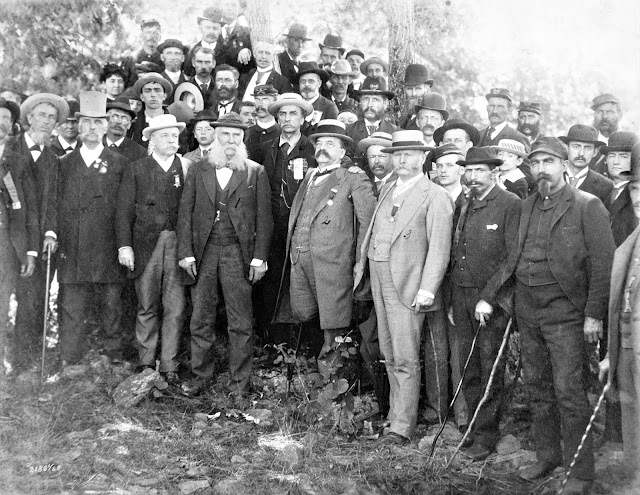
In an enlargement of the William Tipton image below, Civil War commanders (from left)
Joshua Chamberlain, Daniel Butterfield, James Longstreet and one-legged Dan Sickles pose in Gettysburg on July 3, 1888. Sickles lost his leg at Gettysburg on July 2, 1863.
Longstreet and his former Union adversaries in Gettysburg at the 1888 reunion.
(CLICK ON IMAGES TO ENLARGE.)
 
Like this blog on Facebook | Follow me on Twitter | My YouTube videos

A version of this feature story appeared in the January 2021 America's Civil War magazine.

For sheer star power, no gathering of Union and Confederate veterans rivaled the Grand Reunion at Gettysburg in 1888. "There are so many Generals and other chieftains here," a newspaper marveled, "that a catalogue of them would be as long as Homer's list of ships." 

Former Army of the Potomac commanders Dan Sickles, Fitz-John Porter, Joshua Lawrence Chamberlain, Henry Slocum, Abner Doubleday and Francis Barlow, among other Union luminaries, joined ex-Army of Northern Virginia generals Wade Hampton, Fitzhugh Lee and John B. Gordon in Pennsylvania. 

But the most celebrated man at the event sported massive, white whiskers and a cleanly shaven chin: James Longstreet, who commanded the Confederates’ First Corps at Gettysburg on July 1-3, 1863. Nearly everywhere Robert E. Lee’s “Old War Horse” went he drew appreciative, and often awestruck, crowds.

"No man now in Gettysburg," a New York newspaper wrote, “is more honored nor more sought than he."

For Longstreet, the visit to Gettysburg — his first since he commanded troops there — stirred a wide range of emotions: anxiety, joy, excitement, gratitude, pride and sadness. Here's how those remarkable days unfolded during the summer of 1888.

Veterans with family members at the dedication of the 121st Pennsylvania monument 
at Gettysburg on July 4, 1888 -- one of many such gatherings in late June and early July
that year on the battlefield. (William Tipton photo | 
CLICK ON IMAGE TO ENLARGE.)

‘The sentiment which attracts … is powerful’

By 1888, James Longstreet proved more popular with Northerners than with White Southerners. 

After the war, he aligned himself with Republicans, the party of Abraham Lincoln, and supported his friend and former military rival, Ulysses Grant, as president. “Ole Pete” also served in the Republican administration of President Rutherford Hayes, a Union veteran who missed fighting against Longstreet's soldiers at Antietam because of a wound suffered days earlier at South Mountain. Meanwhile, Longstreet received scathing rebukes from Lost Cause devotees for his criticism of Lee’s soldiering at Gettysburg and other perceived failings.

Longstreet, who lived in semi-retirement on his farm in Gainesville, Georgia, arrived in Pennsylvania on June 30. On the train ride to Gettysburg, he sat near Gen. Hiram Berdan, whose two regiments of sharpshooters slowed the Confederates’ advance at Devil’s Den and the Peach Orchard on the battle’s second day. The men eagerly discussed the fighting during their journey. 
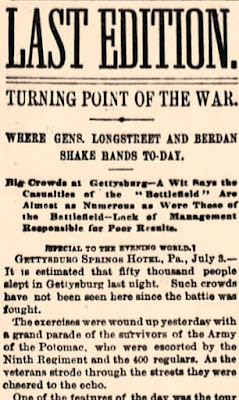
The press extensively covered
James Longstreet's visit to Gettysburg.
The 67-year-old general, who stood about 6-foot-2 and weighed more than 200 pounds, looked “enfeebled,” according to the New York Times. But another account called the broad-chested Longstreet  “vigorous” despite his age. 

In late June and the first days of July 1888, dozens of other trains packed with veterans unloaded at Gettysburg’s lone railroad depot for the Grand Reunion. “Most of the old soldiers went accompanied only by their memories,” according to an account, “but some took their wives and children with the intention of showing them the places in defense of which they fought so bravely.” 

Rooms in the town's few hotels became scarce, so organizers erected tents for veterans on East Cemetery Hill and elsewhere. At least 30,000 people — White veterans and civilians alike — attended each day of the three-day event organized by the Society of the Army of the Potomac, a Union veterans’ organization. One newspaper estimated attendance as high as 70,000 for a single day.

“Such crowds,” the New York Evening World wrote, “have not been seen here since the battle was fought.” (Black veterans did not officially serve in the Army of the Potomac as soldiers in 1863, and thus few, if any, African Americans are believed to have attended.) 

Unsurprisingly, the massive gathering — which included about 300 Confederate veterans — severely taxed resources in Gettysburg, population roughly 3,100. "The want of a head" in town, the Evening World reported, "has seriously interfered with the success of the reunion," while the New York Sun published a much more scathing Gettysburg critique: 
“The town is indeed a poor place for the accommodation of such crowds of visitors as come here. There is not a really good hotel in the village. … Carriages are needed to go from point to point, for the battlefield covers an area of twenty-five miles, and the people take full advantage of the crowds and gouge everyone who hires a buggy or a hack. The extortion is worse than that practiced by the St. Louis hotel people during the Democratic Convention. And yet, in spite of all these unpleasant things, the people come, for the sentiment which attracts is more powerful than the feeling of disgust created at the meanness of the people of the place." 
Despite less-than-ideal conditions, veterans — most in their early 50s — eagerly re-connected with former comrades. “The meeting of the survivors of the armies of Meade and Lee on the field of Gettysburg,” a Pennsylvania newspaper proclaimed, “is the greatest occasion of the kind known in our history, if not in the annals of nations.” 

Many veterans went souvenir-hunting for battle relics in fields and woodlots. Scores attended the dedication of more than two dozen battlefield monuments. At one of those events, a New Jersey veteran claimed he found in a rock crevice the cartridge box he had hidden during a retreat in July 1863. Two bullets remained in the bent and rusty relic, which he proudly took home. 

An 1880s view of Spangler's Spring, where some 
veterans partied at 1888 reunion. (William Tipton)


On East Cemetery Hill, four veterans of the Louisiana Tigers Brigade from New Orleans became the center of attention on ground where they made a desperate attack 25 years earlier. Pennsylvania veterans eagerly greeted the men, who wore blue, silk badges adorned with the letters “A.N.V.” for Army of Northern Virginia. 

“[S]uch a shaking of hands,” the New York Times reported, “was never before seen on East Cemetery Hill.”

In town, residents and others hawked everything from lemonade and badges to horse-and-buggy rides, available for from 50 cents to $2.50 an hour. At the Catholic church in Gettysburg, Irish Brigade veterans attended a special mass for the fallen in battle. Meanwhile, attendees enjoyed bands that played “Marching Through Georgia,” “John Brown’s Body” and “The Star-Spangled Banner." At night, electric lights mounted on a tall mast lit up Cemetery Hill, creating a dazzling scene. 

Many found time for carousing, too. At Spangler’s Spring, near Culp’s Hill, veterans partied hard after the reunion’s official end, drinking beer in “huge quantities.” 

Cordiality among the former enemies largely took precedence, although Union men groused that some Confederate veterans wore lapel pins adorned with a Rebel flag. “That was the flag of treason and rebellion in 1861,” Union Gen. John Gobin said in a speech, “and it is the flag of treason and rebellion in 1888.”

In a cropped enlargement of the William Tipton image below, Longstreet stands next to
 former Union general Henry W. Slocum. Who else do you recognize?
U.S. Army veterans and Longstreet on July 3, 1888. Dan Sickles, who lost a leg at Gettysburg,
stands next to Longstreet (right).  
(CLICK ON IMAGE TO ENLARGE.)

‘Old Pete’ and Sickles: ‘Friends in a moment’

Almost from the beginning, James Longstreet’s Gettysburg visit proved eventful and often surreal.

When word spread June 30 of Longstreet staying at the popular Katalysine Springs Hotel, about two miles from town, hundreds headed in that direction. But the general had already left for the dedication of Wisconsin Iron Brigade monuments in Herbst's Woods. There, “Old Pete” briefly met with Rufus Dawes, the Iron Brigade officer whose soldiers captured 200 Confederates nearby in the unfinished railroad cut west of town on July 1, 1863. 

“General,” Dawes said as he surveyed the area near the Chambersburg Pike, “it looks very different from the scene of 25 years ago.”

“Yes,” Longstreet said, “it reminds me of a camp meeting.”

Another U.S. Army veteran remarked to Longstreet that the battle might have ended quite differently had Confederate command listened to his advice. Then an attendee quizzed the general about Pickett’s Charge.

Were you really against it? the man wondered.

“Yes, sah,” Longstreet replied.

Asked if former Confederate Gen. Jubal Early — a high priest of the Lost Cause and a sharp critic of Longstreet — might attend the Grand Reunion, the general expressed his doubts. After all, the commander who ordered the sacking of nearby Chambersburg in 1864 probably would not have been well received on Pennsylvania soil.

Longstreet, though, rarely had a free moment at the reunion. Veterans of all stripes eagerly exchanged pleasantries and shook the hand of “Old Pete.” 

Later that day, Longstreet dined at his hotel with 68-year-old Daniel Sickles — the first meeting of the former enemies. As commander of the Third Corps at Gettysburg, the controversial Sickles lost his right leg to enemy artillery on the battle’s second day. 

“They were friends in a moment,” according to an account of their meeting, “and there was very little eaten at that table for 30 minutes as they talked about events a quarter century old.” While the old foes conversed, others in the room gawked and "let their dinner go almost untouched." 

40th New York veterans and two women in Devil's Den pose for a photo at a reunion
in Gettysburg, perhaps in 1888. (William Tipton | Library of Congress)


‘Something beyond description’ 

The pairing of Sickles, a cigar-smoking New Yorker, and Longstreet, a South Carolina-born part-time farmer, proved a hit. As a group of New York veterans marched through Gettysburg one morning, the two rode in a carriage behind them. 

"This was a meeting of blue and gray worth recording," a Philadelphia newspaper correspondent wrote, "and as they passed along the street that led to Seminary Hill and Seminary Ridge the enthusiasm of the crowd who recognized them was something beyond description."

With Sickles and other former Union bigwigs, Longstreet visited the notable battlefield sites — the Peach Orchard, Wheatfield, Devil's Den and Little Round Top, the “apple of Longstreet’s eye.” Little had changed, the general observed, since his soldiers' desperate assaults on the Round Tops on July 2, 1863, and, a day later, at the "Bloody Angle" during Pickett's Charge. While he toured the battlefield, Longstreet called the charge "a great mistake" and discussed strategy and tactics with former Union commanders.

When the general began a tour on horseback with former U.S. Army generals Daniel Butterfield, Berdan, and others, a large crowd gave the group three cheers. After they reached the summit of Little Round Top, word quickly traveled of Longstreet's presence. Union veterans gathered nearby for a monument dedication rushed toward their former adversary.

"Boys, here's Longstreet!" shouted the one-legged Sickles as he sat at the foot of a tree, "and he meets us once more on Round Top." Three rousing cheers from the crowd of about 100 "went surging through the shimmering air to the plain below." 

On July 1, Longstreet nearly broke down during a speech before an estimated 10,000 First Corps veterans in Reynolds Grove, near the monument to Union Gen. John Reynolds, who was killed on the first day of the battle. 

As he walked to the massive speakers' stand, Longstreet received a loud Rebel yell greeting, the Gettysburg Cornet Band played "Dixie" and veterans crowded around the commander. "General,” a one-legged Federal veteran told Longstreet, “I fought against you at Round Top. I lost a wing there, but I am proud to meet you here."

“Yes,” Longstreet replied as he grasped the man’s hand, “those were hot times then. But I’m all right now.” 

After Longstreet took his place on the stand, a former Federal officer shouted, "Comrades, you see on this platform one of the hardest hitters whoever fought against us. I propose we give three times three for General Longstreet, one of the best Union men now in the country!" 

The crowd erupted, surging toward the wooden stand and "showering God bless you's” on the teary-eyed general.

Moments later, though, the platform collapsed amid shrieks, falling two feet, but no one suffered a serious injury. Smiling, Longstreet bowed left and right. Then “Old Pete,” his voice shaking as he began his speech, told the veterans of his pride in commemorating the battle and of his eagnerness “to mingle with those brave men who know how to appreciate heroism which will give up life for country's sake." 

During his speech, Longstreet called the third day at Gettysburg the greatest battle ever fought. 

“But times have changed,” he said, according to the Times. “Twenty-five years have softened the usages of war. Those frowning heights have given over their savage tone, and our meetings for the exchange of blows and broken bones are left for more congenial days, for friendly greetings, and for covenants tranquil repose.

"The ladies are here to grace the serene occasion and quicken the sentiment that draws us nearer together,” he continued. “God bless them and help that they may dispel the delusions that come between the people and make the land as blithe as bride at the coming of the bridegroom.”

Longstreet appears in a cropped enlargement of the William Tipton image below.
In July 1888, Longstreet posed on horseback with Daniel Butterfield (on second horse from right),
 
George Meade's former chief of staff, near the summit of Little Round Top. The
 155th Pennsylvania monument appears in right background. BELOW: A present-day view.


'All were inspiring'

On July 2 at the national cemetery, the final resting place for more than 3,500 Federal soldiers, Longstreet shared the speaker’s rostrum with Sickles, Gordon, Barlow and other notables. Nearly 5,000 people crowded onto the hallowed ground where Abraham Lincoln had delivered the Gettysburg Address in November 1863. A New York Times reporter wrote about the remarkable scene:
"The actors were the very men who defended the ridge on whose slopes the cemetery lies against the repeated assaults led by the very men 25 years ago this very day who joined them here now in pledges of friendship, loyalty to a common flag and unity of devotion to a common country. All  place, scene, and the living figures of the men themselves  were inspiring."

A post-war photo of John Gordon,
who gave a speech at the
Gettysburg National Cemetery
at the 1888 reunion.
(The Cyclopaedia of American
biography)
Shortly after 5 p.m., Sickles gave a short speech.

“As Americans,” said the general, who became instrumental in preserving the battleground, “we may all claim a common share in the glories of this battlefield, memorable for so many brilliant feats of arms.” He later read a telegram from Pickett’s sickly widow, who offered “God’s blessing” to the throng. 

When Georgia governor John B. Gordon, a brigade commander at Gettysburg, received his introduction, a deafening roar greeted him.

“Hurrah!” and “Good!” the crowd shouted.

Longstreet spoke only a few sentences.

“I changed my suit of gray for a suit of blue so many years ago,” he said, further endearing himself to the Union vets, “that I have grown myself in my reconstructed suit of blue.”

At the dedication of the 95th Pennsylvania monument that day in the Wheatfield, though, the general’s actions spoke much louder than any words. Longstreet held the regiment’s tattered battle flag, pierced by 81 holes in fighting at Gettysburg, Antietam, Fredericksburg, Malvern Hill and elsewhere. 

Gently, James Longstreet pressed the flag to his lips … and wept.


Have something to add (or correct) in this post? E-mail me here.


SOURCES
  • Harrisburg (Pa.) Independent, July 2, 1888
  • Harrisburg (Pa.) Telegraph, July 5, 1888
  • New York Evening World, July 3, 1888
  • New York Sun, July 1, 1888
  • New York Times, July 2 and 3, 1888
  • New York Tribune, July 4, 1888
  • Philadelphia Inquirer, July 3, 1888
  • Philadelphia Times, July 3 and 5, 1888
  • The Times Picayune (New Orleans), July 3, 9 and 13, 1888