Sunday, January 07, 2007

History in our back yard


Here's another gravestone in the cemetery within sight of our new house. I think the design at the top is pretty neat. Joseph Hinman died in 1787. Amazingly, the writing on the face of the tombstone is still easy to read.

Saturday, January 06, 2007

Sad end of Private Austin D. Fuller

Austin Fuller was just 23 when he died in 1865. He served with the 16th Connecticut after enlisting in August 1862. Less than a month later, on Sept. 17, 1862, the 16th saw heavy action at the Battle of Antietam in Maryland, suffering 43 killed and 161 wounded. Austin was among the green Connecticut troops who ran into a buzzsaw: veteran Confederate troops under Lt. Gen. A.P. Hill (left below), who arrived on the field after a 12-mile march from Harpers Ferry, Va., and saved the day for Gen. Robert E. Lee.

Here's a map of the engagement from Brian Downey's excellent Antietam site and below is an account of what they faced there from the regiment history. A photo of the 16th Connecticut monument at Antietam is below.

"As the regiment entered the fated cornfield it was met
by a most terrific volley of musketry, and the slaughter was
appalling. Men fell by the score. That the regiment did
nobly, is the verdict of all who witnessed its heroism on the
battle-field. Its aggregate loss in killed, wounded, captured,
and missing, equaled that of any other Connecticut regiment
engaged."


Austin didn't meet his maker at Antietam, however. He became a prisoner of war in April 1864 at the Battle of Plymouth (N.C.), where Union forces, outnumbered about 5 to 1, were attacked by land and sea. Here's an account of the battle from the regiment history:

"Five times the enemy stormed the lines, and as many times were they handsomely repulsed, with great slaughter. The rebels raised the "black flag" against the negroes found in uniform, and mercilessly shot them down. Fort Pillow was re-enacted. The losses in the Sixteenth, including the captured, were four hundred and
thirty-six."


After the Battle of Plymouth, captured enlisted men such as Austin were shipped farther south, to Andersonville, the notorious Georgia POW camp. Prison camp conditions on both sides during the Civil War were terrible, and many died of disease. Austin probably was among them. He died on Jan. 8, 1865, and was buried in Avon, Conn. One can imagine the scene -- a cold, winter day, a blanket of snow on the ground and a grieving family weeping over his grave.

Meet Asahel Woodford

As I mentioned several days ago, there's an old cemetery within sight of our new house. It is unseasonably warm today -- temperature could reach 70 -- so I after my four-mile run, I stopped by the cemetery again today. I discovered four more markers for Civil War veterans, including one for Asahel Woodword. With a couple clicks on the HDS Civil War database, I was able to dig up information on Asahel. Here's what we know:

He resided in Farmington, Conn., and enlisted on Sept. 9, 1862, as a private. He was mustered in to the 25th Connecticut infantry Co. K on Nov. 11, 1862, and mustered out on Aug. 26, 1863.

Here's a brief history of the 25th, which served mostly in the South and saw battle in Louisiana.

"This is one of the best of our nine months regiments, and
bore a conspicuous part in the advance upon and campaign
preceding the fall of Port Hudson. By the bravery always
displayed on the field of battle and the patient endurance
manifested on many long and arduous marches, it has won for
itself a high and lasting reputation."

The Twenty-fifth was mustered into the United States
service November 11, 1862, and on the 14th sailed from Hartford
for Centerville, L. I., to join at that rendezvous the Banks
Expedition. The muster-roll showed 811 men, thoroughly drilled
and well appointed, except that they were without rifles, which
were served to them on the ship after their arrival in the
Mississippi River.

The regiment embarked November 29, 1862, in two divisions-
one division of five companies, under command of Colonel
Bissell, on the steamer "Mary Boardman"; and the remainder,
under command of Lieutenant-Colonel Stevens, on the steamboat
"Che Kiang." The destination of the expedition was unknown
when the vessels sailed, and the sealed orders were not to be
opened till the ships had sailed twenty-four hours to the
southward and eastward. The orders, when opened, were found to
be simply to report at Ship Island, off the mouth of the
Mississippi River, allowing a call at Dry Tortugas for coal, if
necessary. The ships duly arrived at Ship Island, and
proceeded at once up the river to New Orleans, where they
arrived on the 14th of December. On the 16th the "Mary
Boardman," with several of the other ships, went on to Baton
Rouge, where they arrived the next day. The "Che Kiang" landed
the left wing of the regiment at Camp Parapet, just above New
Orleans. Thus the command was unfortunately divided. I say
"unfortunately," for the discipline and experience of the
separate and separated wings not being alike, made it difficult
when they finally came together, weeks after, to bring them
into harmony and full efficiency."


The 25th fought in these engagements, although Asahel apparently mustered out by then, perhaps to be with his family back in Connecticut:

Irish Bend, La., April 14, 1863.
Port Hudson, La., May 25 and 26, 1863.
Port Hudson, La., June 14 and 15, 1863.
Brashear City, La., June 23, 1863.
Bayou Boeuf, La., June 24, 1863.

Monday, January 01, 2007

Jackie Kennedy slept here

On my way home this afternoon, I stopped at the famous Miss Porter's School, an all-girls boarding school in Farmington, Conn. Jacqueline Bouvier graduated from Miss Porter's in 1947, before she married John F. Kennedy and later became First Lady.
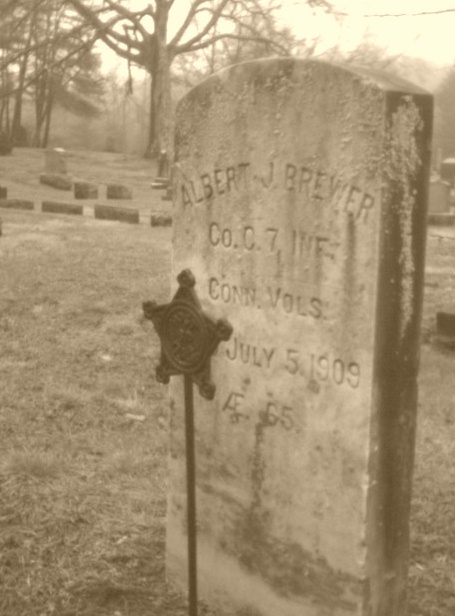
Grave of a Civil War soldier

I like checking out old graveyards, and there's no shortage of them here in Connecticut. At an old cemetery near our new house in Avon, I discovered the graves of several Civil War veterans, including this one for Albert J. Brewer, who served with the 7th Connecticut Volunteers. I took this shot using the sepia feature on my camera phone.

Brewer, a private, enlisted on Aug. 29. 1862, and served through the end of the war. He was discharged on June 26, 1865. The 7th Connecticut saw a lot of action in South Carolina, according to these records I found on Historical Data Systems Civil War database.

The Seventh Regiment Connecticut Volunteers was organized
at New Haven in August, 1861, under the first call for three
years men, and contained a large percentage of the lately
discharged three months volunteers. Their previous experience,
drill, and discipline so ably seconded the zeal of the officers
that the regiment was soon reported ready for active service.
Alfred H. Terry of New Haven, late Colonel of the Second
Regiment, was commissioned Colonel, with Joseph R. Hawley of
Hartford, late Captain of "Rifle Company A," of the First
Regiment, as Lieutenant-Colonel, and George F. Gardiner of New
Haven, as Major.


Brewer participated in the following engagements:

Fort Pulaski, Ga., April 10-11, 1862.
James Island, S. C., June 16, 1862.
Pocotaligo, S. C., Oct. 22, 1862.
Morris Island, S. C., July 10, 1863.
Fort Wagner, S. C., July 11, 1863.
Fort Wagner, S. C., July to October, 1863.
Olustee, Fla., Feb. 24, 1864.
Chester Station, Va., May 10, 1864.
Bermuda Hundred, Va., May 10-17, 1864.
Bermuda Hundred, Va., June 2, 1864.
Bermuda Hundred, Va., June 17, 1864.
Deep Bottom, Va., Aug. 14-15, 1864.
Deep Run, Va., Aug. 16-18, 1864.
Chapin's Farm, Va., Sep. 29, 1864.
Near Richmond, Va., Oct. 1, 1864.
Newmarket Road, Va., Oct. 7, 1864.
Darbytown Road, Va., Oct. 13, 1864.
Charles City Road, Va., Oct. 27, 1864.
Fort Fisher, N. C., Jan. 15-19, 1865.


Here are the earthworks at Bermuda Hundred.